Ottawa’s music scene: ch-ch-changing

Is live music disappearing from Ottawa nightlife? If so, the PepTides didn’t get the memo: Business is booming for the eccentric Ottawa pop group.
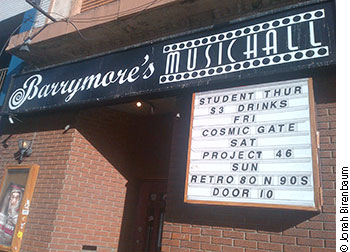

Barrymore’s once hosted bands as big as U2. Now weekends are dominated by electronic acts like Cosmic Gate and Project 46.

“We’re still doing well,” says singer and multi-instrumentalist Claude Marquis, whose band has pervaded the local circuit, playing Irene’s Pub, Ritual, and the Black Sheep Inn two times apiece since January 2012. “We keep getting asked to play. Wherever we end up playing, they sort of respond, ‘We got to have you back.’ ”

But despite the busy schedule of certain Ottawa bands, rumours of the live scene’s gradual demise here have gained considerable traction recently.

Over the past 12 months, two of Ottawa’s more prominent live music venues – Tucson’s and LiVE Lounge – have closed their doors. A recent ownership change at The Elmdale has threatened live music’s future at the Hintonburg hotspot. And Barrymore’s, Ottawa’s iconic rock sanctuary, has embraced the economic allure of top-40 and electronica, distancing itself from its own live music roots. This leaves but a small group of local institutions – the most prominent being Zaphod Beedlebrox, Ritual, Babylon, and Mavericks – as the city’s remaining bastions of live music. In light of the foreboding signs, there’s a discernible ambivalence among Ottawa’s purveyors of live music as to the health of the scene.

A scene in flux

“There’s lots of clubs that are still doing live music that are still doing great,” says Adam Kronick, owner and operator of Bank Street’s Babylon nightclub. “It’s hard to generalize about the whole industry of live music in the city based on a select few wanting, for whatever reasons, to make a change.”

Babylon’s proverbial king since the club’s inception in May of 1998, Kronick was quick to dispel any notion of live music going extinct in Ottawa. Despite his protestations, however, Babylon has amended its own live music mandate in recent years, incorporating more electronica and DJ performances to keep up with music’s transient trends.

“We’re keenly aware that we need to be evolving and responding to new aspects in the market,” he says. “To be still successful after a number of years, you need to evolve your business model. We’re still evolving our business model all the time.”

‘You get DJs booked constantly now. Hopefully it’s not the death of the scene in Ottawa. But it’s definitely changing.’
– Blake Brooks, pub manager

However, Kronick refuses to suggest that ever-evolving musical trends portend the end of live music in the city. “I think it’s really hard to to say from a few examples that live music isn’t going well in Ottawa. I think it’s exactly the opposite,” he says.

Blake Brooks, manager of Oliver’s Pub and Patio, doesn’t share Kronick’s optimism. He says new musical tastes represent a threat to the live scene.

“You get DJs booked constantly now; that’s what younger people are listening to,” he says.  “Hopefully it’s not the death of the scene in Ottawa. But it’s definitely changing.”

Brooks fondly recalls his formative years as a Carleton student, when up-and-coming Canadian rock bands would frequent Oliver’s pub, and boisterous crowds would gleefully croon along. These days, however, Oliver’s seldom hosts events featuring live music, and when they do, it’s certainly not marquee acts that are performing.

While renovations have played a large role in the evolution of Oliver’s – the current floor plan isn’t entirely conducive to live music – Brooks says the change has more to do with economics than anything else. “I like it when we do stuff here,” Brooks says of hosting live music, “but we just don’t do it enough, I guess.  It’s a money thing more than anything, probably.”
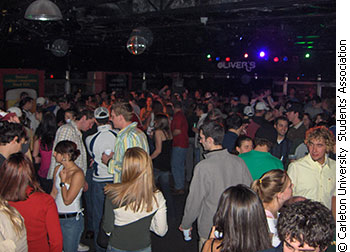

Thirsty Thursdays, a weekly staple at Oliver’s, features DJ performances and routinely draws large crowds.

‘Live’ not dead yet

Though the musical zeitgeist might dictate that electronica is the style du jour, Kronick points to Ottawa’s hugely popular music festivals as an indication of the local appetite for live acts.

Attendance at Ottawa’s Bluesfest – lauded as the second largest blues festival in North America – has grown exponentially since 1994, when the event became an annual staple. More than 300,000 people attended Bluesfest 2012, a 12-day musical binge highlighted by performances by Alice Cooper, Our Lady Peace and Snoop Dogg.

“There’s obviously fans that want to go see music,” says Kyla Clarke, a concert promoter who’s routinely blown away by the Bluesfest crowds.  “Why don’t they do it all the time?”

Clarke, who works for the popular Ottawa rock station 106.9 the Bear, says that contrary to popular belief, the infrastructure for a vibrant live music scene still exists in the nation’s capital; she cites the emergence of groups like the Balconies and the Love Machine as testaments to the wealth of local talent. However, it’s become increasingly difficult to get people to show up to see lesser known bands at more obscure venues, she adds.

“I think there’s probably a lack of promotion going on across the city,” says Clarke. “I think people have this idea that like, ‘Oh, no one is going to go, so I’m not going to go.’ ”

And indeed, this perception has compelled club owners to place a greater emphasis on DJ performances. Yet even though electronica has impinged aggressively on live music venues in recent years, some musicians don’t seem to mind. Marquis, whose band performed on Bluesfest’s main stage in 2012, says the two styles can coexist harmoniously.

“There’ll always be a place for both, I believe – for the DJ aspect and for live bands,” Marquis says. “I don’t think it should be a competition. There’s a place for every different kind of art form.”

In fact, Bluesfest 2012 featured an unprecedented number of electronic acts, including performances from MSTRKRFT and Skrillex. But according to Mike Rouleau, Bluesfest’s director of operations, the festival’s identity remains intact.
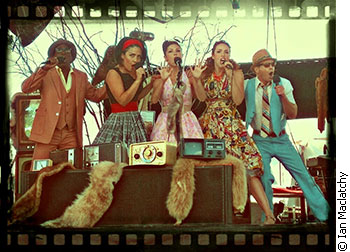

The retro PepTides, very much live onstage at Bluesfest 2012.

“The vast majority of the festival is still driven by bands and live music and live performances,” says Rouleau, who adds that electronic acts claimed the main stage headlining slot on just two of the festival’s 12 nights.

Meanwhile, the PepTides’ schedule remains full. Admittedly, they don’t play as often as they could, but that’s for fear of exhausting their repertoire.

“We sort of have to refuse some of them,” says Marquis, whose band has sojourned to places like Mississauga, Ont., and Fredericton, NB., in recent months to tap into different markets.  “We can’t tire out our audience by performing every weekend.”

But while the PepTides have yet to feel the blowback of Ottawa’s evolving music scene, the consensus remains that the times are a-changing.

“I’ve seen some of those DJs at those venues, and they’re packed,” says Oliver’s Brooks. “People are going to see something, but maybe it’s changed so much.”
Barrymore’s: dead and walking?

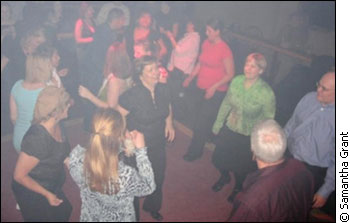
The Barrymore's middle aged clientele bopping to 80s music on a Sunday night.
Grey power: The dance floor on an ’80s-request Sunday night.

Tipsy twenty-somethings, decked out in Wayfarer sunglasses, fanny packs, neon nylon windbreakers and fishnet stockings, bop to all-request ’80s music atop a stage. Middle-aged Ottawans sway side-to-side or bop equally, to music they’ve requested, from what may be the decade to which their twenties belonged. This is Barrymore’s Music Hall and its clientele on a Sunday night, better known as ’80s Night.

To those swaying side-to-side, I pose a question: Do you happen to be reminiscing about the good old days at Barrymore’s? Though it now draws a crowd only on Sundays, Barrymore’s at its height did not need a nostalgia night to attract people.

Opened as a disco in 1977, Barrymore’s quickly transitioned and was a rock ’n’ roll club by 1979. Throughout the ’80s, Barrymore’s was known as Ottawa’s answer to New York’s Studio 54 and was host to such legendary acts as U2, B.B. King, R.E.M., James Brown, Tina Turner and the Tragically Hip.

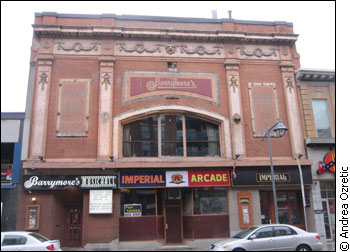
Today Barrymore’s faces all the challenges of a modern nightclub, but is also regarded as an important space that holds many memories for people in Ottawa. Yet despite such strong public sentiments, Barrymore’s has consistently been unable to recapture its 1980s buzz. Even the building—an architectural marvel nearly a century old, formally known as the Imperial Theatre—now shows a weathered façade, deemed an eyesore by many.

The run down Barrymore's exterior.
The Barrymore’s Bank Street exterior embodies faded glory.

The venue has undergone several ownership changes since 1991. Owners have included Eugene Haslam (the man behind Ottawa dance club Zaphod Beeblebrox) and then Randy Lanctot. During the ’90s Barrymore’s still had big-name acts like Radiohead, Bo Diddley and The Commitments. The venue was also used for CD release parties.  Allan Wigney, a journalist currently working on a book about the music scene in Ottawa, says that Lucinda Williams’s performance at Barrymore’s in 1998 was the last big act he recalls there. During the late ’90s and early 2000s, there were local bands with original music performing, but eventually it became more and more cover bands.  Wigney attributes the decline of original music at Barrymore’s to Haslam’s departure in 1999.

The most recent change happened when Montreal-based club owner Vince Simeone purchased Barrymore’s from Randy Lanctot in August 2008. Business at Barrymore’s hasn’t been bustling, and opinions of its latest owner have been lacklustre.

“Without a visionary kind of ownership, it lost its way. New owners who are from out of town, they have tried to put into place the tried-and-true ‘We’ll put in the formula disco night or themed disco night,’ ” says Denis Armstrong, Ottawa Sun entertainment columnist.

“You have a lot of very interesting people who live in Ottawa, a lot of creative and dynamic people, but the city needs to have places where these people can collect and socialize,” Armstrong adds.

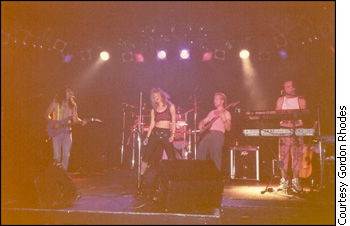
Gord Rhodes ran the club from 1978 to 1991 together with his wife, Sherry Rhodes, and her father, Sonny Thomson. Gord is primarily attributed for bringing in the acts.

“I just told them, ‘You’re playing Montreal one night, and two nights later you’re playing Toronto, and you got all these other days off. Why waste your time? Come and do two shows in one night,’” said Gord.

People performing in the 80s on stage at Barrymore's.
The scene in the good old days.

Sherry Rhodes says they had a great team in the office. Bob Jones came in during the later years as the promotions manager. Sherry describes Jones as having “a pure white Mohawk with pure white extensions that went down to his waist.”

“We had three generations of music between us.” Says Sherry, “ Gord was the ’50s and ’60s: he’s a few years older than me. I was the ’70s, and Bob was the ’80s and ’90s.”

She describes her dad, Sonny Thomson, as the night keeper, there to make sure everything ran smoothly. He once saved Canadian legend (and Guess Who veteran) Burton Cummings from being attacked onstage. Cummings signed an autograph for Thomson that night: “Dear Sonny, thanks for keeping me out of the hospital.”

Despite the acts and the crowds that Barrymore’s was able to bring in, the business still had its challenges. “We didn’t have a lot of capital. We would lose money, win on others. We took some big losses; we were never in a really comfortable position,” said Sherry.

‘Without a visionary kind of ownership, it lost its way.’
– Denis Armstrong

Gord says that larger organizations like the NCC and the Jazz and Blues Festivals had larger backings that made it hard for him to compete. He says that he would break the acts into Ottawa’s scene and lose money doing it, and when it was time to bring them in again and make a profit, the festivals would offer the acts big money to play at a free outdoor concert.

“It’s not a fair business at all; I was very fortunate to be able to do as good as I did,” said Gord.

“If I had the chance I would take it [Barrymore’s] back because I think my husband, Gord, was the perfect promoter,” said Sherry Rhodes.

A different nightlife

Armstrong describes an Ottawa nightlife that has changed dramatically since the 1980s. He sees ’80s Night at Barrymore’s as a diluted version of the past.

“It’s sort of like the zombie version, because they were dangerous times, risky times, sexually, socially. There was a lot going on—people having sex in the bathroom, people doing coke on the dance floor—and now we don’t even allow smoking in the clubs,” he said.

Gord says the introduction of stricter drinking and driving laws was a detriment to his business: “It wouldn’t work now. Drinking and driving laws, television’s too good, there’s just too much going on.”

Many echo the idea of by-laws as being detrimental to Barrymore’s.  Says Armstrong, “You know, people would go to these places to have fun, relax, let their hair down. They don’t want to do it while policemen are hanging over their shoulder, breathing down their neck.”

George Syriannas is a relative of Simeone, and the manager at Barrymore’s. He admits that it has been a challenge for reasons including the by-laws.

“The problem is Barrymore’s can fit 1,000, but the city of Ottawa stepped in here with the by-laws and all these other things over the years, and they said, ‘Stairs, exit this, that, and capacity 420 that’s it, that’s all.’ ” says George Syriannas.

‘People in Ottawa like to complain, but then they don’t man up.’ – George Syriannas

As a result of the lower capacity levels, he says that Live Nation, the company that promotes and book bands at venues, will not book them at Barrymore’s, turning instead to bigger locations.  Without the ability to bring in bigger names, Barrymore’s is struggling to attract a crowd.

Also, Syriannas says, people want to see live bands playing their own music at Barrymore’s, but financially Barrymore’s does not benefit from this format. “There are smaller bands and smaller promoters that want to book Barrymore’s, but again it comes down to money. They don’t want to give us any money from the cover.”

Forfeiting cover would not be such a problem if people were spending more at the bar. However, that is not the case, as Syriannas explains.

“Best-case scenario is we put 360 people in here. The average person will spend $10; when you do the math, we sold $3,600 in those two or three hours. Out of that take taxes; take out $1,000 that I need for my staff; take then my cost, and I’m down to nothing.”

Syriannas says the only alternative Barrymore’s can afford is booking cover bands, a popular and successful format used in Byward Market venues. But even this has been a challenge.

He explains that the previous Saturday they widely advertised that Barrymore’s would have a cover band, and that there would be no charge to get in. Fewer than one hundred people showed up.

“People in Ottawa like to complain, but then they don’t man up,” adds Syriannas.

All this contrasts with Barrymore’s in its ’80s heyday. Gord recalls it was not easy back then, either, but they found a way to make it work.

“It was very, very difficult to do it,” says Gord, “getting people to come out and see shows. You know February the 27th; it’s 40 below; we’d have eight or nine hundred people there. It was very amazing. But if you wanted to see the act, you had to come out.”