The new concert tour—performed out of fans’ homes

To make money today, musicians need to perform on tour, and tours can get pricey. Once a musician or band has paid for travel, hotel rooms, meals, and rented venues, tours can leave them bankrupt. Especially when playing in small spaces with small audiences, they may find the cost not be worth the reward.

There is an alternative. House concerts, which have gained ground over the last 20 years or so, give artists more control of their tours and let them keep more profit from their labours. This type of concert gives artists a place to play and stay, saving them large sums and earning them more because they don’t pay a percentage to the venue.

For up-and-coming folk music artists, this alternative is one of the only ways to survive. Pubs and coffeeshops typically have too loud an environment for their style of music—which could however thrive in a more intimate setting like a home. Musicians need look no further than their fans’ living rooms for the perfect stage.

How house concerts work

Jacob Moon, a folk artist from Hamilton, Ontario, has been a professional musician for 20 years, and has done house concerts for the last 15. He says the setting can be intimidating, but also powerful.

“A miracle happens when you can turn that group of unassociated people into a group that is related to one another through the musical experience that they just had,” says Jacob Moon, here performing in Hugh’s Room, a folk music venue in Toronto, Ontario. [Photo taken by Andy Wright]
Jacob Moon performing in Hugh’s Room, a folk music venue in Toronto. [Photo © Andy Wright]
“A miracle happens when you can turn that group of unassociated people into a group that is related to one another through the musical experience that they just had. It sort of binds them together.”

House concerts are almost always acoustic, small or solo acts. Tickets range between $10 and $25, and all revenue goes to the performer. Typically, the host provides dinner to the artist, and a bed for the night, which beats paying for a hotel.

Moon says he invites fans across Canada to organize concerts for him. He says it’s a great way to create a dedicated fan group, and that to survive as an artist today, you need to take any and all venues you find.

Folk singer Fran Snyder knows this well. Snyder is the founder of concertsinyourhome.com, a website helping artists plan house concerts worldwide, though it’s most popular in North America. Snyder says that, through house concerts, he wants to change how people listen to music, and that this inspired him to found the website.

Musicians need look no further than their fans’ living rooms for the perfect stage.

“I think it’s important that we try to encourage more people to discover that they can actually enjoy sitting with their mouths shut listening to music, instead of talking through a performance,” says Snyder.

The website provides information to potential hosts, and for a membership fee helps artists to connect with those hosts and book house concerts.

Snyder says house concerts are becoming more popular because artists are recognizing they can make money on weekdays when they’d normally be staying in a hotel, waiting for their weekend gig. As well, Snyder says house concerts give a venue for emerging singer-songwriters, to play original music when public venues look mainly for cover artists.

Snyder is writing a book, House Concerts and Modern Touring for Small Acts, to help inform artists and hosts who want to be involved.  He says, “They’re so vital to the development of new talent, that we don’t want house concerts to get compromised by people who don’t understand what they’re doing.”

A house concert set up in Lawrence, Kansas.  [Photo taken by Fran Snyder]
Intimate and elegant. A house concert set up in Lawrence, Kansas. [Photo © Fran Snyder]
In the book, Snyder explains his 10-10 concept of 10 songs and 10 guests, for $10. He says this system encourages fans to organize a show because it’s not as intimidating as bringing together a large audience.

Snyder says hosts should advertise concerts by word of mouth or direct emails, to control the number of guests by having them RSVP to tell the artist how many to expect. Because selling alcohol without a permit is illegal, Snyder’s guide says guests can bring their own liquor, but only if the host is comfortable with the liability risks.

A boon to fans and artist both

Nicole Colbeck, the host of Westboro House Concerts in Ottawa, makes a living as a manager for house concert artists on tour. She says she’s had more clients lately because of a lack of venues for emerging artists who tell a story through their music, especially an original story.

In Ottawa, Colbeck says, only a few spaces are suited to solo or acoustic acts, and some of those are too large for a newer artist to fill, such as Centrepointe Theatres, Fourth Stage at the National Arts Centre, and the Great Canadian Theatre Company.

“There’s a real thirst for house concert hosts on the part of artists. Artists are really looking for quality venues where people will come and sit,” and ultimately listen well, says Colbeck.

House concerts benefit lesser-known artists because audiences trust the host’s choice: they’ll come no matter who’s playing.

Colbeck hosts about two concerts a year.  She says house concerts work for lesser-known artists because guests trust the host’s choice. In a traditional concert venue, people may come only if they recognize the artist, but in a house concert, if they know the host has good taste in music, they’ll come no matter who’s playing.

Kathy Jarrell got into attending house concerts in Calgary six years ago. She says she loves the intimacy of it, and has a good experience each time she goes.

“I just trust the people who are hosting, that they’re putting on a show for someone who’s deserving of being listened to. And it has me stretch my usual music repertoire, and that’s great,” she says.

Folk singer Joe Cousineau, performing in June 2011 at Westboro House Concerts, held in Nicole Colbeck’s house in Ottawa.  [Photo courtesy of N. Colbeck]
Folk singer Joe Cousineau performs at Nicole Colbeck’s home in Ottawa for Westboro House Concerts, June 2011. [Photo courtesy of N. Colbeck]
Roch Parisien, a music journalist, and founder of Rocon Communications, says the real problem with traditional venues may not be venues or the people hiring.

“There may be more opportunities to play now than there ever used to be,” says Parisien about all types of performance venues, house concerts, traditional, and online, “but there are more people trying to take advantage of those opportunities.”

Parisien says online music sharing sites have made it easy for anyone to be a musician. He says house concerts are good because hosts act as gatekeepers in the music business, by filtering artist applications. Snyder says this guarantees a performer whom at least the host believes in.

Organizing the movement

The house concert landscape is changing because what used to be only privately organized has become more formalized. Home Routes is a not-for-profit organization involved in that process. Founded in 2007, it organizes exclusively house concert tours throughout Canada.

The group was founded by musicians who saw the difficulties artists face trying to make a living touring in Canada, says Selena Bewsky, program coordinator and operations manager at Home Routes. She says house concerts weren’t always so well known a venue.

“We’ve definitely brought the idea out there, and it’s become more popular as a result,” Bewsky say.

Home Routes tours are scheduled over a two-week period, with the artist performing somewhere new every night, other than two nights off. This increases the profitability of tours, according to Bewsky. Home Routes provides the musician with maps, contacts and, she says, anything else needed to make the tour a success.

Artists pay a membership fee to Home Routes, which registers them with SOCAN, the Society of Composers, Authors and Music Publishers of Canada. Through SOCAN, artists get money back whenever they perform their original music live.

As house concerts become more popular, SOCAN is continuing to raise awareness with hosts about licensing, and how it can benefit the artist and support the art form.

An artist plays in a corner of a bar. The room is loud and busy. Now the scene shifts. The chairs are turned one direction and the room is stripped of everything but chairs and a few family photos. All eyes are on the performer, and the show begins.

[Front page photo courtesy of Jacob Moon]

Putting zines back on the scene

Zines come in a variety of sizes, colours and designs, but they all come from the same place: the photocopier. [Photo © Rachel Gilmore]
Write down an idea. Use as many expletives as you like. Or don’t. Maybe try something thoughtful, emotional, intimate. Cut-and-paste cat heads onto human figures from magazines. Or, hand-draw your deepest, darkest thoughts. No matter how you do it, you’ll find yourself at the photocopier, ready to share your work. This is how you make a zine.

A zine (rhymes with “green”), an abbreviation of “magazine,” is a form of self- or collaborative publication. Zines are printed in small circulation and vary in topic. They can be anything from queer, feminist essays to love letters to musicians, and everything between. Born from the anarchist and punk culture of the late ’70s and early ’80s, zine culture in Ottawa seemed to have all but disappeared in recent years. But in true do-it-yourself fashion, one passionate zine creator resuscitated the culture in her backyard.

Max Critical discovered zines when she was 15. For the next year, she tried her hand at making her own, before stopping for seven years. This changed two years ago when she found a solution for her own zine impulses—the Ottawa Zine Off. Critical co-founded the event, which encourages local writers and artists to develop zines, in old-fashioned hard copy, to exchange with the rest of the community. By asking friends to work their creative juices, she said, the event became a sort of communal deadline.

“Everyone was asked to make something and come together to show each other the finished product,” Critical said. “It worked well. A lot of people made zines.”

This promotion of community has brought many Ottawans together to share their work in zine format. After its first incarnation, Critical moved the event from her backyard to Pressed, a local café, to accommodate larger numbers.

New wine in an old bottle

Enough to go around: Ottawa Zine-Off co-organizer JM Francheteau (standing) exchanges his zine S.O.P. with a few zinesters.
Fair trade. At Ottawa’s Zine-Off, co-organizer JM Francheteau (standing) exchanges his zine S.O.P. for other zinesters’ work. [Photo © Fraser Tripp]
The November Zine Off had the most attendants co-organizer JM Francheteau said he had ever seen at the event; he estimated a crowd of over 50. A number of the zines were akin to early publications, like Cometbus or Maximumrocknroll of the punk era, but elsewhere the content diverted from the classics and was strongly 21st century. Participants exchanged their work for any of the other dozens items available that evening, including, but not limited to, zines about grunge-rocker Mac Demarco, an art zine of Kanye West in various outfits and a collection of Francheteau’s own poetry under the title S.O.P., or some. old. poems.

In just two years, the culture has matured considerably, according to Michelle Duquette, a zine enthusiast who moved to Ottawa from Toronto to pursue her undergrad in literature. She said that larger cities like Toronto have well established zine cultures, with independent book stands and libraries, but that it’s rare to see events there like the Zine Off.

She said the original community, formed from a group of friends, had changed: “We were all colleagues, and people were connected. And now it’s literally a forum for anyone. There’s a lot of new faces; there’s lots of variety in age and discipline.”

Francheteau agrees: “We’ve seen a real explosion in terms of the number of people who show up for the events and the number of people who are doing zines locally. We’ve gotten a lot more people to come out of the house and maybe try something they wouldn’t have done otherwise.”

‘People were making zines. But without any forum for people to trade and talk, they didn’t find each other.’ – Lily Pepper, zine rack curator

He said the November Zine Off showed substantial turnover from prior events: “I didn’t recognize a lot of the people here. More people are becoming interested in it, or at least different ones are becoming interested in it.”

Francheteau said he thinks a lot of this turnover comes from word-of-mouth advertising, at least for the younger high school crowd that is beginning to take an interest.

“I suspect there’s likely turnover of older people as well; some lose interest maybe, or no longer require the stimulus the Zine-Off provides to encourage their work.”

This participant fluctuation in a city like Ottawa has a strong effect on its zine scene, said Alison Lang, editor-in-chief of Broken Pencil, a Toronto-based magazine about zine culture. Having lived in Halifax, Lang explained that certain cities where people grew up or went to school begin to feel small, resulting in an exodus of young people to cities like Toronto or Vancouver. She said people then notice a lack of community feeling in these larger cities and might return to smaller, tight-knit places like Ottawa—thus invigorating the local culture.

“Even if people grow out of zines, even if they think they grow out of their small towns, that part of them that was a self-starter that made zines, I feel is always there,”she explained. “Once you embark on that sort of journey, it’s always kind of within you, and you always have an interest with it.”

Emerging into view

Ottawa’s zine scene was bolstered by one such self-starter in Lily Pepper, who moved from Montreal to Ottawa two years ago. According to Pepper, the Ottawa scene has traditionally worked underground; however, Pepper said,  zinesters never disappeared here.

“I think that people probably were making zines. But without any sort of a forum for people to trade and talk, they didn’t find each other.”

Shortly after arriving, Pepper began curating zine racks at Pressed and local record store Gabba Hey. These racks create a regular spotlight for local zinesters and zines that, Pepper thinks, will bring attention to the movement.

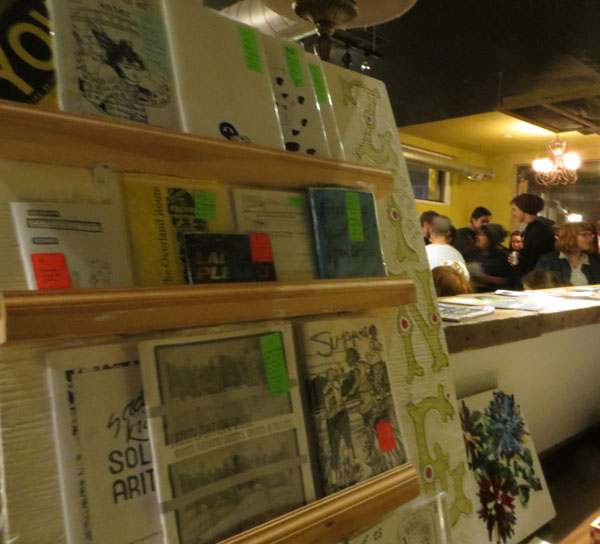
One stop shopping: The zine rack at Pressed carries a varied selection of local zines on sale for three to five dollars. [Photo © Fraser Tripp]
Local produce: The zine rack at Ottawa’s Pressed café offers work for sale for $3 to $5.
[Photo © Fraser Tripp]
Meanwhile, Pepper has produced YOW! Ottawa Writers Write About Ottawa, a compilation of reviews and intimate impressions of the city. To create YOW!, Pepper recruited some close friends, many of whom had never worked with zines.

Groups of new zinestars, like Pepper’s friends, are part of what is keeping the culture alive, according to Lang. She said the culture is infused with a new generation of younger people who aren’t well acquainted with classic, punk publications like Maximumrocknroll but who nevertheless have something to say.

A familiarity with zines, past or present, is not required: You don’t need to know anyone in order to join in, Pepper explained. And with such an open and growing community, you don’t even need to produce a zine to participate.  But, as all the Zine Off posters say, “wouldn’t it be cool if you did?”

[Front page art courtesy of Alanna Yaraskavitch]

Strong is the new Skinny: female bodybuilding’s dynamic rise

Cassandra Minors is competing in her first bodybuilding competition. Before hitting the stage at the Ontario Physique Association’s Ottawa Championships—sponsored by health-products giant GNC and held at Algonguin College on Nov. 1, 2014—Cassandra is wandering the theatre’s crowded lobby, chatting with fellow bodybuilding competitors and stopping to check out a few of the fitness-themed merchant booths. The lobby is abuzz with excitement, and filled with both spectators and competitors alike. The female competitors are distinguishable by their sprayed-on russet tans, carefully applied stage makeup, and manicured nails, but, surprisingly, not by their physical size.

Sporting her own deep, fake tan, a smiling Minors is covering her sparkly purple bikini with a black satin bathrobe, blazoned on the back with rhinestones spelling out “Beauty & Beast”. While displaying an impressively defined and muscular physique, Minors doesn’t exactly fit the stereotypically bulky, pumped-up physiques that may come associated with bodybuilding.

Well toned Figure competitor Cassandra Minors at the Ottawa competition in November. [Photo courtesy of Cassandra Minors]
Bodybuilding wasn’t always on Minors’s radar: She has Instagram to thank for kick-starting her fitness journey. In late 2013, Minors noticed an acquaintance frequently posting about fitness and dieting on the popular photo-sharing app. “I messaged her on Instagram one day and asked, ‘Can I come to the gym with you?’” Minors recalls. After months of shared training, that acquaintance convinced Minors to start preparing for the November competition.

Minors’s experience exemplifies two trends prominent within the female bodybuilding industry today: the inclusion of more competition categories that cater to women with less-muscular physiques than traditional female bodybuilders, and the power of social media to promote this sport and lifestyle. Together, these two factors can be credited with fuelling the explosive rise in popularity that female-bodybuilding contests have experienced over the past decade.

Bikini madness

The International Federation of Bodybuilding and Fitness (IFBB) is the sport’s largest governing body. As one IFBB article stated, “Bodybuilding history accelerates quickly from the beginning of this year: every next event breaks the record of participation!” The 2014 European Championships is cited as just one record-breaking example, with 783 competitors participating. The Bikini division proved the most popular: 189 women out of the 394 females competing did so in the Bikini division.

Bikini is the most recent example of a new category that contradicts the stereotypical image of bulky, masculine women competing in the Bodybuilding division. In 2002, the IFBB implemented the Figure, or “Body-fitness,” division for women who wanted to build less muscle mass and maintain a more feminine silhouette. The IFBB took one step further in 2011 with the addition of the Bikini division, which requires women to build significantly less muscle mass and, according to the IFBB, calls for its competitors’ appearances to be “similar to that of models.”

 ‘It’s like a beauty pageant with muscles.’ – competitor Cassandra Minors

Meanwhile, the competition organization World Beauty Fitness & Fashion (WBFF) uses different names to categorize its female divisions: Diva Figure Model, Diva Fitness Model and Diva Bikini Model. And it’s strayed even farther from the steroid-enhanced stereotype by adding a new division for 2015, called Commercial Model.

These divisions have one other common factor distinguishing them from the original stereotype: Women aren’t judged solely on their muscle size, but on their hair, makeup, stage presence, symmetry and femininity, as well. “It’s like a beauty pageant with muscles,” explains Minors.

The traditional female bodybuilding division “is slowly phasing out,” explains IFBB Pro Natalie Waples. Ottawa-based Waples is an IFBB professional athlete in both the Figure and Bikini divisions. She competes at an international level, against other pros, since earning her pro status card at the 2008 IFBB North American Figure Championships. She says these new divisions were added because they “appeal to a more attainable and marketable physique.”

IFBB Pro Natalie Waples (Second from right) poses with her fellow competitors after placing third in a 2011 contest. Photo ©Ron Avidan
IFBB Pro Natalie Waples (second from right) poses with fellow competitors after placing third in the 2011 California Pro.
[Photo ©Ron Avidan]
The new categories seem to have done their job. Jamie Bell began competing in the WBFF’s Fitness Model division in 2011, after following a friend’s competition preparation over Facebook. Bell thought if her friend could do it, so could she. “My first show, I competed on the stage against six other women. My latest show, two years later, I was onstage next to 25,” she says. Bell says she believes the industry has undergone a “huge growth spurt” over the past few years.

The social media cycle

As the sport’s popularity grows, so does its social media presence. Competitors are well known for chronicling their journeys on their social media accounts. Instagram was launched in October of 2010, just before the Bikini division was implemented; since then, Instagram has become a space for current and aspiring competitors to interact and follow each other’s preparations, often through a series of fitness-themed hashtags accompanying their photos. One Instagram search of the popular hashtag #Fitspiration yielded over 3.5 million results, while #BikiniCompetitor displayed over 300,000 hits, and 12.8 million posts mentioned #Bodybuilding. Nevertheless, it remains unclear whether social media’s impact is purely positive (see sidebar).

Minors’s bodybuilding campaign started with Instagram, and she says the social media service continues to play a major role in her lifestyle-and-fitness journey as she looks ahead to more competitions. She says posting pictures helps her keep track of her own progress.

Since sending that fateful “Can I come to the gym with you?” Instagram message over a year ago, Minors has lost 40 pounds and placed sixth in her first Figure competition. “So many people are coming to me and asking what I do, how I did it, and how they can do it,” she says. She’s grown used to strangers reaching out to her through social media: telling her that following her Instagram account encourages them to live a healthier life. “I like [posting Instagram photos] because it motivates people,” Minors says. “It’s nice to have people from all across the world say, ‘Wow, you inspire me to do something.’”

A panel of judges score a competitor at the 2012 Hong Kong Bodybuilding Championships.  Photo ©istolethetv.  Retrieved from Flickr under creative commons: https://creativecommons.org/licenses/by/2.0/legalcode
Field of dreams. Judges score competitors at the 2012 Hong Kong Bodybuilding Championships. [Photo © istolethetv. Retrieved from Flickr under creative commons licensing: https://creativecommons.org/licenses/by/2.0/legalcode]

Feminist fatales: young women become our movie heroes

In March 2012, The Hunger Games, starring then-22 year-old Jennifer Lawrence, opened with $152.5 million domestic gross, delivering what was then the third-biggest opening weekend of all time. The plot: a girl in a dystopian future must fight oppression in order to save those she loves.

Lawrence at the lead: "The Hunger Games" actress Jennifer Lawrence at Comic Con in San Francisco in July 2013. [Photo copyright: Gage Skidmore]
Catching fire: star Jennifer Lawrence at Comic Con in San Francisco, July 2013. [Photo © Gage Skidmore]

It didn’t take long before other movies with similar premises started popping up: Divergent, The Host, Mortal Instruments: City of Bones, and How I Live Now. Not to mention the next films in The Hunger Games franchise: Catching Fire and Mockingjay Part 1 and Part 2.

Many of these films are based on best-selling books. But what may seem like Hollywood studios just seeking a piece of Hunger Games success actually carries heavier connotations. More than ever now, there is a market for female heroes onscreen, instead of traditional “damsels in distress” stereotypes.

The Katniss effect

Lawrence’s character, Katniss Everdeen, has become a feminist role model—even being named one of Time magazine’s Most Influential Fictional Characters in both 2013 and 2014.

“What The Hunger Games did was put at the centre of this universe a very strong female character,” says Paul Dergarabedian, senior media analyst at Rentrak, a media tracking company. “These movies have been able to combine a hybrid situation where they may have a movie that will appeal to females, yet also has elements of action, edginess, and not necessarily the most optimistic view of the future, which a lot of movies that are aimed at young people generally tend to do.”

Movie critic Richard Crouse agrees. “They’re putting young, good looking adults in perilous situations that are all kind of similar,” he says. “And there’s the underlying subtext about strength, loyalty, and family. It’s really basic stuff that is primal and appeals to people, and involves concepts that everyone can easily grab.”

Back to the future

These “perilous situations” often involve  futuristic, post-apocalyptic settings wherein the young heroines are thrown into conflict with an oppressive force: either a dictatorship, invading aliens, or a World War Three scenario.

“It’s escapist, which is maybe part of the draw,” says Kerrie Bible, a box office analyst at Exhibitor Relations. “Parts of fantasy, part of the illusion.”

But perhaps it is more than just a setting for moviemakers to distort reality and create unrealistic situations. Perhaps the dystopian setting of these films is commentary on our world today. 

Laura Horak, an assistant film studies professor at Carleton University, sees The Hunger Games as a class critique of the “one percent.”  

“It’s looking at consumption from the point of the view of the workers—like the miners and the loggers—and the people in the Capitol [the government] are sort of the ones who are using all the resources,” she says. “It reminds me of a critique of the way North America is using resources and providing them.”

Young women working together is more common on screens than ever before.

The concern about the future of our civilization extends globally. “I think that this concern about the dystopian future and the concern about class inequality is going to stay with us as we have all of these environmental challenges and class inequalities around the world and within every country,” Horak says.

Girls stick together: Saoirse Ronan (Daisy) and Harley Bird (Piper) must stik together to survive Wolrd War Three in "How I Live Now". [Photo courtesy: Magnolia Pictures]
Saoirse Ronan (Daisy) and Harley Bird (Piper) must stick together to survive Wolrd War III in How I Live Now. [Photo courtesy of Magnolia Pictures]

Girl power

It’s hard to ignore such movies’ message of female solidarity. Katniss during the Games finds her ally in Rue, a younger girl. In How I Live Now, Saoirse Ronan’s character, Daisy, takes guardianship of her young cousin, Piper, to try and unite their family. Young women working together without needing men to help them is more common on screens than ever before.

“It’s part of the new ‘girl power’ thing where it’s great to be spunky and independent, as long as you’re very young,” says Horak. “Those qualities might not be as interesting or as attractive in an older woman.”

And it’s not just the fictional characters whom audiences can relate to. The actresses who play them are just as quirky. Whether it’s tripping on the red carpet (Lawrence) or being a self-proclaimed environmentalist (Divergent star Shailene Woodley) or skateboarding (Chloe Grace Moretz, star of the upcoming The Fifth Wave), these actresses present themselves in ways that relate to female audiences.

“If you were a teenage girl and look at someone like Jennifer Lopez, you can’t really say, ‘Okay, she’s going to understand my life, and I’m going to relate to her,’” says Bible. “But look at someone like Jennifer Lawrence. She comes across, whether it’s manufactured or not, as more human and more relatable.”

Tough love: Actors Shailene Woodley (centre) and Theo James (right) star as Tris and Four, love interests in "Divergent". Photo courtesy of Lionsgate.
Tough love: Shailene Woodley stars with romantic interest Theo James in Divergent. [Photo courtesy of Lionsgate]

Typically these onscreen characters are just coming into their own in a world that (much like reality) seems unforgiving for girls trying to grow up. While in the films there are romantic interests and hints of young love, Horak points out that viewers don’t normally get to see how the characters progress as adults.

“Because they’re young, it plays on the tradition of the tomboy, that it’s okay and it can even be great and interesting for a young woman to be not that girly and be very independent,” she says. “But we don’t see what happens to them when they grow up. What happens when they enter a relationship or if they get old enough to have a career? That picture we see less often.” 

While moviegoers may not see any weddings or babies, these films arguably are breaking down doors for all female characters onscreen.

“Every time a Hunger Games does well where at the centre there is a strong female character, it changes people’s perceptions and they’re more open to accepting a character like Angelina Jolie in Maleficient,”says Dergarabedian.

Women haven’t completely won yet. But they’re getting there.

[Front page photo courtesy of Lionsgate. Photo © Murray Close]

Party arty at Paint Nite

Let’s preface by saying this isn’t a kindergarten art class. In front of each student is a blank canvas, paintbrushes and plastic plates that double as palettes. Red Solo cups are filled to the brim with a poison you don’t want to mistake as your drink: paint water. Flashes of light signal “before” selfies (showing empty canvases). It’s 7:00 p.m. and someone shouts, “Cheers.” Participants clink their brushes together and “woo” in excitement as they look wide-eyed to the front of the room. Julie Cote introduces herself as a social painting instructor and, in a high pitch that conveys only enthusiasm, says, “Welcome to Paint Nite!”

It’s a Thursday night at Mambo Nuevo Latino restaurant in the ByWard Market. Cote stands in a lime green smock which is uniformly worn by the sold-out crowd—in this case, 36 participants who fill over two-thirds of the restaurant.  Only three of them are men. And with only three returning painters, anticipation thickens as the whispering dies.

Mixing painting and alcohol, this pop-up experience is known as “social painting” and is held in local bars, pubs or restaurants, encouraging the slogan, “Drink creatively.” For each event, a social painting instructor prepares a prototype painting for the lesson, and provides necessary art supplies. Tonight Cote points to a painting called Fall Tree Road, and explains that in the next two to three hours, each painter will have her or his own version to take home.

‘Going from a blank canvas to finished product is amazing, and of course the alcohol helps.’  – Ajaz Hussain, CEO of Paint Nite Canada

Tap into your inner Gauguin

Social Painting Instructor, Julie Cote stands at the front of the room instructing the group on their next steps for Fall Tree Road. Photo © Bethany Rubin.
Social painting instructor Julie Cote guides the group’s next brush strokes for Fall Tree Road.
[Photo © Bethany Rubin]
Although instructors give step-by-step directions on how to replicate the presented painting, Cote encourages her students to colour outside the lines: thus enabling participants to dip brushes into their innate creative ability and produce their own unique paintings.

But the painters don’t just come away with a new piece of art that will either hang on their wall or collect dust in their basement. Cote explains the experience itself can be therapeutic. Still pointing to the Fall Tree Road model, she says, “When we start painting the leaves on the trees, I need you to channel your anger from your daily life.” The painters will then stab—or dab—the painting, to give a depth to the leaves that would otherwise be missing. Sound complicated? Not only can you choose an event based on the level of difficulty the piece will present, but prior painting experience is not required—even for instructors.

Erin Reece, a social painting instructor in Toronto, says she never painted before attending a Paint Nite event in November 2013. While painting, Reece says, she fell in love with the experience, calling it relaxing and eye opening, as it revealed a gift she never knew she had. While she works five to six nights a week as a social painting instructor, Reece also works part time as a criminal defence law clerk.

A drinks party with vision

Paint Nite can’t be brushed off as just another fad. According to Paint Nite’s website, the social painting experience is now in 90 U.S. cities and 18 cities internationally and hosts approximately 2,500 events each month. This incorporated company was co-founded in March 2012 by Sean McGrail and Dan Hermann, two Bostonians who were inspired after attending a friend’s party where they painted pictures while drinking wine and beer.

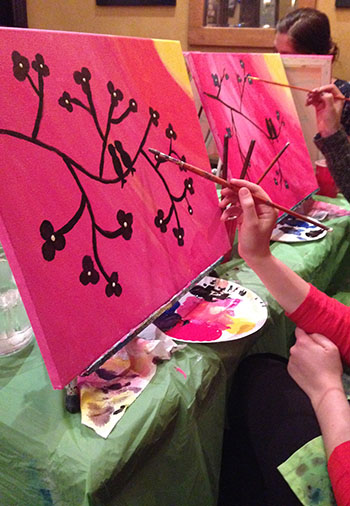
Working side-by-side two artists paint the same image with their results strikingly similar yet different. Photo © Bethany Rubin.
Two versions of the model painting Birdie Love show intriguing differences.
[Photo © Bethany Rubin]
“Going from a blank canvas to finished product is amazing, and of course the alcohol helps,” says, with a laugh, Ajaz Hussain, CEO of Paint Nite Canada. Hussain first learned about Paint Nite through Hermann, who was a student of his in economics and marketing at Babson College in Boston. With no prior experience in art, Hussain says he realized this event was especially fun for people who had never painted before, like himself. He brought Paint Nite to Canada in 2013.

“It brings people together,” Hussain says, explaining that it provides a setting for people to bond and have a good time. He says although most people come with friends, the experience also attracts individuals, who share in the powerful group dynamic. “You’re drinking and doing a creative activity; it’s a great way for people to interact.” The camaraderie and creativity, he says, supply an attractive alternative to just going to a bar.

Social painting instructors are told to create a no-shame zone, which removes the element of negative critique and promotes positive vibes for yourself and your neighbour. Instructor Reece says she wants to impart a stress-free zone, to help give the painters an escape from daily cares.

Throughout North America, businesses such as Paint Lounge, Paint Social Art and Social Artworking—to name a few—have popped up, mimicking Paint Nite’s social painting experience since it began three years ago. While Paint Lounge’s website mentions that it launched in 2010, before Paint Nite, it is available only in three cities, all in Ontario, and with a mere 3,768 Facebook likes, as compared with Paint Nite’s 21,122.  When comparing the various companies’ popularity on social media, Paint Nite has yet to be beat. Paint Social Art has 8,163 likes; however, it is available only in certain cities in Connecticut and Massachusetts.

According to an article by Barbara Quick on the Yahoo Small Business website, social media acts as one contributor that paints Paint Nite as popular. The article says McGrail and Hermann calculate that 35 percent of Paint Nite’s ticket sales are due to people tagging themselves and posting about their experience on social media sites. The participants with Cote at Mambo Nuevo Latino admit they learnt of Paint Nite predominantly through emails from Groupon, a website that recommends a “deal of the day” to customers by providing an electronic coupon for activities in select areas. The site usually offers up to 46 percent off of Paint Nite. This means the cost of your night out would drop from $50.85 plus tax to $27.46—not including your cost of drinks.

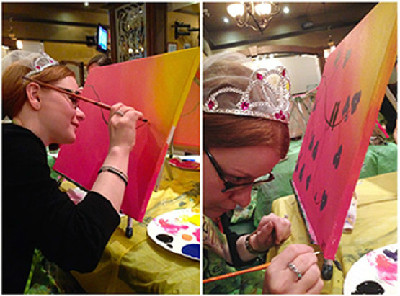
Bride-to-be Nicole Shievitz starts and finishes her Birdie Love rendition. [Photo © Bethany Rubin]
On Nov. 1, 2014, Nicole Shievitz, a medical general practitioner, was surprised by her friends in Toronto with a Paint Nite party to celebrate her bachelorette. Shievitz was always an artistic child but never pursued it further than high school art class. She says she would attend Paint Nite again, time allowing, but not necessarily on a weekly basis. Instructor Reece says she has seen several bachelorette parties, and that girls’ night, birthdays and co-workers’ team building are also popular. Reece says there are countless memorable moments, specifically recalling one where a gentleman proposed, via canvas, to his date.

It’s 9:36 p.m., and flashes of light betoken “after” selfies with freshly signed masterpieces. A woman with a paintbrush in one hand and an almost empty wine glass in the other begins cackling at the sight of her painting: “I don’t know if I needed less wine or more wine!” The other painters respond with laughter, “More is always better.” As Cote takes a group picture to place on Paint Nite’s Facebook page the next morning, her assistant cleans up the mess. The fulfilled amateur artists begin to drift out the door—or back to the bar. It may not be karaoke, book club or speed dating, but it’s providing a new alternative to a typical night out.

[Front page photo © Bethany Rubin]

New frontiers of sharing: read your old diary onstage

Pressed Café in Centretown Ottawa is normally a bustling place—fingers clunk on laptop keyboards and people chatter—but on the evening of July 6, 2014, the room is quiet. Two hundred eyes look up at a spot-lit Lindsey McCaffrey. She is about to do something most people have thought of only in nightmares. To a roomful of strangers, she will read aloud from her childhood diary .

Cracking open the unicorn-cover diary that was hers at age 12 (and which includes a warning at the front to her sister to “stay out!”), McCaffrey, now 38, shares about her first heartbreak. “I absolutely cannot believe it,” she reads. “Ronda just phoned me a few minutes ago telling me that Chris broke up with me!” The room erupts in laughter.

McCaffrey’s performance is part of a stage show called Grownups Read Things They Wrote as Kids (GRTTWaK). The show is an open-mic style event where participants sign up to read from their adolescent writings onstage at a bar, café or similarly laid-back venue. The participants are regular people—not professional performers—who have dug through their old shoe boxes and found something funny, touching or just plain embarrassing that they think is worth sharing.

Gaining momentum

GRTTWaK began as a stage show in Toronto in 2007, but last summer the show’s creator, Dan Misener, took it on the road, drawing crowds and local participants in all ten Canadian cities he visited. GRTTWaK isn’t the only show of its kind. A similar open-mic show called Teen Angst began in Calgary in 2000. There are also curated diary shows across North America, such as Mortified in the U.S. and Dear Diary in Toronto. In the curated shows, producers meet with participants before the performance to help tease out a story within their adolescent writings (unlike in the un-coached open-mic shows).

Close to home. An all-too-relatable moment at a Mortified show in San Francisco. [Photo © Todd Hartman]
Stage shows of both varieties, curated and open-mic, have cropped up across North America over the last decade, and their popularity has grown. Since Mortified began in 2002, it has expanded to nine American cities and it also has a chapter in Malmo, Sweden. A documentary about the show called Mortified Nation was released November, 2013. It got some press, winning positive reviews from The Washington Post, Time, and Newsweek, among other sources. The film also seems to have sparked a renewed interest in these types of shows. Dear Diary started in Toronto in September 2014, after the show’s creator, Alexandra Parravano, saw the Mortified documentary. Meanwhile CBC Radio picked up on public interest in these shows and commissioned Misener to produce a 10-part podcast series of GRTTWaK. The audio episodes were broadcast live throughout the summer of 2014 on CBC Radio, and can now be accessed online at the GRTTWaK website.

Real-life drama

Misener says he came up with the idea for GRTTWaK while helping his girlfriend sort through boxes at her parents’ house in 2007. He found her Grade Seven diary, and they spent the afternoon reading it aloud. Misener realized it was compelling, and the show was born.

Dave Nadelberg, founder of Mortified, says these types of shows are popular because they are honest. “I think audiences are really hungry, on an emotional level, for things that take them on a true human experience,” he said. With so-called “reality shows” feeding audiences anything but reality (think Kardashians and Real Housewives), people are craving authenticity in art. The way we have segregated emotions in our entertainment to different genres (dramas, thrillers, comedies) is also not indicative of how we experience life, said Nadelberg. In shows like Mortified, the audience will find themselves laughing one moment and crying the next, much like life, certainly like adolescence.

Our culture now places a high value on vulnerability.

Nadelberg also says the popularity comes from how universal and relatable adolescence is. Even if audience members can’t directly identify with a participant’s life experience, Nadelberg hopes they can still relate to the emotions. “I want to have an audience member who grew up as a total Mormon goodie-two-shoes boy, and I want him to totally connect to some punk rock girl who’s reading her lyrics on stage,” he said.

Mortified participant Garry Davis shares his struggles with growing up feeling like an outsider. [Photo © Allana Taranto]
The connection comes not from having gone through exactly the same thing, but in understanding—through your own experience—the other person’s feelings. One participant in Mortified, Garry Davis, shared about growing up as a gay, black male from a religious family in the Southern U.S. Nadelberg says he couldn’t directly relate to Davis’ story since he’s straight, white and from the Midwest. “But I do know what it’s like to feel misunderstood,” Nadelberg said. “I do know what it’s like to feel different.”

Parravano of Dear Diary says the show creates a collective experience for audience members. “At the end of the show, everyone feels like they’ve gone through something together,” she said. For the audience members, the performers seem to guide a process of looking back. While viewers might come to the show to hear other people’s embarrassing stories, they come out talking about their own. The audience and performers—who were strangers at the beginning of the night — feel like they know each other at the end, she said.

Who would do this?

But the whole trend invites the question: Why would anyone want to read their diary to a bunch of strangers?

“I loved it,” said Diane Finkle Perazzo, a participant in Ottawa’s GRTTWaK. “I loved that they were laughing.” Perazzo says the experience was therapeutic for her, because of the support she gained from the audience. She said one of her friends didn’t like the show because she thought the audience was making fun of the performers. But Perazzo is quick to assert that she was being “laughed with” rather than “laughed at.”

GRTTWaK’s Misener, “The dirty little secret of all of this is that when you are listening to someone onstage read from their childhood writings, you’re really not laughing at them; you’re kind of laughing at yourself.” The performers can sense this support and realize they are not the only ones who experienced these things. There’s a new perspective gained on problems that may have seemed so large at the time.

Lindsey McCaffrey reflects on how she’s changed since she wrote her diary and how, in a way, she’s still the same. [Photo © Emma Brown]
“It was a good reminder to me of who I used to be,” McCaffrey said. She realized she didn’t give herself enough credit as a kid because she was actually “pretty awesome.” McCaffrey found herself turning to her childhood writings during her 20s, while she was searching for a sense of identity. Performing for an audience was a way for her to celebrate her younger self.

But one of the most poignant reasons why adults want to read their diaries aloud is this: deep down they are still that kid who just wants to be heard. Teenagers often feel like nobody’s listening to them; no one understands them. Nadelberg said, “What I’ve always liked about getting to do Mortified is this idea that all these years later a room full of strangers are sitting in the dark and they’re listening.”

Back at Pressed Café, McCaffrey finishes her reading with her record of happenings at a middle-school dance:

“1: Phil asked me if I wanted to dance with John to a slow song. 2: I danced with John. 3: Phil said, ‘You and John look good together.’ 4: Brian said, ‘You should go out with him.’ 5: Eventually, I decided to ask John out. 6: Brian told Phil. 7: Phil told John. 8: John thought. 9: John said yes!”

The audience cheered. They cheered for 12-year-old Lindsey. They cheered because deep down we’ve all hoped “John” would say yes to us. They cheered because they understood.

Etsy website takes the ‘hand’ out of handmade

Imagine a store that sells everything. From beeswax candles and embroidered throw pillows to vintage clothing and one-of-a-kind jewelry, it’s all there waiting to be purchased.

Etsy CEO Chad Dickerson wrote in an October 2014 blog post that Etsy defines “handmade” as a set of values, not actually making a product by hand, reigniting anger among sellers over the year-old policy change.  Photo Courtesy of Etsy.
Etsy CEO Chad Dickerson wrote in an October 2014 blog post that Etsy defines “handmade” as a set of values, not actually making a product by hand. [Photo courtesy of Etsy]
The store is real, and it’s online; you don’t even have to leave your living room. It’s called Etsy, and since its inception in 2005, the Brooklyn-based online marketplace has been esteemed as the best place to buy and sell unique vintage and handmade goods from around the world. From the beginning, “handmade” was the key word: Etsy sellers had to make the products themselves, with an exception for curators of vintage items. However, in October 2013, the company changed its seller policies to allow the use of outside manufacturers, thus taking the “hand” out of “handmade.”

Although Wired business reporter Liz Stinson calls the policy change “a fundamental shift in the company’s DNA,” Etsy never intended it as such. The changes were meant to relieve sellers whose businesses had grown so much they could no longer handle production on their own. The old policies regarding manufacturing were unclear, leaving many sellers to avoid the use outside assistance—subsequently stunting their businesses growth—for fear of having their store shut out by the site.

Despite the change, Etsy CEO Chad Dickerson wrote in a blog post October 15 that “the one-person shop is still the heart of Etsy, and one-of-a-kind items, vintage treasures, and craft supplies all have a place in our marketplace.” Many of these one-person shops, however, saw it as a betrayal of Etsy’s original values, a blasphemous shift in ideology.

The policy change has allowed sellers to flood the site with mass-produced merchandise.

A number of sellers also complained about knockoffs, and multiple stores selling the same “one-of-a-kind” product; one Ottawa-based seller, who also shops on the site, described looking for a purse and finding three images, side by side, of the same bag. Most of these sellers saw it as a sign it was time to pack up and move on.

In the weeks and months after Etsy announced these changes, Stinson says the Australian e-commerce site Zibbet saw its transactions double, as the site positioned itself an alternative to Etsy. Zibbet was opening its arms to those “pissed off” sellers looking for a new home.

Stinson says, “People were like, ‘What the f*@k? If Etsy is not going to uphold this ideal of handmade, then I’m going to go somewhere else that does, somewhere that puts the makers first.’”

The initial outcry faded quickly after the most outraged sellers left the site. But a year later, as the dust settles, the question remains: Has Etsy passed the point of no return?

Little guys are losing

Samantha Brazeau-Wilson, who runs Birch Jewelry on Etsy, says she doesn’t like to think so, but has doubts about how long she can wait for proof the company’s decision was the right one; she says she saw her sales plummet after the policy changes, and they still haven’t bounced back.

“There are many benefits from supporting the handmade community, but not everyone sees the advantages,” she says. “It comes down to convenience, availability, and price. Someone who uses an outside manufacturer will more than likely come out on top over someone who takes the time and effort to create something themselves.”

This crafting-disadvantage is not the only drawback of the company’s new handmade policy. Sellers must apply to Etsy’s Integrity, Trust & Safety team to have their chosen manufacturer approved, and while the company does review the seller’s role in the design process and their relationship with the manufacturer, Etsy does not vet the manufacturer themselves. It is the seller’s responsibility to choose the type of manufacturer they’ll partner with. This gap in the policing of manufacturers has allowed sellers to flood the site with mass-produced merchandise.

If Etsy sellers and manufacturers are caught falsifying their product by the Integrity, Trust & Safety team, their store will be shut out. But according to a number of sellers, there is no system in place to prevent such sellers from opening a new store under a different name.

With Etsy purists always on the hunt for now-scarce handmade jewelry, the Blue & Grey Ombré Paper Rose Earring Gift Set is one of Brazeau-Wilson’s best sellers.  [Photo © Samantha Brazeau-Wilson]
Handmade jewelry like this Birch Jewelry earring set has become harder to find on Etsy. [Photo © Samantha Brazeau-Wilson]

Brazeau-Wilson says leaving the production standards of the manufacturer in the hands of the seller will likely cause more harm than good. “Not everyone stays faithful,” she says.

Despite sending some users and sellers away, and inviting some not-quite-handmade products in, the policy change has allowed Etsy to become a force to be reckoned with. In 2013, the site went from 800,000 to 1 million active sellers, and from 22 million to 40 million users, with sales totaling over $1 billion US.

Compare those 1 million sellers to the 6,500 on Zibbet in 2013, and it’s easy to see why those who remained after the initial exodus will be sticking with Etsy. According to Stinson, for the site to reach this size and level of financial success, change was inevitable.  She says the size difference is unfortunate for a “new kid on the block” like Zibbet, but says it’s important to remember “it makes a lot of sense to use the platform where more eyeballs can see your stuff.”

Despite the drop in her sales, Brazeau-Wilson says she’s still more likely to make a profit on Etsy because of the huge number of consumers who visit the site. At the end of the day, she says, “there are still shoppers out there that can appreciate a good handmade product and will pay that little bit extra to support the handmade community. That, to me, is enough.”

Etsy CEO Dickerson wrote in October 2014 that Etsy “knew that not everyone would embrace them,” but believed the changes were essential for the company to continue to thrive. To thrive, Stinson says, a company has to make tough decisions. In Etsy’s case, this meant risking the loss of its authenticity.

“Companies have to be able to grow in whatever way they see fit, and sometimes that means alienating people,” she says. “It’s just a fact of life.”

Same appearance, changed content

On the surface, the policy change doesn’t seem drastic; the purchasing and shipping processes remain the same, and regular users can still easily find their favourite sellers. But in the 17 months since the change, shoppers have seen a difference in what they put in their carts.

The Etsy Lab in Brooklyn, NY, marks the birthplace of the controversy, as it was the site of the town hall meeting where Dickerson originally announced the policy changes.  [Photo Courtesy of Etsy]

Simple seeming. The Etsy Lab in Brooklyn, New York. [Photo courtesy of Etsy]
Hillary Allaire, a student at the University of Ottawa, says she started using Etsy in high school, originally supporting a friend’s store and gradually finding local clothing designers she would buy from regularly.

Now, she says, she buys almost exclusively manufactured goods on Etsy. She says she often heads there in search of screen-printed t-shirts with “funny or stupid things on them,” to wear to concerts or parties where she just needs something “quick and cheap.”

“I know they’re mass produced and the quality isn’t good, but it’s basically the same as going to a store like Forever 21,” she says.

‘Someone who uses an outside manufacturer will likely come out on top.’ – jewelry maker Samantha Brazeau-Wilson

The policy change has not ruined all aspects of Etsy. Etsy is still the site where you can buy beeswax candles, embroidered throw pillows, vintage clothing and one-of-a-kind jewelry. But now you can also buy purses mass-produced in Malaysia or Indonesia. The one thing you won’t find, however, is the eclectic, community feel Etsy built its empire on.

When he announced the policy changes to a room full of Etsy sellers in fall 2013, Dickerson said Etsy “is all about creative people building businesses, connecting people through commerce, and making items that have stories behind them. Etsy is not just another e-commerce site, and we never will be.”

But following the policy changes, Etsy has become the store that has everything, just like eBay.

Frozen town, frozen treats: how Ottawa gelato vendors survive

So you think you have it tough here in winter? Try selling frozen yogurt or gelato for a living.

Despite any global warming trends, Ottawa winters remain four months of sometimes-brutal cold. With frostbite warnings and driving advisories in the news, Ottawa residents might hesitate to step out—let alone step out for cold dessert. On Elgin Street, Michelle Tommy has been owner and operator of Pure Gelato for 15 years, selling gelato in a variety of flavours, plus café-inspired desserts, sandwiches and crêpes. She says the trick to sustaining her business through the winter is simple.

Michelle Tommy, owner and operator of Pure Gelato on Elgin Street. [Photo © Selin Kum]
“We coast,” she says as she drops her hands. “You make your money all summer, and you coast throughout the winter.”

Tommy says that crêpes and desserts account for only around 15 percent of her year’s total sales; gelato captures 85 percent. Yet she says gelato sales are a big variant: completely reliant on season. “During the summer we have lines out the door, but when it comes to winter and it’s minus 40 degrees outside, I could write ‘Free’ on my windows and I would not have that same line-up,” Tommy says. So we basically streamline to survive.”

A cooler sales season

Gelato vendors like Tommy look at a 12-month span: May to August is the vital one-third, counterbalancing much of the rest of the year. Over 12 months, vendors will have balanced their highs and lows, for a sustainable business model.

Frozen yogurt, also known as “froyo,” is sold by a franchise named Menchie’s, a make-it-yourself shop with four Ottawa locations. James King is general manager of the ByWard Market and Barrhaven locations. He admits that business definitely slows in winter: “When temperatures dip, folks are less likely to source out a cold treat.” Menchie’s mitigates the winter slump by putting on less staff, reducing costs. Thus Menchie’s coasts part year, like Pure Gelato. King says they choose to stay open year-round because they don’t want to lose their trained core staff, or have their brand forgotten.

 ‘You hope the summer comes early, and you hope it lasts long.’ – Pure Gelato owner Michelle Tommy

The café advantage

For Tammy Giuliani, owner and master gelato chef of Stella Luna Gelato Café in Old Ottawa South, the story differs slightly. Stella Luna has won many awards from websites like Urban Spoon and TripAdvisor for its food and customer service. This past summer it took fourth place in the North American Gelato World Tour in Austin, Texas. Says Giuliani, “Even in the winter time, gelato still accounts for 50 percent of our sales. Gelato in the summer time, of course—you have your line-up out the street.”

She ascribes Stella Luna’s success to quality products, customer service and a seating-friendly café format. She says winter brings a higher demand for take-out gelato, while over-the-counter sales are helped because the café interior is warm and inviting, making gelato a reasonable indoor choice.

Stella Luna opens daily at 8 a.m., as opposed to 11 a.m. for Menchie’s and Pure Gelato. Giuliani says they cater to every pocket of the day, from early-morning risers to lunch goers to after school, in that they also offer European-style breakfasts and pastries. Street value plays a huge role, too, as the café draws different clienteles throughout the day. “You have to think of each slot and how you can service that slot, notwithstanding that you still have to offer a premium product,” Giuliani says.

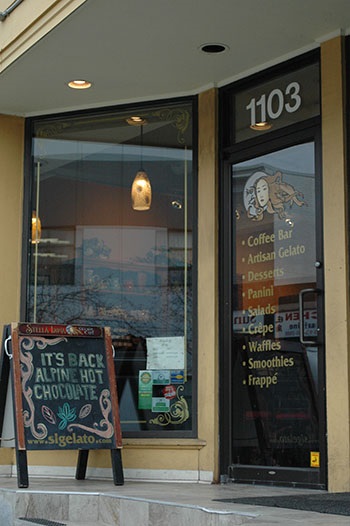
A street view of Stella Luna Gelato Café, located on Bank Street, near Sunnyside Avenue in Old Ottawa South. [Photo © Selin Kum]
Street smart. Stella Luna Gelato Café, on Bank near Sunnyside. [Photo © Selin Kum]
Pure Gelato enjoys strong street value, as well, but owner Tommy says its atmosphere is more modern and lively, brightly coloured. The contrast with Stella Luna’s dark wood furniture and auburn atmosphere seems to show that these two gelato places appeal to different ranges of clientele.

King says it helps that Menchie’s customers can personalize their frozen yogurts with sprinkles and gummy bears and such. He credits this feature with helping keep sales alive in winter. “People like to be in control of their experience, so this isn’t just the traditional way of getting a cold treat.”

Tommy observes that for selling a small-ticket item, location is key. “You never want to be somewhere where you don’t have people walking by, especially when you’re selling a five-dollar product.” Winter hits hard, with its huge reductions in sidewalk traffic. “That’s when you hope the summer comes early, and you hope it lasts long.”

[Front page photo © Selin Kum]

Google Art Project: all looks and no brains?

For over two thousand years, museums have diligently worked to gather arrays of artwork, house them, explain their individual slices of history and display them. The museum’s walls, interior and exterior, create clear-cut spaces for us to wander. Museum walls were the gatekeepers of art: that is, until nearly 70 years ago, when André Malraux ushered the world into his musée imaginaire.

In 1947, Malraux—an art theorist, novelist and France’s first minister of culture—presented his “museum without walls,” an imaginary structure, not rooted in any one place, where works were not nailed to walls but rather released into the hands of people through photographic reproductions. For Malraux, reproducing art in books dissolved the restrictive walls of the institutions that housed the world’s cultural treasures.

Now, transport Malraux’s wall-less museum to 2011, when Google entered the imaginary museum and built on its bold addition, the Google Art Project. The addition has seemed to sparkle, being seen as the new way to educate about, and spread, the world’s wealth of art.

One of the world’s leading art galleries, The Metropolitan Museum of Art needs little help from the Google Art Project to attract viewers to the gallery and its website. [Photo Copyright: Maciek Lulko]
The ship sails on. The Metropolitan Museum of Art needs little help from Google’s tiny online sample to attract visitors to its majestic Manhattan venue or to its own website.
[Photo © Maciek Lulko]
A branch of the Google Cultural Institute, the Google Art Project has partnered with over 300 museums and galleries from over 40 countries to host artifacts online. Its most dazzling feature, capturing the most attention during its debut, was the high-resolution gigapixle format of images, giving viewers the ability to zoom in at brushstroke level. A selection of museums also features 360-degree virtual tours, using the same technology as Google Street View. Currently, there are more than 6.2 million objects available for viewing, just a click away.

However, while Malraux in heaven, and others, on earth, may applaud another Google triumph, the question of how effective and necessary the project actually is for museums and viewers is slowly peeling paint off the canvas.

Rich returns were expected

For most museums and galleries, making their collections available to the broadest possible audience is part of their mandate. So, for institutions including the Textile Museum of Canada (TMC) and the Art Gallery of Ontario (AGO), teaming up with the Google Art Project seemed an obvious opportunity to further their mission—especially as many museums were already working toward digitizing their collections on their own at the time. It was a great opportunity to promote accessibility, said Roxane Shaughnessy, curator and collections manager at the Toronto-based TMC. According to Google, more than 19 million unique visitors accessed the platform between June 2013 and June 2014.When the Google project first launched, it was “really seductive,” says Jim Shedden, publication manager at the AGO, adding that the amount of press which zoomed in on it helped to make the project even more attractive.

The AGO joined the project in 2012, as the first Canadian museum (only another nine have partnered with Google since). A news release by the Canadian Heritage Information Network reported that “the added media interest contributed to a 25 per cent increase in visits to the AGO website the week of the launch.”

It is possible, however, for museums to generate millions of views to their sites without the Google Art Project’s help. The Metropolitan Museum of Art is one example, with 44 million visits to its website annually. Although the New York City–based institution is included on the Google site, Google’s selection of 80 works represents a surprisingly small portion of the Met’s digitized collection: over 400,000 works available on the museum website. Furthermore, the Met site is sophisticated and ­­well built, featuring high-resolution viewing very similar to that on Google Art, along with numerous learning resources (see sidebar).

The Google Art Project entices viewers to examine brushstroke-level texture of paintings such as Emily Carr’s Seascape (1933), at the Royal BC Museum. [Photo courtesy of Google Art Project]
Part of the goal in partnering with Google for museums, whether community based or internationally renowned, was that it would drive viewers to their own websites (which offer greater information and context on pieces, versus the shallow sidebar of detail typically provided by Google). One of Shaughnessy’s hopes when the TMC partnered with Google was that people would “discover us and what really rich online resources we have: not just our online collection but our several websites.” However, this connection hasn’t been as successful as galleries may have expected.

The Royal BC Museum, which has a collection of 81 pieces online showcasing the work of renowned Canadian landscape and modernist painter Emily Carr, hasn’t seen viewers pushed to their site through the project, said David Alexander, head of new archives and digital preservation. “What we wanted was more exposure for our collection but also more traffic to our website, for people to see the artwork and get excited and want to see more. What we’re not finding is increased traffic from Google Art Project to our website or our other digital projects.”

A piece missing?

It can’t be forgotten that accessibility to collections is only one part of what museums are attempting to achieve with new, online technology.  Engaging the public in learning and understanding about art is an important part of any museum’s mission, and is a main expectation sought by the public.

‘I applaud what Google is doing, but it’s only one piece of what art education is about.’ – art historian Sara Angel

An abiding criticism of the Google Art Project is that it stints on textual commentary about the art, understating (or completely leaving out) the significance and context of each work. And while high-resolution brushstroke viewing promotes the close looking that museums encourage, unless you know what you’re looking for, it’s not necessarily helping art education. “It’s the difference between you walking through the Met and trying to figure it out yourself or being taken through by an educated guide,” says Sara Angel, Trudeau Doctoral Scholar in art history at the University of Toronto. “I applaud what Google is doing, but it’s only one piece of what art education is about.”

Last year, Angel established the Art Canada Institute because she believed there was a significant lack of information online about Canadian art: “The education piece in understanding art is critical.” Angel notes that what matters is having the image accompanied by credible and responsible commentary. “I think the piece that’s left out of Google Art Project, there isn’t that provision of material that then gets into the explanation of what the art is and what it’s about.”

The Google Art Project allows for closer viewing of a painting than could ever be achieved in person, but is that its greatest strength? [Photo Copyright: Eric Parker]
Getting the whole picture. Online, Google allows closer viewing than could ever be achieved in person, but critics say it misses the informational overview.
[Photo © Eric Parker]
The AGO was excited to become part of Google’s brainchild, but has already found it to have lost some of its initial value. “Google Art Project hasn’t become a definitive source like so much else of what Google has done: maps, street view, books. There’s nothing on Google Art that I can’t see somewhere else,” says AGO’s Shedden, adding that “the advantage to being on our site is that there’s more of a history, more context.” Therefore, he says, instead of investing in high-quality images for Google, resources may be better spent on the gallery’s own site. This cooling toward the Google Art Project can be heard also in the voice of Alexander of the Royal BC, and TMC’s Shaughnessy says that although the museum wants to eventually add more Google images, they aren’t in any rush.

Although Google may have been the first one through the doors of Malraux’s “museum without walls” in our technology age, it no longer is the only one. As Shedden says of Google, “They were ahead of the game.” But now museums themselves are able to recreate and improve upon Google’s idea, with greater context and learning resources.

Praise and gratitude are still heard for Google’s cultural initiative.  But, as Shedden says, it may “become more and more irrelevant.”

NaNoWriMo: 30 days to write that novel

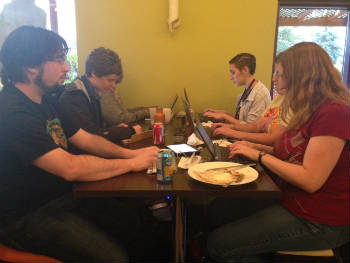
From left, Guillaume Hébert-Jodoin, Laurel Harris, Althea Nawalleh, Helena Verdier, Marie-Christine Houle, and Carol Brereton at a Luna Café write-in. [Photo © Jon Willemsen]
On a snowy November afternoon, a group of dedicated Ottawa writers is beating the cold by staying inside Luna Café in Kanata. They sit quietly sitting at a table. Apart from some periodic friendly comments, the only sound from the table is the furious typing on their laptops.

The reason for their gathering was to further an individual, yet collective, goal: to each write a 50,000-word novel entirely in the month of November, as part of a completion called National Novel Writing Month—or NaNoWriMo, as it is affectionately known by its willing participants.

“It’s absolutely insane, but it’s a challenge and it’s a lot of fun,” says a smiling Helena Verdier, one person at the table.

Verdier, 21, is one of three NaNoWriMo liaisons in the Ottawa region. She balances that volunteer role with a full-time job at a car dealership, along with writing her own novel. She’s in charge of coordinating NaNoWriMo writers’ meetings around the city for the month of November. These meetings are called “write-ins,” where writers meet new faces or catch up with old friends, then sit down together and start writing.

‘At every write-in event, I’m seeing new faces, which means more people are doing it.’ – Guillaume Hébert-Jodoin, NaNoWriMo participant

Verdier, who organizes and attends write-ins “almost every day” in November, says they are the most productive way to achieve the daunting 50,000-word goalpost. “You really need that community support,” she admits. “There are days where you don’t want to write, but seeing other people work hard pushes you to keep going.”

A global movement

National Novel Writing Month has grown into an international non-profit organization, with more than 300,000 people participating in November 2013. [Photo courtesy of National Novel Writing Month]
Warriors of the pen. The NaNoWriMo logo references the hell-bent Vikings. [Photo courtesy of National Novel Writing Month]
From its humble roots in 1999 with only 21 participants in the San Francisco Bay area, the movement has spread worldwide. According to the official NaNoWriMo website, more than 300,000 participants across six continents wrote novels in November 2013.

Since 1999, NaNoWriMo has evolved into a southern California–based non-profit organization, dedicated to helping encourage writing around the world. While the cost is free for anyone to join in writing her or his own novel, participants are encouraged to donate to the organization, to help fund its youth literacy initiatives: Camp NaNoWriMo and the Young Writers Program, both designed to provide a community and resources to hopeful young writers.

The major idea, for most participants, is to knock off a novel first draft. Even if that draft isn’t yet publishable, it may provide the author with a literary agent or a publisher willing to provide editing in order to publish it.

NaNoWriMo has led to a number of successes.  Among the noteworthy published novels to have come out of the event in the last 15 years are Sara Gruen’s Water for Elephants, Erin Morgenstern’s The Night Circus, Hugh Howy’s Wool, and Marissa Meyer’s Cinder.

The cover page for Averill’s NaNoWriMo novel, The Beautiful Land, which after years of revising and searching for a publisher was finally published in 2013. [Photo courtesy of Alan Averill]
The cover page of Averill’s NaNoWriMo novel, published in 2013. [Photo courtesy of Alan Averill]
Alan Averill, a Seattle-based author, wrote the first draft of his novel The Beautiful Land during NaNoWriMo. Eventually the book was published in 2013 by ACE/Roc Books, a division of Penguin Books. But Averill he says the road to publication was far from easy: He spent an entire year simply trying to find a literary agent, and, even so, a book deal was reached only after the manuscript had won the Amazon Breakthrough Novel Award.

Averill credits NaNoWriMo with helping him to focus on at least finishing the manuscript: “I’ve wanted to be a professional writer since I was a little kid, so I suppose in that way I was thinking about getting it published. But it didn’t seem like any kind of realistic goal.”

In Ottawa, NaNoWriMo has been a fixture for about the past decade, according to Guillaume Hébert-Jodoin. The 33-year-old University of Ottawa law student and writer, who served as Ottawa community liaison for the prior two years, believes that November 2014 has drawn some of the largest write-in crowds he can remember. “At every write-in event I go to, I’m always seeing new people,” he says. “Of course, there’s that core group of people you see every time, but most times this year I’m seeing new faces every week, which means more people are doing it.”

Nearly 4,000 participants in the Ottawa-Gatineau region were officially registered as members in November, according to the NaNoWriMo website. Hébert-Jodoin estimates that each of the daily write-ins draws about 10 to 20 people (with far more showing up for the larger, community-wide events). He recalls significantly fewer people attending such events in 2013.

Daunting task, distant finish

Verdier serves as one of the Ottawa community liaisons this November, and she has to balance the demanding volunteer commitment with her full-time job. [Photo © Jon Willemsen]
Helena Verdier: ‘You’re encouraged to keep going, dreaming of writing your own novel.’ [Photo © Jon Willemsen]
However, the prize of a finished novel in one month remains elusive for many brave souls who try it each year. With a daily target of 1,667 words, participants agree it’s a massively ambitious goal.

Meagan Black knows the difficulty first hand. The fourth-year English student at Carleton University has attempted NaNoWriMo twice, both times unsuccessfully. She says it simply was taking too much of her time. Another factor, she says, was frustration: “I just wasn’t happy with what I was writing. It makes it hard to motivate yourself to keep going when you aren’t happy with where the story is going and you’re spending so much of your time writing.”

Still, habitual NaNoWriMo participants consider the concept of a-novel-in-a-month to be very healthy, since it banishes procrastination and perfectionism. It gives authors the incentive to crank out chapters and reach the story’s end, no matter how imperfectly, as opposed to rewriting constantly and getting caught in a loop.

“It’s not about the quality of what you’re writing, but the quantity,” explains Verdier. “You can go back and edit your story whenever you want. But you’re always encouraged to keep going by seeing everyone else working hard and dreaming of writing your own novel. And that’s what makes NaNoWriMo worth it.”

Last brush standing: the rise of competitive live art

Art Battle format requires artists to paint in a circle as the audience walks around to evaluate each piece. [Photo courtesy of Art Battle Canada]
Thumbs up or thumbs down? While painters, centre, work against the clock, an Art Battle audience circulates critically. [Photo courtesy of Art Battle Canada]
Across Canada, visual art is being taken to a new level, as artists are pitted against each other in a public competition called Art Battle. The goal: to create a painting within 20 minutes. Typically the painters work standing in a circle, facing inward, while audience members move around the room to take in each piece at various stages of completion. After 20 minutes, the audience votes on which painting or paintings are best.

The contests form a tournament, ascending to a national paint-off in July. First, from a citywide competition of 12 artists, the top four artists move on to a next round, which meanwhile is fed by other 12-artist contests from the same city; eventually, one winner will go to the National Art Battle Competition. The number of city competitions per year varies with population—Ottawa normally holds 12—but each participating Canadian city winds up sending one artist to the national battle. Twenty contestants are expected at this coming summer’s national event in P.E.I.

Art Battle is the brainchild of Toronto-based artists Chris Pemberton and Simon Plashkes; it emerged from the Toronto art scene six years ago. Pemberton says they were “looking to create an ongoing event that showcased artists and had also a level of interactivity for the audience.” They wanted to build something exciting and new that could cater to an audience’s multisensory perspectives, and their innovation has paid off. Since the first battle, in 2009, the competition has expanded across Canada to cities such as Vancouver, Kingston, Ottawa and even Red Deer.

Pemberton says the tournament has doubled each year, with more than 100 competitions in 2013–2014. Rapid growth has included increased exposure and attendance: Art Battle now hosts over 300 artists, versus about 100 in Year One.  It provides a space for established and emerging artists to showcase their talents, while giving attendees an inside look at the creative process.

Nurturing confidence

Although painting a piece in 20 minutes may seem a daunting task, many competitors enjoy the challenge. Vancouver-based Yared Nigussu has won the National Art Battle three years running. “In the studio, it’s more like you’re a traditional artist,” he says. “I spend three or four days on it, depending on the mood of the piece.” But the pressure and exposure of Art Battle have both been good for him, he explains: “Three years ago I was just kind of a shy artist, painting in my own corner. Nobody heard about me.  Now people have heard of Art Battle. I say I have been a winner for three years; then they give me some value.”

Nigussu’s experience has inspired him to perform live for audiences on his own.  And he estimates that his following of clients and fans has grown 50 percent with his involvement in Art Battle.

‘You get to see someone’s personality and how they paint.’ – Art Battle audience member Felice Miranda

Ottawa artists too are using Art Battle to showcase their work more widely and to network with colleagues. “I want to really help other artists get some recognition, get some publicity, because we do have some amazing, creative people in this city,” says Art Battle Ottawa organizer Peter Purdy. He praises Art Battle’s benefit to newer artists: “Unless you’re in that upper echelon, you’re not going to get into galleries.”

Purdy, previously an Art Battle competitor, became involved in administration only in the last year. He says that more often than not, his participation in Art Battle has resulted in a commissioned work and expanded his customer base. “Art galleries  aren’t the most accessible for all members of the public,” he  says, laughing. “Art Battle really humanizes it. You get to see the artists: it’s not just a painting on a wall, it’s a part of them.” He estimates that at least 50 percent of the artists who competed in Ottawa’s last Art Battle were approached about commissions.

Each artist is allowed to prepare a pallet of paints before the timer begins, and they gather in the centre to start the competition. [Photo courtesy of Art Battle Canada]
Ready, set… Artists, each with pallet and blank canvas, wait for the start in the crowded hall. [Photo courtesy of Art Battle Canada]
But Peter Simpson, arts-editor-at-large for the Ottawa Citizen, remains skeptical of Art Battle as a springboard for young talent. “I’m not sure it’s the kind of thing that would directly get gallery directors interested in artists,” he says. “The ability to create art very quickly, in the high-pressure position of being in front of a live audience, does not typically involve skills one thinks of as essential for an artist.” He acknowledges, however, that Art Battle may help new artists’ personal development: “If you decide to make a career as a visual artist, you’re going to be beset with obstacles.  If Art Battle can be a lesson in overcoming challenges, it’s got to be beneficial in that way.”

Patrick S. Greene, a finalist in Ottawa’s Art Battle of October 18, 2014, agrees: He cites the benefits to artists of being thrown outside their comfort zone. Part of the Ottawa arts community since 1989, Greene has often challenged his own perceived limits, even painting a live exhibition blindfolded. Art Battle is unique, he says, because it allows artists to build confidence while learning from fellow competitors. “I like that it’s a community. If you’re in the competition more than once, it’s a good way to explore new ideas and learn to be very fast. It teaches you to use the full canvas rather than just teeter on one spot.”

Despite its format of competition, Art Battle fosters growth.

Natalie Morrissett, at 16 the youngest competitor of the evening, says that winning was not a major goal for her. The ability to network with other artists and try something challenging was satisfaction enough. “Even not making it into the next round, that’s okay with me,” she says. “Those artworks were amazing! I’m coming back next round.”

Drawing a crowd

Although Ottawa normally holds monthly battles, Purdy says organizers were unable to secure a venue for this year’s November and January competitions—thus reducing the possible number of artists who could compete for the second round. Purdy says he knew there would be hiccups in his first year as organizer: “I am dedicated and determined that next season will be our greatest showing ever!”

While the event’s rise in popularity is due partly to word of mouth among artists, co-founder Pemberton says that the returning audience has been equally crucial. Although some are family or friends of the artists, showing their support, many venture in to experience the unusual atmosphere of live, timed art. Felice Miranda attended her first Art Battle a few years ago as a birthday present to herself. “It’s a competitive battle; it’s really exciting!” she said. “You get to see someone’s personality and how they paint.” Catherine Duveau, having been to battles in Ottawa and Toronto, says she continues to seek out the event because “it’s always different.” She enjoys observing the artists, she says: “I like seeing them do something they love. It’s a good thing for Ottawa.”

Like Patrick S. Greene (pictured left), artists try to employ a unique artistic technique to set them apart from their competitors. [Photo courtesy of Cat Hennessy]
Ottawa artist Patrick S. Greene, foreground, doing Art Battle. [Photo courtesy of Cat Hennessy]
Many involved in Art Battle are veterans of the visual arts community, well versed in the difficulties of breaking into a local limelight. They agree the event creates opportunity in cities where big names dominate or where arts communities are just emerging. Says Purdy, “After owning a gallery and being a struggling artist to get my name out there, it’s become a real passion to help up-and-coming artists. This is a way that’s helping artists get exposure who might be struggling to do that.”

Despite its format of competition, Art Battle provides an environment to foster confidence and growth in local art scenes. “Though there is one winner at the end of the night, typically all the artists have a really great time,” Pemberton says. “We consider all of our painters to be stars. We share all information and work as widely as we can.”

[Front page photo courtesy of Art Battle Canada]

Can the digital revolution rescue in-store shopping?

When the Rolling Acres Mall opened in August 1975, it was the talk of Akron, Ohio. On Saturday mornings, residents  citywide would flock to the popular social hub. But after years of financial struggle, the mall began shutting in October 2008, with just two department stores left in business. The last store, J. C. Penney, closed five years later. Once a symbol of the American dream, the building complex now stands deserted.

Since closing its last store in 2013, all that’s left of the Rolling Acres Mall in Akron, Ohio is dust and disappointment. [Photo © Rob Vaughn]
Killed by e-commerce? Rolling Acres Mall in Ohio, shut since 2013, is now an image of decay. [Photo © Rob Vaughn]
Its fate is all too typical. For the past decade, news media in North America have chronicled the slow deaths of bricks-and-mortar shopping centres, versus the rising tide of online retail and portable technology.

Due mainly to e-commerce, the future of shopping malls is uncertain, says Ian Lee, assistant professor at Carleton University’s Sprott School of Business. He speculates that they will vanish completely in 50 to 100 years: “People will look at them with the same sense of wonder as we look at the cathedrals. ‘Once upon a time, everyone went there on a Saturday morning, wow.’”

Yet the International Council of Shopping Centers (ICSC) says that media forecasts of the shopping mall’s extinction are distorted. The news doesn’t always paint a complete picture, explains Jesse Tron, spokesperson and communications director for ICSC: “It’s extremely overblown, and it is a bit sensationalized.” Tron says that shopping malls tend to fail because of demographic and economic issues in the neighbourhood, not lack of interest in in-store shopping.  He says e-commerce can never replace the full in-store advantages.

In fact, some experts argue that digital technology, while obviously competing with bricks-and-mortar stores, could also be harnessed to keep those same stores in business—mainly by attracting customers into the physical store. Features such as phone apps could actually be the saviour of malls and other retailers. The reason: Corporate vendors now have the ability to gather and sort vast amounts of customer information, making it easier to target consumers, and also the ability to send information easily and instantly to customers, offering them incentives and helping them to navigate the in-store inventory.

And that’s exactly what malls and retailers are trying to do. By offering information and deals to specific customers, they can improve the in-store shopping experience, says professor Lee.

A hybrid shopping experience

Today’s malls hope to increase foot traffic by creating a two-faceted experience, one that allows shoppers to interact with products in store while still giving the perks of online shopping. Effort is being made to get people out of the house and into the mall, explains Chris Carder, co-founder of Kinetic Café, a Toronto-based innovation firm that helps companies, including shopping centres, overcome obstacles in product services and customer experiences. “All the shopping centres are in real times of transformation,” he says.

Shoppers can access a retailer’s website or app by connecting via mobile device. [Photo © Mackenzie Kearnan]
Consumers today expect online and bricks-and-mortar shopping to complement one another, says professor Lee. They want to be able to buy a product online and have it delivered to the store, where they can later return it if necessary. This is all part of the omni-channel strategy, which brings together different shopping methods to create one experience. People want to research online through different retailer websites and then go to the store and make their purchase, says Tron. Thus storeowners have to make sure the platforms are integrated and are speaking to each other, to accommodate the omni-channel consumer.

It’s all about getting people into to the mall and keeping them there. Technology may help.

The shopping experience doesn’t start when the shopper arrives at the mall, but rather at home, explains Carder: “It doesn’t even start in the moment when the person says, ‘Hey, I need a new wallet.’ It starts from knowing when they bought their last one.”

Malls are using technologies to convince customers to make the trip. One example is “beacon technology”. With permission, this low-cost piece of hardware sends shoppers notifications as they walk past stores. Beacons use low-energy Bluetooth connections to send store promotions, product information and flash sales directly to the shopper’s smartphone. The technology also gathers information on shoppers. According to the Beacon Technologies website, retailers will be able to tell how much time a customer spends in each part of the store, and even how they navigate the store. The sales staff could also find out the customer’s name and spending habits.

In the U.K., some stores are equipping mannequins with beacon technology. Nearby shoppers will be sent useful details about the mannequin’s outfit.  [Photo © JenniferWoodard Maderazo]
Mannequins in the U.K. are being equipped with beacon technology, to send clothing details to nearby shoppers. [Photo © Jennifer Woodard Maderazo]
But that’s not all. Cadillac Fairview, which owns the Rideau Centre, is looking at a technology that anonymously monitors signals from mobile devices to track how people move in the mall, explains Cindy VanBuskirk, general manager of the Rideau Centre. It would help the mall decide which stores to put close together.

While technology has its benefits, VanBuskirk says shopping centre owners have to be careful when implementing digital features. Digital screens and flashing lights can be distracting for shoppers, she says: “We have to think about the shopping experience.” Which is also why the Rideau Centre is in the midst of a $360 million redevelopment. The food court was transformed into a more upscale dining hall, to keeps people around longer, says VanBuskirk.

And that’s what it’s all about. Getting people into the mall and keeping them there, says VanBuskirk. Technology may help to do that.

Survival of the fittest

“Technology is a way to evolve quickly,” says Tron. It may be the saviour that retailers have been waiting for.

Experts suggest that evolution is the key to any successful business. As in any industry, retailers and shopping centres have to take chances and make changes. Technology is a great platform for growth in the industry, says Tron. It allows every mall to create a unique experience for shoppers, one that provides the best of both worlds.

“Leveraging technology is an absolute imperative for all traditional retailers and malls right now,” says Carder. “People who put their head in the sand and ignore technology and strategic transformation are going to be dead as a doornail.”

[Front page photo courtesy of Tim Reckmann]

Roll the dice: timeless fun at board game cafés

Board games have been around for centuries and are regularly played in the comfort of home, with friends or family. They have been a source of fun that is free and relatively private. But all that’s changing, at least in certain cities, with the recent emergence of board game cafés and pubs.

 Kayla Schultz, Daniel Kolanko & friends are regulars at Ottawa’s board game cafés/lounges. [©Melissa Novacaska]
Kayla Schultz (left), Daniel Kolanko, and friends are Ottawa board-game-café regulars. [photo © Melissa Novacaska]
These are public drinks-venues that cater to board game enthusiasts who come as a group or alone, pay a roughly $5 per-person cover charge and choose from hundreds of boxes of games, for unlimited playtime. From classics such as Scrabble, Cranium, Battleship and Guess Who to more recent games (Cards Against Humanity, the Catan series), your board game café stocks them all. Typically these are mainstream venues, also offering food, hosting a wider clientele.

Board game cafés emerged as a Canadian trend in Toronto in 2010, and a year later in the United States; from 2012 to 2015 they have expanded across North America. A few are located in Europe (London) and Asia (Guangdong), but the movement remains mainly North American. Toronto alone has roughly 20 such places, including Snakes and Lattes and Castle Board Game Café; other involved Canadian cities include Edmonton, Vancouver and more recently Ottawa.

The handsome stone house of The Loft Board Games Lounge on Waller Street. [Photo© Melissa Novacaska]
The Loft’s handsome stone house on Waller Street. [photo © Melissa Novacaska]

‘Boarding houses’ of Ottawa

The Ottawa market is still small: only two board game destinations. Café Monopolatte at 640 Somerset West, a small, more traditional café, led the way in 2012. It’s a quaint spot, located nicely near Carleton University, geared toward both young and old. It emanates a baked-goods-and-latte feel, yet is licensed. The Loft Board Game Lounge, which opened last May at 14 Waller Street—another perfect location, right by the University of Ottawa and the Rideau Centre—appears on the inside like a large kitchen/living room (with glass tables, wooden chairs, large couches) but also offers a pub basement. The Loft seems more for a rowdier, younger crowd; Monoplatte is more a place of calm and reserve.

Café Monopolatte has proven popular not only with youth and early-to-mid-twenties people, but also with families who want a nice time out without going anywhere too rowdy or expensive. Monopolatte visitor Gerald Williams, a gentleman in his early fifties, said he came initially with his children for some “quality time,” which can be hard to find amid the week’s routine: “Coming to a place like this on a Sunday is a great way to spend time with those closest to you.  And being able to enjoy a little friendly competition together is even better.”

A soothing break from technology

Monopolatte also lets players get away from their electronic screens and return to a nostalgic time when communicating with others was not based largely on mobile devices or the web.

'The Settlers of Catan is one of the more popular games young adults are catching on to play.' [©Melissa Novacaska]
The Settlers of Catan is among the more popular games for young adults. [Photo © Melissa Novacaska]
Valerie Fleck, a recent Algonquin grad and newbie to the board-game-lounge scene, said she had no idea what to expect at The Loft, but had heard good reviews. “It’s actually a cool concept, and the fact that it’s like a bar but more calming is different, the good kind of different,” she said. Fleck is pretty social, but says she’s seen random people come in and ask to join her group, which she was more than happy to allow. “If this is where all the non-social individuals typically want to hang out, then I’ll definitely let them join and get them out of their shell,” she said.

 ‘It’s like a bar but more calming.’ – Recent college graduate Valerie Fleck

Carleton University student Mike Sylvia said he checked out Café Monopolatte for the first time this past summer and now stops by every so often. “It’s a neat concept that makes me question why I need to constantly have my technology on,” he said.

No matter what your opinion on board games—whether they’re fun or, well, boring—these two cafés definitely represent a growing North American trend. “If these places continue to form, it might just get us more focused, and bring us back to making connections with real people rather than virtual beings,” Sylvia said.

[Front page photo © Melissa Novacaska]