
Pop-up galleries help artists ‘do it yourself’

Walking through Centretown near Bank Street on a Saturday, you don’t normally find people huddled around paintings under a tent top. It’s rainy and mid-October, but that doesn’t discourage passersby from stopping to look at the art, displayed on wood pallets in an empty parking lot.

This one-day art-for-sale exhibition in an unconventional space represents part of a new movement—temporary “art galleries”—that has swept Ottawa and other cities in recent years. Such galleries are called pop-ups, and despite their impromptu nature, they seem to be here to stay.  Pop-up galleries have attracted artists from Toronto, Montreal, St. John’s and other Canadian cities who want to take sales into their own hands and show their work without help of traditional galleries. Often this is because galleries will take a cut of half the sales, and it’s not always easy for emerging artists to sign with a gallery at all.

Artist Cynthia Münster stands next to her paintings at the Support Local pop-up gallery, Oct. 18, 2014. [Photo ©Lesley LeRoux]
Artist Cynthia Münster displays her work for sale at the Support Local pop-up tent on Florence Street, October 2014. [Photo © Lesley LeRoux]
One artist featured in the October pop-up, organized by then-Somerset Ward candidate Martin Canning, says she was intimidated by the thought of bringing her work to a conventional gallery. As a photojournalist for iPolitics, Cynthia Münster says she paints more as a hobby and hasn’t displayed her work much. “I’ve always been kind of shy about it,” Münster says. “I’ve shown in cafés and in a tennis club, but I’ve never actually approached galleries because I figure you have to have a more consistent body of work.”

Münster got involved with the pop-up gallery through a former colleague who worked on Canning’s campaign. Although pop-ups typically are indoor spaces leased by the artists themselves, Canning and his team wanted to showcase local talent with a display right on the street. As part of local blog Apartment613’s “Support Local” month, they partnered with Antique Skate Shop to secure the empty parking lot next door for free.

“What we were hearing on the doorstep was a lot of people are expressing concern about opportunity within the artistic community to share their ideas, and also looking for a space to create,” Canning says. “There’s this particular niche of visual artists that contribute to the creativity and local aesthetic that needs to be celebrated.”

Democratizing the sale of art

Across the pond, London has been churning out pop-ups for several years now, with support from ventures like Pop Up Gallery, which launched in 2010 to help emerging artists find vacant spaces around the city to exhibit their work. According to Diane Cardwell in a 2009 report for The New York Times, New York City started to see more storefront pop-ups as the recession pushed commercial landlords to seek new ways to rent out unoccupied spaces. Eventually, Canadian artists like Bill Rose of St. John’s began to take advantage of this phenomenon. In 2012, after severing ties with the gallery that had represented him, Rose created the pop-up movement ARTocracy with the help of his agent, Peter Coombs. The name apparently refers to the democratization of opportunity for artists who seek to sell their work outside the gallery system.

“Selling the work is important, but so is promoting your work,” Rose says. “The last gallery I was with had 50 people they were representing, and I didn’t think that they really had enough staff to represent everybody properly.” With this in mind, Rose and his agent took representation on themselves and have hosted five ARTocracy pop-up galleries in a hotel in St. John’s, with another planned for May.

‘I would like to see more people do it. Get your stuff out there.’    – Ottawa artist Alison Fowler

As for Ottawa, pop-ups have been around for three years now. A group, Pop-Up Gallery Ottawa, was formed in 2012 and has been running events every December just before the holidays. It began when artists Katherine Jeans, Andrew King and Alison Fowler, being no longer represented by galleries, decided to plan an exhibition themselves. They held their first pop-up in an unoccupied house in Westboro.

Alison Fowler at her studio in front of one of her poppy paintings, “All That We Perceive,” which was up for sale at Pop-Up Gallery Ottawa. [Photo © Lesley LeRoux]
Alison Fowler, co-founder of Pop-Up Gallery Ottawa, at her studio with her poppy painting All That We Perceive. [Photo © Lesley LeRoux]
Fowler, a full-time artist with a studio in the area, explains the method to planning a pop-up. First, their group picks an area where they want to hold the event—typically around Wellington Street West, which draws a community of art buyers—and looks for unused indoor spaces. “I do find that people are very curious about, ‘Where are you going to go next?’” Fowler says. “So it’s almost like a little bit of a vibe that you’re creating, especially in the art world. You want people to keep guessing.”

The group targets locations that have been up for rent for a while and pitch the pop-up idea to the real estate agent at the last minute, a month before the event. Fowler calls this process a gamble, but says it’s the only way they can get a space for a few weeks at a decent price without signing a year-long lease.

This past December, Fowler, King and architectural landscape artist Eryn O’Neill held the pop-up in a street-level retail space on Richmond Road. Among the three artists, they sold 37 paintings—a result that Fowler says they were happy with. She says they were thrilled this time to find a building owner who gave them the space for free for two weeks. As a result, their only overhead costs were in buying refreshments and renting tables and glasses for the opening night. Typically, Fowler says, a space can cost several thousand dollars: last year, the artists spent $4,000 plus tax for one month for the Westboro retail space that now houses the Kardish health food store.

‘The time is right because of social media.’ – ARTocracy co-founder Bill Rose

While organizing a pop-up takes some negotiating savvy to secure a location (not to mention the initial hunt to find one), artists must swallow other costs traditional galleries take care of, such as food and drink for the opening reception. Fowler recommends that artists band together in a group of at least four to six, to divide the costs and attract a greater range of visitors if each artist has her/his own following. “I would love to see more people do it: like, get your stuff out there. The more exposure, the better. Just don’t be cheesy or cheap about it,” she says. “If you see a spot or space or anything, just ask. Even if it’s a restaurant or a clothing store or something, the worst thing that could happen is they’ll say no.”

Power to the people
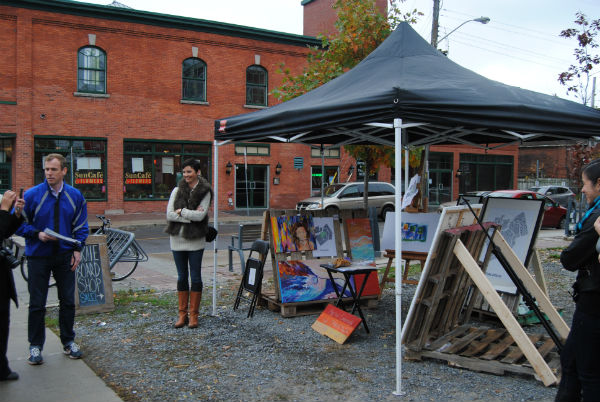
Ward candidate Martin Canning (left, with volunteer Bailey Reid, centre) at the Support Local pop-up to showcase Ottawa talent. [Photo © Lesley LeRoux]
Rose and Fowler agree that social media sites like Twitter help get the word out, contributing to pop-ups’ success in recent years. “I think the time is right for it now because of social media,” Rose says. “I think there’s been a revolution, and it’s because of the digital age that we can promote our work every day on Facebook and constantly build a brand.”

These factors contribute to a culture that allows pop-up galleries to thrive, particularly in a pop-up’s first few days, when, Fowler says, most of the sales happen. Therefore, she maintains, even short-term pop-ups, like the one that ward candidate Canning arranged for the Saturday afternoon in October, hold potential to be of real help to emerging artists.

One volunteer with Canning that day, Bailey Reid, says pop-ups give people a chance to re-imagine public space. The otherwise vacant gravel lot that they used was made vibrant for four hours, attracting potential art buyers. “Today, for us to do this was really pretty easy, and there’s lots of spaces in Ottawa where pop-up stuff can happen,” Reid said amid the small crowd surrounding the pop-up tent. “I think pop-up anything is a cool opportunity.”

Women not welcome here? Female gamers and harassment online

On Oct. 14, 2014, feminist blogger and media critic Anita Sarkeesian cancelled a lecture at Utah State University. Both Sarkeesian and the university received anonymous emails threatening the “deadliest school shooting in American history” should she give her lecture. As an online gamer, Sarkeesian is vocal about sexism and misogyny in the gaming world. As a result, she became the target of many rape and death threats, like this one. But Sarkeesian is not the only female gamer who faces these issues.

While playing video games online, many women are forcefully harassed. This could include sexist comments, and even threats of physical or sexual violence. Women like Sarkeesian who choose to speak out about what they’ve experienced will often face even harsher intrusions. 

According to a study by the Entertainment Software Association, female gamers made up roughly half of all gamers in 2014. This represents a steady climb from 40 per cent in 2010. But even so, women are struggling for acceptance in the gaming community. 

Online gamers can communicate via headset with others, which leads to exchanges of insults and threats. (Photo © Ross Heale-Whittle)
Online gamers can communicate via headset, which may bring the onset of insults, even threats.
[Photo © Ross Heale-Whittle]

Most popular video games have an online component which involves playing with other people around the world. Popular games like League of Legends, Call of Duty and World of Warcraft often involve gamers fighting each other, or teaming up against computer-controlled bad guys. Players can set up profiles, and communicate via headset or instant messaging with other gamers. Communication can be one-on-one, or to a group. It is here that most harassment occurs.

Genevieve LeBlanc is an Ottawa gamer and “all-around huge nerd.” As someone who “cosplays,” she will impersonate story characters at comic conventions. She also writes for Nerd Reactor, a geek news website, and does video game reviews for Ottawa radio station Live 88.5. LeBlanc started playing video games when she was a kid. According to LeBlanc, she gets harassed every single time she games online.

“It is not the same kind of trash talk other people experience. It’s very specific threats of sexual violence,” she says.

LeBlanc notes that she will receive threatening and harassing messages, as well as inappropriate photos. This can occur in game, or via social media platforms and email. 

“I should be able to play these games without these kind of consequences, and without it being some kind of toll on my emotional and psychological well being,” Leblanc insists. 

 ‘It is not the same kind of trash talk other people experience. It’s very specific threats of sexual violence.’ – Genevieve Leblanc, gamer and game reviewer

As a female gamer, game reviewer, and cosplayer, Genevieve LeBlanc is frequently harassed online. Here, she dresses as Jill Valentine from Resident Evil. (Photo courtesy of Genevieve LeBlanc)
Gaming enthusiast Genevieve LeBlanc (here dressed as Jill Valentine from Resident Evil) is routinely harassed online. [Photo courtesy of Genevieve LeBlanc]

In order to continue gaming online, LeBlanc has to take precautions to hide her gender. She will turn off her headset, and use a gender-neutral username. However, the continued harassment has largely turned LeBlanc off of gaming online.

“I know that it’s by far a small minority of players that are engaging in this kind of stuff, but a lot of the other players in the game will just kind of be silent about it,” she says. “It’s very unwelcoming.”

The silent majority

Stephen Langton is an avid online gamer and a third-year game development student at Algonquin College. He says that he has often witnessed gamers make sexist comments while gaming online.

“Throughout my gaming career I have met countless people who are misogynists. It’s always been there,” he says.

Langton says that while gaming, most players will be bullied at some point. But female gamers are targeted more often. In Langton’s experience, very rarely will someone speak up for the players being harassed: “Most players wouldn’t say anything. They will brush it off, and ignore it.”

Langton believes male gamers stay silent about this harassment to avoid becoming a target themselves.

“I think they’re afraid of the people turning against them instead of someone else,” he says. “It’s the internet, and people can act out without having any repercussions.”

This harassment has frequently been labelled as “trolling”. A troll is someone who attempts to hijack a discussion through harassment or an inflammatory comment. Trolling can be humorous, but can sometimes turn threatening.

Langton believes that harassment against women is not something specific to video games, but that video games provide a public platform for abuse that happens everywhere.  

“Because it’s on the internet, everyone’s hearing about it and it’s in the spotlight,” he says. 

Gamergate

Lately online bullying has been given a new dignity, under the banner of enforcing full-disclosure ethics in video game journalism. “Gamergate” is the online movement that unintentionally has brought sexism and gaming to the attention of the non-gaming community. Gamergate began when game developer Zoe Quinn was accused of having a romantic relationship with a journalist, which supposedly led to positive reviews of a game she developed. As a result, Quinn was harassed voraciously online. 

Supporters of Gamergate state that the issue is ethics in video game journalism. Critics of the movement say the misogynistic and aggressive comments made by those supporters point to the bigger issue of sexism in video games. 

Kaye Elling is a former game developer and a lecturer in computer games at the University of Bradford in the U.K. Elling says movements like Gamergate are dangerous for women in the game development industry. 

“Gamergate has set women back in the industry by a good decade, if not more, because of the very real threat of doxing, let alone the threats of violence, rape and death,” she says in an email. Doxing involves digging up personal details, and posting them online. Both Quinn and Sarkeesian have been victims of doxing. 

“It’s shocking, terrifying, and has wide implications for all kinds of industries and women’s rights in general,” Elling says.

Blogger and gamer Anita Sarkeesian chronicled her online harassment on her Twitter account, @femfreq.  [Photo courtesy of Twitter]
Tweets like these, aimed at blogger and gamer Anita Sarkeesian, are deemed acceptable by Twitter’s harassment policy. [Photo courtesy of Twitter]

Elling believes stricter online harassment legislation could be a start for combatting online bullying.

“It’s going to take better legislation and application of current legislation to make a difference.”

A fundamental problem

Currently, cyberbullying legislation exists in many countries. In Canada, most provinces have legislation which specifically address cyberbullying. If cyberbullying escalates into criminal harassment or uttering threats, the perpetrator could face criminal charges, including jail time. However, online anonymity can make it difficult to track those who harass, and some laws are still outdated in regards to how to handle cyberbullying.

Most video games have their own policies in regards to harassment. Functions in the game allow players to report players who use offensive language or make threatening statements. If a player is reported consistently, his or her account can be suspended, or in extreme cases banned permanently. Certain games, like League of Legends, have tightened their policies, leading to more players being suspended. 

Tighter harassment policies have also appeared on social media sites like Twitter. Recently, Twitter has started to increase its rate of deleting or banning users who post threatening messages. Features added in December make it easier for users to report threatening or abusive tweets, and block people from viewing those accounts. 

Rena Bivens, a professor in the School of Journalism and Communication at Carleton University, studies social media and gender. Bivens believes that while these functions may act as preventative measures, this isn’t enough.

“The block-and-report features only respond to the incident after it’s happened, which puts the responsibility on the victim,” she says. 

As far as Gamergate goes, Bivens believes the issue comes down to a power struggle between male and female gamers.

“There’s an idea that there’s one type of gamer, which is a young male. That’s not the case anymore,” Bivens says. “Male gamers have the power, and now they feel threatened, and like something is going to change.”

Bivens maintains that the only future solution requires addressing the real problems in gamer culture.

“It’s about changing our culture, and being intolerant of these assumptions of gender and power which are a part of it.”

[Front page photo courtesy of Genevieve LeBlanc]

Scary from any viewpoint: the new found-footage horror film

You’re running for your life through a forest in the dead of night with only the weak beam of your flashlight to guide you. You can see only a few feet ahead. Violent screams erupt somewhere, but you don’t know why. Your vision is shaky as you sprint, until your flashlight dies. There is complete darkness; you are heaving for breath. You sense the killer right behind you. Then it’s over.

Paranormal activity resuscitated the found footage tradition with its release in 2007. [Photo courtesy of Paramount Pictures]
Paranormal Activity introduced the multi-screen twist in 2007. [Photo courtesy of Paramount Pictures]
This is the experience of watching a found-footage horror film.

It is a type of movie that makes the audience feel they are the main character. Traditionally, in the movie plot, a recording device such as a hand-held camera tells the narrative, and a documentation of something terrifying ensues. The taped footage is then “found” by a third party who turns it into a film. Hollywood production is replaced by a very shaky camera, first-person perspective shots, and a gritty image to make the films feel realistic.

The idea is simple enough, but newer examples of the subgenre are starting to move away from its prior conventions. Filmmakers are catching on to the fact that simply finding a single camera’s footage with scary images doesn’t work anymore. Why is that? Probably because multiple screens and formats are our real lives today.

Fresh blood

Found footage leaped into view in 1999 with The Blair Witch Project, about three filmmakers who disappear in the woods while filming a documentary about a local myth called the Blair Witch. The audience is told the filmmakers are missing, and the footage of their documentary was discovered a year later. The film consists of the found footage they shot.

It was one of the first films to be promoted on the internet, which effectively blurred the lines of fiction and real-life documentary. Shrouding it in mystery paid off enormously; it went on to gross nearly $250 million, from a budget of only $60,000.

The Blair Witch Project’s success spawned numerous found-footage copycats,with the genre peaking with films such as Paranormal Activity (2007), Quarantine (2008), and Cloverfield (2008).  These, in fact, were so popular that critics started to consider found footage a gimmick. Films like Paranormal Entity (2009) and Monster (2008) failed to capitalize on the phenomenon because they offered nothing new.

André Loiselle says the found footage tradition is an interesting challenge to horror movie conventions, but he isn't sure if it'll stay popular forever. [Photo © Martha Darby]
Film studies professor André Loiselle: not sure that the found-footage tradition will endure.
[Photo © Martha Darby]
André Loiselle is a professor of fim studies at Carleton University with a special interest in horror films. He says that film genres like found footage survive by spinning the old conventions into something new and exciting.

“You have an expectation for a horror film, but it’s a rethinking of those conventions and trying to find new spins that will make it a success,” he says.  “Even horror buffs get bored of the same formula.”

Multiple screens, multiple screams

The emerging trend in found footage is a complete removal of the traditional hand-held camera, replaced by a number of slightly different spins where new technology is used to record the footage. Instead of a movie shot solely from first-person perspective, other recording devices like cell phone cameras, web cams and GoPros show multiple visual viewpoints converging to tell a narrative.

“Horror comes from the content,” says Loiselle.  “The found-footage narrative device is not new, but visual content can make it fresh.”

The Paranormal Activity franchise has picked up on this and experienced enormous success. The 2007 Paranormal Activity grossed $193 million dollars, from a budget of only $15,000, making it one of the most profitable films ever. It is reviewed on Rotten Tomatoes as one of the scariest ever made, too.

Paranormal Activity and Paranormal Activity 2 (2010) use the hand-held camera viewpoint like The Blair Witch Project, but make it more interesting by using footage from house surveillance cameras to add suspense.  Paranormal Activity 4 (2012) takes the new spin even further by using a combination of webcam and Skype footage.

Another found footage franchise using multiple screens and viewpoints to create a horrific atmosphere is REC (2007), where the films are shot as a live journalistic feed from a television camera. As Above, So Below (2014) is a recent example that is filmed on digital cameras mounted on each character’s head, as they venture down into the catacombs of Paris.  The footage then switches to different characters’ perspectives throughout the film, to make a more complex plot.

The popularity of found-footage films like Paranormal Activity invites some explaining. Yes, the new multi-format found-footage film offers a visceral, scary experience. But why does it get to us so effectively?

Creepily close to home

Professor Loiselle explains that this new breed of found- footage films tie into society’s fascination with technology and immediacy. With everyone recording everything in real life, multi-viewpoint found-footage films feel more realistic and scary.

“There is an immediacy for news and events now,” he says. “Found footage gives us immediacy and no distance from what’s happening. And the response to the familiar feeling of immediacy is terror.”

Using technology like cellphones or webcams in found- footage films removes the safe feeling of distance for a 21st-century audience. The idea of your webcam filming a ghost in your bedroom seems more plausible than you being attacked by a grotesque monster.

Jake McDowell is an amateur found-footage filmmaker in Toronto. He says he finds the subgenre so scary because it feels like it could happen at any moment.

“We live in such a voyeuristic society these days, where almost everywhere you go, you’re recorded,” he says.  “When you’re watching found footage, it sort of feels like daily life but you don’t have control to look away or run away.”

Crowsnest is a found footage horror film where five friends go missing on a road trip.  [Photo courtesy of Brenton Spencer]
Crowsnest is a found-footage horror film where five friends go missing on a road trip.
[Photo courtesy of Brenton Spencer]
Brenton Spencer is another Canadian filmmaker who has tapped into the subgenre’s shift. He directed a found-footage horror film called Crowsnest that was released in both Canada and the United States in 2012, which used the traditional hand-held camera narrative. He is now working towards a sequel that uses the new multi-viewpoint style.

“It’s going to be led a lot by technological developments in media,” says Spencer. “From Google Glass to developments in cellphones, to incredible digital cameras and the ability to post material and distribute it instantly.”

And so filmmakers continue to think up new ways to incorporate everyday technology and experiences into their horror films.

“Found footage gives off the impression that it is real, but we all know that it’s fiction. That’s why we like the shivers down our spine,” says Loiselle.

The idea of your webcam filming a ghost in your bedroom seems more plausible than you being attacked by a grotesque monster.

Found-footage films can act as a mirror to society, with the goal to scare the audience. They resonate with a new generation because people use multiple screens and formats in today’s real life. We are constantly online, on our cell phones, or sharing our lives over social media, which is what these films are mimicking.

[Front page photo courtesy of Paramount Pictures]

Hollywood exodus? Why small screen is our new realm of storytelling

Does Hollywood production seem a bit vacant of late? Star Kevin Spacey and ace writer Aaron Sorkin are nowhere to be found. Steven Soderbergh’s director’s chair is empty. And where have these big talents gone?

Answer: They’ve crammed themselves into a TV set. From Spacey starring on House of Cards to Sorkin creating The Newsroom, big names in the film industry are making the move to TV. And many observers are calling TV the future vehicle for intelligent storytelling.

Film veteran Kevin Spacey stars on Netflix’s original TV series House of Cards.
Never look back: Movie veteran Kevin Spacey now stars on Netflix’s original-TV hit series House of Cards.

In his 2013 speech to students at the University of Southern California, Steven Spielberg said that his 2012 Academy Award-winning film Lincoln almost never made it to the big screen, and was instead going to become a made-for-TV HBO movie. Film studios today seem increasingly wary of making dramas that won’t appeal to mass audiences. “In the industry’s current state, even proven talents are having difficulties getting their own movies into theatres,” said Spielberg. Jim Sheridan, a six-time Oscar nominated director, echoed Spielberg’s words in a press conference at last year’s Busan International Film Festival in Korea. “I think Hollywood is making movies for China and India and Brazil and Russia. So they don’t want dialogue movies. They don’t want dramas. They’ve migrated the drama to TV,” he said. With international box office sales on the rise, industry experts predict that China will overtake the U.S. in 2020 as the world’s biggest film market. If Hollywood is going to produce more movies that rely on special effects and are geared to the international market, how are filmmakers like Spielberg going to make dramatic films such as Lincoln?

Why story matters

“The writing for TV over the last five to seven years has gotten so much better,” says Frances Brennand Roper, who has worked with Caroline Sinclair Casting and is currently producing Escape of the Living Dead, a sequel to George Romero’s Night of the Living Dead. Rather than having an hour and a half in a movie theatre to tell a story, Roper says that writers are able to create much longer narratives in a TV season, which means more story and character development. “The content is the massive draw,” says Roper, commenting upon the film industry’s migration to TV.

‘The writing for TV over the last seven years has gotten so much better.’ — producer Frances Brennand Roper

The success of long-running TV shows like Game of Thrones has helped create a demand for quality TV series, which in turn has provided new opportunities for actors. “Eighty per cent of lead roles in TV are offered to big names,” says Roper. One example would be Steve Buscemi, who stars in HBO’s Boardwalk Empire. Roper says that while access to bigger roles is continually getting harder, there are opportunities for up-and-coming actors to get supporting roles, thanks to the proliferation of new TV shows.

Frances Brennand Roper
Producer Frances Brennand Roper says the demand for quality TV series is providing new opportunities for talent from Hollywood.

Mandy Safavi, an Executive Producer behind last fall’s theatrical release of Ender’s Game, and President of Tall Girls Productions, is seeing more filmmakers wanting to work in TV because of its creative freedom. With its plethora of visual effects, films like Ender’s Game are fairly easy to market; however, Safavi says, “It’s harder to make films that are more character driven and dramatic. That style of filmmaking has now moved over to cable television.” Safavi’s work involves transitioning movie talent, such as writers who are open to it, into the TV business. Her company, Tall Girls Productions, focuses on bringing new female talent to both film and TV, in front of and behind the camera.

The business end of things

How is it that smaller cable TV companies are attracting talent over the much older and more experienced film studios? Says Roper, “Unfortunately, movie studios are run by businessmen and women who don’t know anything about making films. Of course they understand the business side and employ the directors and producers, but ultimately a lot of the decisions are made by the executives, and these people don’t know what the best thing is creatively.” According to Roper, studio executives generally look for formulas in scripts; for example, an action movie must have a certain number of shootouts in order for an executive to decide whether or not the film will make money.  “If studios always did this, movies like Forrest Gump would never be made. Luckily, this isn’t always the case, as recent studio films like Prisoners and The Way Way Back were brilliant,” she says. In the case of a cable television channel such as HBO, there is less of an executive hierarchy to answer to. “It’s less of an intense business model in terms of red tape and bureaucracy,” says Roper. This is why smaller cable television companies are able to leave creative control in the hands of the artists. In fact, as Safavi says, “In television, the writer is the king, because the TV industry is a lot more collaborative. The writer, who is usually credited as the series’ creator, has a lot more say.”

‘In television, the writer is king, because TV is a lot more collaborative. The writer has a lot more say.’ — producer Mandy Safavi

Like HBO, the Internet streaming service Netflix makes creativity a major priority when it comes to original content. In his speech at the 2013 Edinburgh Television Festival, Kevin Spacey applauded Netflix for trusting the creators of House of Cards to produce the entire first season without having to shoot a pilot episode. Spacey explained that they wanted to create a sophisticated, multi-layered story that would take a long time to tell, something that would have been difficult if faced with the pressure of making a pilot. Television networks such as Fox and ABC, which are bigger than cable companies, have a bureaucratic system similar to movie studios. But unlike studios, networks have begun focusing to create edgier, dramatic shows in order to compete with the likes of cable. “TV networks have had to step their game up and produce better shows, because cable channels like HBO and Showtime have been crushing them,” says Roper. Matt Coatsworth, who worked as an assistant to an executive producer on Ender’s Game, admits that working with studios and TV networks can result in a loss of creative control, but says he understands the need for businessmen in the industry. “You need marketing teams to know what’s trending. You need people to sell the movie. Although having creative control is ideal, a filmmaker has to sometimes learn to adapt,” he says. Coatsworth has been trying to independently produce multiple television projects, including a children’s cartoon, but he’s met many challenges and has considered going to a television network to finance it, even though he will potentially lose some creative control. “When you hear ‘no’ from many different people, the other direction starts to look a lot better,” he says.

The game changer: technology

Technology also seems to be playing a significant role in the shift to TV. With easier accessibility to TV and movies provided by Internet companies such as Netflix, small screens are being favoured by millions of viewers. “Technology is changing how we view content,” says Coatsworth. “With fewer movies being made and the rise of the 13-hour TV season, the shift is already happening.”

Playing to convenience: Netflix allows people to catch up on their favourite shows on the go with their smartphone or tablet.
Playing to convenience: Netflix allows you to keep up with your favourite show while on the go, with your smartphone or tablet.

Roper says that technology has given this generation “an insatiable appetite” for entertainment content. “People now ‘binge watch’ TV shows, so Netflix was smart to release the whole season of House of Cards all in one go,” she says. “I think a lot of other platforms will start to follow their lead. Hulu, Amazon and YouTube are already making their own content.” But what will the future hold for the big screen? Safavi says that there will be fewer people going to the cinema in the future. “Features will have to reinvent themselves now with the many different ways that people are viewing content. I think a lot of people will be less inclined to go to the movies and be happy to stay at home and watch something on HBO like Game of Thrones.” Safavi still enjoys feature films, but she says that it is a changing landscape and it will be interesting to see where it ends up. Some of these changes are already becoming evident with the emergence of the superticket at selected theatres: Moviegoers can purchase these higher priced tickets, which offer incentives such as advanced screenings and digital copies of the film. One recent example of a movie that implemented the superticket is Anchorman 2, starring Will Ferrell. Whether somebody goes to the cinema to catch the latest blockbuster, or prefers to stay home binge watching the latest season of The Walking Dead, the film and TV industries are clearly in for some changes. Whatever the direction the industry decides to take, Roper says, “The talent will follow wherever the great stories are.” Home-page photo courtesy of Netflix.

Looking for love (or ‘Likes’) on ‘Spotted at Carleton’

You’re navigating among dusty bookshelves at Carleton’s MacOdrum Library, when you notice someone: a girl in a blue polka-dotted dress. There’s something about her curly hair that strikes you. As she leaves, you’re left wondering if there’s a way to reach out to her.

The “Spotted at Carleton U” Facebook page could give you a second chance to connect.

The page is a space for Carleton University students to post comments about someone they’ve “spotted” on campus. The forum allows hopeful romantics to reach out to a potential love interest they may not bump into again — or simply to compliment someone they’ve seen, without taking things further.

But there’s a catch: all of the posts are anonymous. So even if your future Juliet spots your romantic note, she’ll have no clue whom it’s from or what you look like. You’ll be able to connect only if the spotted individual responds to your anonymous message.

‘The only trouble is that the connection isn’t real. It’s just a Facebook post.’ – Psychologist Sue Johnson

Visiting the Facebook page allows students to read what Amandeep Gill, a fourth-year sociology student, calls “a Spotted moment.” Romantic posts that seem genuinely heartfelt have hundreds of “Likes”. For instance, a post asking a mystery woman to meet her admirer in a secluded staircase has about 230 Likes, while a more superficial post that refers to someone as “eye candy” has only four Likes.

Natasha Gnanam, a third-year law student at Carleton is checking out the “Spotted at Carleton U” Facebook page on her laptop.
Check in to see if you’ve been checked out. Carleton student Natasha Gnanam says being “spotted” can give you a much-needed ego boost.

“Spotted” turns the private phase of beginning a relationship into something more fun and interactive, says Natasha Gnanam, a third-year law student. “Sometimes a friend will tell me to visit the page if they see a funny post, and its popularity grows when people talk about it in person.” Although she has never posted a comment on the “Spotted” page, Gnanam visits the forum because she finds the posts amusing: “I just see it as a distraction. And sometimes you see something genuinely romantic that’s worth telling your friends about.”

She adds, “If I saw a description of myself, I probably wouldn’t get in touch with my admirer. But I would at least take a screenshot of it to show my friends — just for laughs.”

Yet not all Spotted-worthy posts are romantic in nature, as student Gill points out: “You’re more likely to get ridiculed for a love-related post, but if you write about trying to reach out to someone who’s done a good deed, the responses are much more positive.”

One kind message thanks a stranger who helped a first-year student find his classes, while another recognizes a person for holding a door open. Other posts ask readers for advice. For example, a student asking if anyone can recommend an easy elective course has about 40 comments that offer suggestions.

Sparrow McGowan, the social media consultant for the Association of Universities and Colleges of Canada, says people are more active on social media if they see other people engaging with it on a regular basis. Popular pages “encourage more people to comment because it’s a place where people aren’t isolated as commentators,” McGowan says. Posts that ask for opinions or seem applicable to a large number of readers quickly become popular because they act as open conversations, she adds.

“Let’s face it, we’re an online community,” Gill says, smiling. “In university, most of us haven’t met each other but we know each other through our online posts and personas.”

The site administrators allow negative or slightly offensive posts if they are witty or will encourage responses. One post reads, “To the people on [the] forth floor… While I am impressed that every night at 1 you are having sex, I would kindly appreciate it if you didn’t do it so loudly.”

‘If I saw a description of myself, I probably wouldn’t get in touch with my admirer. But I would take a screenshot to show my friends.’ — Student Natasha Gnanam

Since its launch in 2012, the page has been immensely popular. The thrill of finding out if you’re the inspiration behind a post has over 10,000 students liking and visiting the page on a weekly, or even daily basis. A group of anonymous students at Carleton created the page and update it daily. With hundreds of posts, and thousands of Likes, it’s hard to keep track of the amount of activity on the page. “I visit the page a couple of time a day, and comment weekly,” Gill says. “It’s addictive because it’s constantly being updated,” she adds.

University campuses are buzzing with life, and many across Canada have started their own “Spotted” pages on Facebook. The University of Ottawa’s page has over 14,900 Likes, while the “Spotted at Ryerson” page is relatively new, with about 5,000 Likes since its launch in March 2013.

There seem to be two main reasons behind the page’s growing popularity: It presents romantic possibilities to starry-eyed students, but more importantly, the page thrives due to its entertainment value. Viewers often revisit the page to see if they were spotted, or to post comments they think will be Liked.

The illusion of connection?

Students frequently check into the "Spotted" Facebook using their cell phones
Smartphones fuel the “Spotted” addiction and allow students to send messages the moment they spot a beauty on campus

The idea that your soulmate could be one of the hundreds of people you unknowingly walk by each day is what makes the page an instant hit, says psychologist Sue Johnson, Ph.D., the director of the Ottawa Couple and Family Institute. On a few occasions, friends who know the spotted person reply to the post, offering to play matchmaker and get the potential lovers in touch.

In her new book, Love Sense, Johnson says people are “wired to bond with one another.” University students feel the pressure to find a romantic partner because they need someone to confide in, especially if they’re living away from home, she says. There’s also the desire and need for a physical connection, Johnson explains. she adds, “Men are more tuned to visual cues, which could explain why their posts are often about sexual attraction.”

It’s difficult to tell if all the posts are heterosexual in message. Some comments indicate that the post is from a person of the opposite sex, but the majority of messages don’t provide any indication.

There’s also the question of whether or not people are looking for sexual gratification. “There’s certainly a ‘hook-up’ or ‘friends with benefits’ culture among some students,” Johnson says. “People who visit these sites with the intention of finding casual sex or a one-night stand think of it as freedom, but it’s actually a desperate way of trying to connect. Sleeping with a stranger can even leave you feeling lonelier.” These sites may help you reach out, but visitors are unlikely to find emotional fulfillment, she explains.

“The page allows people to engage in their fantasies of connecting with someone who they find attractive — and they can act on it without the risk of upfront rejection,” Johnson says. “The only trouble is that the connection isn’t real. It’s just a Facebook post.”

Gill says the page “makes Carleton students look like love-sick puppies.” She says Carleton needs a separate dating site because she hasn’t heard of any successful relationships that began on “Spotted.” But Badar Muhi, a second-year accounting student, says “Spotted” played a role in his love life. He says he sent a romantic message to the page’s administrators about a crush he had on a girl in his economics class. Although the couple didn’t get together because of his post, “she thought it was sweet,” Muhi says. “At the time, she didn’t have Facebook and didn’t see it on the page, but it was still nice to publicly state my feelings for her,” he adds.

Badar Muhi, a second-year accounting student at Carleton, keeps his cell phone out at the university gym in case he witnesses something that is “Spotted-worthy.”
Getting in shape could get you noticed. Student Badar Muhi says the page can make students feel like celebrities in a campus-sized bubble.

Due to the page’s popularity, the anonymous founders created a “Spotted at Carleton Gym” page in September 2013. “You’re more likely to get in touch with someone if the page is limited to a smaller area like the university gym,” Muhi says.

A love affair with social media

All feelings aside, it seems that trying to spot a mention of yourself on “Spotted” is adding to the page’s popularity. “Secretly, I’ve always wanted to be spotted because I want to know how someone else would see me,” says Muhi. There’s something encouraging about being seen instead of being the one who’s looking and searching, he adds confidently. “I’m not interested in making a romantic connection, but I am curious to see if anyone would notice something about me that’s out of the norm and worth sharing.” Muhi says he visits the page daily and has posted comments that encourage others to write kind and motivating messages, rather than simply romantic ones.

Gill, on the other hand, says she has little interest in posting anonymous messages or being the romantic subject in the posts. Instead, she prefers to comment on the posts. For example, there’s recently been an increasing number of posts that criticize people at the gym for their body shape, Gill says. To respond to the negativity on the “Spotted at Carleton Gym,” she wrote, “All the love is on the neighbouring [‘Spotted’] page, where people are seeking their soulmates.”

Gill says readers need to stop being passive observers and start responding when they see hateful remarks. “The more you comment on a Facebook page, the more others learn about your online personality,” she adds. “That’s because when you send a post to the page’s administrators, you remain anonymous, but when you respond to a post, you name shows up with your comment.”

Some students are merely interested in seeing something they’ve written posted online, where lots of other people will read it, says Rena Bivens, a fellow at Carleton’s School of Journalism. The impulse to revisit the page to see if what you’ve written was Liked or commented on can be addictive to some people, she says. “Over time, Facebook tries to cultivate what a good user is, which is someone who posts a lot,” Bivens adds.

Psychologist Johnson says that the writers of these “selfish posts” are equally as driven, as those who seek to connect, by the need to get attention and form a bond. The urge to display your thoughts indicates your need to reach out to others, she explains: “You don’t know these people, yet you still want to hear from them. So even if you’re not trying to reach out to that special person, you’re trying to write something interesting that you want other readers to respond to.”  She adds, “In the end, the page is about the power of longing for human connection.”

Gill explains that “Spotted at Carleton U” will continue to remain popular because students will use the page to talk about their shared university experiences. Even if students aren’t writing about a specific person, she says students will post in order to complain about the winter weather or point out trends in clothing. “Pretty soon, people will be spotting everyone in the library during exam time.”

“It’s just a Facebook page, but it can change the way we observe others,” Muhi says. “Maybe it challenges us to notice the little details about people we let slide by. If you really want to make a connection, you’ll have to go beyond just describing someone. It’s about something more important: It’s about a lasting impression that stays with you.”

Home-page photo © Jasleen Singh.

Wigging out: The rise of wig fashion

Hair. It’s everywhere, even sprouting up in closets across Canada. No cause for alarm, however. This type of hair is a fashion accessory, and it’s sometimes hard to spot.

Wigs have been present since Antiquity: They’ve graced the heads of famous figures like Cleopatra and Marie Antoinette.  But now wigs are coming at us more subtly. They are blending in seamlessly with natural hairstyles, enabling everyday women to experiment with fashion.

“I’ve noticed an up-shift in the fashion-wig market,” says Alexandra Gunn, fashion editor for Ottawa Life Magazine and anchor for Sun News Network. “Fashion changes so quickly, and this emerging market of hair pieces and wigs allows women to avoid any sort of commitment.” Molanda Joseph, sales representative at Wigs R Us in Toronto, is of the same opinion: “It’s a new trend, I would say.” New people are trying it, she explains.

Joseph says she has witnessed the trend taking shape on Canada’s streets: In cities like Toronto and Montreal, there are increased numbers of people wearing wigs. Consumers are embracing the idea that they can switch up their hairstyle as easily as any other fashion accessory.

Roaming the streets and catwalks

The idea of effortlessly switching hairstyles has even recently made its way onto the fashion runways. The spring/summer 2014 collections that hit runways from designers like Marc Jacobs, Chanel, Fendi and Rodarte featured models wearing wigs, hairpieces or extensions, says Gunn, adding that designers are using these accessories to change a model’s look without consequence. “It really is a big beauty trend, something that the industry is keeping tabs on because it has become quite prevalent.”

Retailers are also taking note of the trend’s popularity. “Fast-fashion retail giant ASOS is keen to capitalize on the trend and has launched a fun and affordable wig range,” says Gunn. “This alone suggests that retailers are aware of this growing trend and the possibility that it may become a commonplace accessory in the future.”

Sarah Graf is no stranger to wig wearing. The fourth year biology student admits to wearing more obvious wig styles once a month.
“Another way to express yourself”: Fourth-year undergraduate Sarah Graf says she wears a more obvious wig style about once a month.

Off the runway and on the streets of Ottawa, one might encounter Sarah Graf wearing one of her wigs. The fourth-year Biology student at Carleton University has used wigs as a fashion statement since high school; she admits that her wig choices tend toward the more obvious. For her, the appeal of wigs stems from her interest in things like comicon (conventions held for comic book fans) and cosplay (wearing costumes associated with fictional characters). “I see it as another type of accessory,” says Graf. “It’s another way to express yourself, if you want to have long hair one day and short hair another day. You can kind of colour that to your outfit.” Wearing wigs at least once a month, she explains she has had a lot of positive reactions: People are surprised at first, but soon become intrigued by the style choice.

Lady Gaga performing in a turquoise wig.
Lady Gaga’s love of wigs for performance and for everyday is inspiring many people to experiment likewise.

Also helping further interest in wig wearing are celebrities. As Gunn notes, “Characters like Lady Gaga or Katy Perry, [are] leaders in this trend where we are seeing women and men using wigs as a form of expression, to better portray and to depict the character they’re looking to show to the world.” Currently this seems especially true in the United States, home and playground to many world celebrities and their imitators. “Although we don’t often see women in Ottawa sporting a Lady Gaga–style turquoise wig, women are becoming more adventurous and will opt for a wig when [attending] a stylish event, or to try out a new hair colour or style,” says Gunn.

Katherine Riley, a Client Care Worker at Inner City Health in Ottawa, wears wigs for personal necessity. She says she’s recently seen a substantial increase in the number of wigs in public and on social media: “As a wearer of wigs, I’m able to pick someone wearing one out of a crowd. I’ve noticed an increase in wigs worn for fashion.”

Shedding the stigma

“It’s like eyeglasses,” says Evelyn Valcourt. “I’m finding that there are a lot of women who wear glasses for fashion. So it’s the same thing [with wigs]. It just needs a little bit more tweaking here in Canada.”

Winnipeg's Evelyn's Wigs owner Evelyn Valcourt
Rebranding wigs with the term “spare hair,” wig vendor and activist Evelyn Valcourt hopes to weave a positive spin on this style option.

Valcourt has owned and managed Evelyn’s Wigs, a wig shop in Winnipeg, for 27 years. Throughout that time, she has noticed a shift in the way wigs are accepted in society. “I remember seeing women going to their work with a black-haired wig one day and then the next day they’d go red and who would care,” she says about wig wearing in the ’50s and ’60s. “They thought that was fun. That was great. And then it all kind of folded up into nothing really.”

Valcourt explains wigs’ dip in popularity as  a side-effect of more people with cancer wearing wigs in the ’60s. A stigma developed around wig wearing. Women did not want to be signalling misinformation about themselves.

Removing the stigma from wigs has been a long process. Acceptance of both wig wearing and cancer in society has allowed wigs to once again enter into everyday fashion culture. Using the term “spare hair” to refer to the item, Valcourt hopes to eliminate any negative association that might still remain. She sees wigs as an extra style option — allowing women to test out new looks without damaging their hair through processes like dying and perming.

‘Characters like Lady Gaga or Katy Perry are leaders in this trend where we are seeing women and men using wigs as a form of expression.’ — fashion editor Alexandra Gunn

Technology has also helped fuel the trend, as more people are realizing that itchy, hot, heavy wigs are a thing of the past. “[The trend] is growing because the wigs are getting better and better,” says sales person Joseph.  Similarly Valcourt, with over 300 wigs in stock at her store,  has definitely noticed wigs’ improvements through the years. She says that the quality of some synthetic wigs today outshines the human-hair wigs available, making it easy to adjust to wig wearing.

These new and improved wigs provide an outlet for those seeking a means to express themselves. “Many people identify themselves through their hair, whether it’s for confidence, sex appeal, individualism, et cetera,” says Cindy Yip, president of Eva & Co. Wigs in Vancouver.

And if you’re having trouble spotting this new trend on Canada’s streets, that’s to the wig’s credit. Says Gunn, “Sometimes the wigs are so well done that you won’t even notice that they are wigs on some people.” Such is the case for Valcourt. When she chooses to wear one of her wigs, she often gets confused reactions from peers. “They can’t figure [out] ‘is it her hair?’ I had one girl sitting beside me at a meeting, and she looked at me and said, ‘Is this yours? Is it your wig?’ And I said, ‘Well, what do you think?’ and she said, ‘I don’t know. I can’t tell.’ And I said, ‘Ok. So let’s leave it at that.’”

Home-page photo courtesy of Evelyn Valcourt.

Photo by Eva Rinaldi from Sydney, Australia (Lady Gaga) [CC-BY-SA-2.0 (http://creativecommons.org/licenses/by-sa/2.0)], via Wikimedia Commons.

Painting the town red: Ottawa’s graffiti scene

A masterpiece or a master crime?

A graffiti artist is sitting on a high scaffold and painting on one side of the Dunbar Bridge
At the Houe of PainT Festival in September, the graffiti artist known as Chemis, from the Czech Republic, worked on the Dunbar Bridge.

What was once profoundly considered an antisocial act of vandalism, graffiti today is gradually becoming more accepted by communities across Canada. Cities such as Vancouver, Toronto and Montreal have already commissioned various graffiti artists to paint murals along buildings, subway stations and traffic signal boxes.

But while some cities have been more accommodating, with commissions mounting to thousands of dollars, the capital city of Canada remains somewhat reluctant.

“We still get the age-old ‘Is graffiti art?’ in 95 per cent of debates,” said Mike Gall, a graffiti artist for 15 years in Ottawa. “The western world seems to have a problem with separating the act from the product, so they have trouble examining the artistry of what’s created.”

Gall, 32, is also a writer and the graffiti programmer for House of PainT, an organization that rejoices in urban and hip-hop culture in Ottawa. This past September, House of PainT celebrated its tenth anniversary at its usual venue under the Dunbar Bridge, Ottawa’s first legal graffiti wall. Despite some mixed responses, according to Gall, the organization has seen a dramatic increase in the volume of participants and attendees since its inception.

Peeling back the layers

Described as “complex” and “little understood” by author Yvette Farkas, graffiti rose in popularity within a typically rebellious young demographic in the 1970s.  That frontier has since shifted toward the centre, with experts eager now to legally define graffiti.

“I think there’s a couple of different trends,” said Jacqueline Kennelly, a sociology professor at Carleton University who focuses on youth, education and urban studies. “On the one hand is still this view of graffiti as problematic, as kind of criminal behaviour that needs to be punished. On the other hand, I think there’s been an embrace of the potential for graffiti as public art — as potentially having a political message or at least as being something that young people can use to claim their space in communities.”

However, the city of Ottawa remains firm. Since the launch of the city’s graffiti management program in 2003, any graffiti reported or witnessed will be removed almost immediately.

“The bottom line is, graffiti is vandalism — it’s put on the surface without permission,” said Paul McCann, the project coordinator of the graffiti management program. “[For] the capital of Canada, all that defacing is not acceptable.”  According to McCann, 90 percent of reported graffiti is tags and scribbles left by young amateurs. Under Ottawa’s Graffiti Management By-law, as indicated on the city’s website, offenders can face fines of up to $615.

‘Slowly but surely, in the city that fun forgot.’ — Mike Gall, Ottawa graffiti activist

Still, there have been some efforts here to follow the trend of other cities that use legal mural paintings to offset graffiti vandalism. In 2010, the city of Ottawa partnered with the Ottawa Police Service and House of PainT for the Paint it Up! mural program, which tries to redirect at-risk youth away from illegal activities and into supervised mural paintings. Paint it Up! is still running in Ottawa and receives $50,000 a year from the city.

An education in deviance

For Mike Gall, the solution lies in educating citizens about graffiti culture. He says this will in turn ease negative stereotypes and de-escalate the long-lived debate. The idea he suggests is for professional artists to convey their knowledge to other aspiring artists. This way, graffiti art can likely lead to “a much higher end product” that benefits from editing and “more policing,” he says.

Adrian Louden is spray painting on a wall
As founder of the Edmonton-based Aerosol Academy, Adrian Louden educates at-risk youth on the uses and abuses of graffiti art.

In harmony with Gall’s philosophy is Adrian Louden, a graphic and industrial designer, working in one of Edmonton’s bronze foundries.

Louden, 27, is also a graffiti artist and the creator of a program called the Aerosol Academy. The program teaches youth about graffiti and art, including teaching the history, practices, techniques and consequences of illegal graffiti. Over the past summer, Louden partnered with iHuman Youth Society, a local group that works with at-risk youth, to teach them in a four-day program.

According to Louden, the response from the course was quite positive. “[Graffiti] can be a good creative focus that can steer them away from some of the negative influences in their environments. The art form and culture was invented mostly by youth, so it has always been something youth were into.”

‘For the capital of Canada, all that defacing is not acceptable.’ — Ottawa city staffer Paul McCann

Others have even found ways to transform graffiti into a form of activism and educating a cause. Julie Forand, 30, came up with a project this past summer, called Sprout Guerrilla.

In her senior year studying industrial design at Ontario College of Art & Design University, Forand’s goal was to “make urban sustainability accessible and fun.” She decided to take the idea of traditional aerosol graffiti art, and replace it with Moss Graffiti — planting all natural moss onto walls in whatever design.

“Traffic pollution often gets trapped at pedestrian level in the streets, so street level is an ideal place for moss to be grown,” she said. “And the creative aspect of graffiti is just plain fun!”

Since then, moss kits have become available online for others to order and participate in the green cause.  “The response has been good so far,” said Forand. “The concept is new to a lot of people so it’s a great opportunity to create conversation around urban greening.” With the success so far, the Toronto-based company will run several more community moss art projects this year.

Progress in acceptance

With his arms far apart, Mike Gall is posing in front of his graffiti piece that reads "Janice" in red.
In Las Vegas, Ottawa graffiti artist Mike Gall poses in front of his piece in honour of his mother. It reads “Janice.”

Although Ottawa city laws remain unmoved, organizations such as House of PainT are undiscouraged, and see the growing opportunities for graffiti culture in public opinion. “Slowly but surely, in the city that fun forgot,” Gall said.

The organization is currently getting ready for another big project planned for February 2014: House of PainT has partnered with the Embassy of Germany in Canada to mark the 25th anniversary of the fall of the Berlin Wall. City dwellers will have the opportunity to witness Canadian and German artists at work to commemorate this significant occasion.

“Seeing the city accept House of PainT like it has pushes me to invest more of my time making life better in my community,” Gall said. “Seeing the progress and positive change over the years gives me hope that it will encourage others to get off the couch and see what the people creating in Ottawa have to offer.”

Anna Khimasia, an art history instructor who teaches a course on graffiti at Carleton University, remains skeptical over the potential success of graffiti in Ottawa, as opposed to other cities. “Ottawa is a bureaucratic town — it doesn’t have a lot of diversity,” she said. “It’s taken a long time for it to grow even partly as diverse as Vancouver, Toronto and Montreal.”

But regardless of locale, Khimasia said we are in an exciting and progressive time for graffiti as an art form generally.  “[Graffiti is] not considered a subculture; it’s been totally normalized,” she said. “To be a graffiti artist is to be an artist like any other.”

Home-page photo © Adam Dietrich, courtesy of House of PainT.

New heights of suburban life

In recent years, the skyline of the Ottawa suburbs has seen additions with the development of high-rise apartment complexes and condos. The city has goals for more intensification, causing development in the city to expand vertically instead of horizontally. This trend is challenging the traditional notion of going to the suburbs to settle down with a big house and a white picket fence.

Nestled nicely within the green landscape of Kanata, this is a rendering of the new condo development, Two the Parkway.
An architect’s rendering of Two the Parkway shows a hopeful melding of urban and suburban, slated for completion in 2016.

In 2012, there were 2,769 apartment-style units starting to be built in Ottawa, compared to 1,592 single-detached houses. Of those apartment-style start-ups, 2,277 were condos and only 452 were rental units. This trend towards more apartment-style residential development has affected not only the downtown core, but also the surrounding suburban areas. Kanata, for instance, has the Kanata Lakes Apartments project, currently under construction in the town centre, and the condo Two the Parkway, slated for completion in Beaverbrook in 2016.

Some observers have questioned this trend towards more high-rise suburban development. With the condo boom in the downtown core over past years, the high-rise trend has become commonplace, but given the unusual nature of this type of development in the suburbs, some question the sustainability of these developments.

City strategy: Build up, not out

The program manager for Ottawa’s planning and growth management, David Wise, says the increased vertical development in the suburbs is due in part to city strategies towards intensification and increasing the population densities of residential areas. Wise says that population densities are an important factor in community planning and strategic development. If you want to have adequate community centres and schools, you have to make sure there are enough people locally to support those institutions. There is also the cost of the supporting infrastructure, like sewers and underground piping, which is very expensive and adds up when looking to increase residential development horizontally. The older Kanata and Beaverbrook areas were originally developed with 15 to 20 housing units per hectare, but the city’s plan says new developments are to be built with 34 units per hectare. The city is also trying to keep all new development within the designated urban limits, which includes some of the suburbs. “We want to make sure we’re getting as much usage as we possibly can out of those things and really maxing it up; otherwise your taxes are just going to go through the roof,” Wise says.

The new trend targets “seniors in the 55-to-60 range who want to stay in the suburbs.” — Ottawa real estate agent Patricia Chiarelli

Another issue to consider with this upward development is the coming light rail transit system (LRT) and transportation plans for the city, which in parts of Kanata will mean increased “transitways” and “busways”. Christine Chollette, an urban planner with Lloyd Phillips and Associates, an Ottawa planning consulting firm, says there is currently a whole movement towards transit-oriented development in Ottawa, which leads to more high-rise development. In areas designated to become hubs for transit, new developments being approved (through by-law amendments) that have greater heights and densities than those outlined in the city’s official plan. In Kanata, the city supports development up to nine stories in certain areas, mainly on main streets, but this height limit can be raised in some areas deemed fit, like those where transit hubs are expected in the future.

Even in the dead of winter, there is never an end to construction. These are the Kanata Lakes Apartments project by Group Lepine in Kanata town centre.
Even in dead of winter, no end to construction. This Kanata Lakes project is just one of the apartment complexes in Kanata town centre.

However, it is important to note that most intensification in the suburbs of Ottawa is happening in the suburban town centres, as not all regions have the infrastructure to support such development. Gary Sealey, President of the KBCA (Kanata Beaverbrook Community Association) says, “The infrastructure capable of absorbing much intensification is not the existing residential areas; it’s in the town centre. There have been recent floods in the residential areas partly because the infrastructure has not been built systematically, for the increased use.”

Seniors on the rise in the suburbs?

According to sources, the general consensus is that the demand for suburban condos and high-rises will catch up to the current over-supply. Anne-Marie Shaker, CMHC (Canadian Mortgage and Housing Corporation) market analyst for Ottawa, says this sort of give and take with the market is normal. “The housing market re-balances. We are higher than population now, but it goes through cycles, ” she says. The CHMC rental-market report for Ottawa states that 23 percent of condos are now being bought as investment properties for resale or rent later. In the downtown core, the main market for these condos is twofold: young professionals and empty nesters — both attracted to convenient urban living.  However, while young professionals generally prefer to live downtown, Ottawa real estate agent Patricia Chiarelli says that sometimes these clients will settle for suburban condos because of the lower price point.

The empty-nester population is another rapidly growing market and especially marketable in the suburbs, Chiarelli says. “They’re usually seniors in the 55-to-60 range who want to stay in the suburbs, usually where their families are living, and they’ve been living in the same area as well.”

Ken Hoppner of Morley Hoppner Group, the developers behind Two the Parkway, had this trend in mind, marketing this development to older residents looking to downsize. With the city’s projection that 20 percent of Ottawa’s population by 2031 will be seniors, there is a substantial market there. Hoppner says that this age group’s people have owned their homes for practically all their lives, and they still want to buy, as opposed to downsizing to a rental or a retirement home. Ottawa Citizen columnist and writer David Reevely agrees that it is reasonable to say that people of this age group would want to stay in the suburbs and continue to buy, since owning a home is the cultural norm for their generation: “They’re not all downtowners at heart who were forced to the suburbs so they could have a lawn where their kids could play but now want to scoot back to Centretown as soon as they’re able. They actually like where they chose to live.”

Vertical Kanata

Sealey says the trend towards suburban high-rises can’t be designated simply as a positive or a negative, as it is not a black-and-white issue. Of city hall’s initiative toward a more pedestrian-friendly Ottawa, Sealey says, “What I think is likely to be consequential is the bringing back of some corner stores, local diners, local small services to residential areas.” On this track, these new city strategies could be credited with trying to create more convenient and dynamic communities in Ottawa outside the urban core.

But there is still some public skepticism as to whether there will soon be demand for all of this increased vertical space in Kanata.  This is to be expected, says Reevely, because these developments are so unusual compared to what development in Ottawa’s suburbs has historically looked like.

Kevin Starkgraff, 20, stands in front of his apartment building at Park Ridge Place. He and his family recently moved there, downsizing from a single-detached home.
Movin’ on up.  Kevin Starkgraff and family recently downsized to this apartment building at Kanata’s Park Ridge Place.

The CMHC Housing Market Outlook Report for Ottawa states that factors like the unstable economy and job market, little resale demand, and the increasing aging population all point to more demand for condominiums and apartments in the future, with semi-detached homes and row houses beating out single-detached homes as the new “dominant low-rise dwelling type” for the first time in 15 years. This trend has embraced the suburbs, too. Says Hoppner, “It’s different from the downtown area where there’s all kinds of opportunities for someone to buy a condo. In Kanata there’s very few.”

Chollette says this housing trend and current city development strategies speak to general lifestyle changes as well, with people living in smaller units, with more city conveniences closer to home. This then creates less need for a car, and makes the suburbs more of a self-sufficient town instead of a bedroom ring around the city.

Kanata resident Kevin Starkgraff, 21, just downsized from a single-detached home to an apartment complex in the Kanata town centre with his family. He says he enjoys being closer to all the conveniences increasingly located in the suburban town. “We prefer the apartment style of living, and we like the convenience of the location,” he says.

Home-page photo © Flickr beyondhue.

Vinyl records still spinning

Convenience and portability reign supreme as top factors in how people listen to music, but one physical format is experiencing a rebirth amongst consumers. Vinyl records, previously seen as an antiquated format in the world of audio, are once again being played around the globe as a worthy alternative to digital listening.

In Britain, sales of vinyl records have reached their highest level for the first time in a decade. An October report published by the British Phonographic Industry (BPI) said that almost 555,000 vinyl long-playing records (LPs) have been sold in 2013. Geoff Taylor, chief executive of BPI and the BRIT Awards, commented that sales numbers show the LP is “back in the groove.” With major labels issuing titles both old and new on vinyl records, a new demographic of listeners are being exposed to the medium.

Detailed artwork from Pink Floyd, Björk, Protest the Hero, and Stone Temple Pilots on display
Home decor. Handsome album art, at 12-inch-record size, is one contributing factor in LPs’ resurgence.

“Whilst sales only account for a small percentage of the overall market, vinyl sales are growing fast as a new generation discovers the magic of 12 inch artwork, liner notes and the unique sound of analogue records, often accompanied by a download code for mp3s,” Taylor noted in the BPI report.

The report further explored consumer purchasing habits, finding that seven in 10 vinyl buyers purchase records at least once a month, while one in five make a purchase at least once a week. Pursuant to Taylor’s comments, the report also found that 3.7 percent of respondents bought records despite not even owning a turntable.

“We’re witnessing a renaissance for records,” Taylor continued in the report. “They’re no longer retromania and are becoming the format of choice for more and more music fans.”

Closer to home

As in Britain, a spike in vinyl record sales has occurred in Canada. Neilson SoundScan, which tracks music sales statistics in both the United States and Canada, reported that 130,000 records were sold in the country. That represents a 47 percent rise in sales over 2011.

Record buying culture in the nation’s capital is alive and well, in large part due the sizable number of independent retailers. One of the most recognized is Vertigo Records, located in the city’s downtown core. Having recently celebrated the store’s ten year anniversary, owner Darrin Tomlin says the shop prides itself on being a leader in supplying new music releases and reissues on vinyl. With regard to his clientele, Tomlin says it’s hard to attribute sales to one demographic.

“I’d say the average customer buying vinyl at our shop is male, twenty-something to thirty-something,” he outlined in an email. “It isn’t limited to that, though, as a lot of younger kids are beginning to show an interest in vinyl after discovering their parents’ collection, as well as baby boomers rediscovering their own collections,” he said.

A customer browses the record bins at downtown store Vertigo Records
At Vertigo Records: what owner Darrin Tomlin calls “that feeling of having something tangible, to look at and play.”

John Thompson has been collecting and selling vinyl records for over thirty years. He owns and manages The Record Centre, a small record store in Ottawa’s Hintonburg neighborhood. The customers he serves at his store are of a similar audience to Tomlin’s.

“It really comes down to two groups of people,” he said. “First there are the older people like myself who never really abandoned the format. A lot of us bought CDs when digital came around, but we never got rid of our records. The other group of course is younger people, usually ages 16 to 25. A lot of them perhaps came to vinyl through a ‘cool’ factor or discovering old collections.”

He adds, “It doesn’t matter how they got there. Once they start listening, they’re hooked.”

But in an age where convenience is key, what draws the consumer to buy music on a format such as vinyl?

“Some people prefer the collectable aspect of a record, while other prefer the rich, warm sound,” said Tomlin. “There is also that feeling of having something tangible in your hands, to look at and play, that people gravitate to, as opposed to pushing some buttons on an iPod.”

‘To fully experience the music, I have to listen to it in its intended format.’ — rock fan Cameron Wheatley

“The ‘cool’ factor largely comes from the collectibility. Some feel a collection is a mark of a serious listener,” said Thompson. “It’s all about the thrill of the hunt, which is something that I’ve never give up. Some collectors are still out there looking for certain things to fill holes in their collections. We all enjoy the sound, the ritual of digging through bins at local stores, putting the records on the turntable, and reading the liner notes.”

The next generation

As is by now obvious, some of this surge is being fuelled by youth. People who grew up with CDs and iPods are now choosing vinyl — at least to supplement. The listening experience of a vinyl record is something that many favour over the sound of digital files.

“My grandma gave me her old record player and a few records for Christmas last year,” said Anjali Chander. The 21-year-old’s interest in the vintage aesthetic largely piqued her interest in collecting. “I love the sound quality, and there’s something about being able to enjoy a whole album so seamlessly,” she said.

Owner John Thompson arranges records in his Wellington Street store, The Record Center
“The thrill of the hunt” can be a big part of LP shopping, says Record Center owner John Thompson (pictured).

“A lot of the music I listen to was originally released on vinyl,” said Cameron Wheatley in an email. The third-year business student listens largely to ’70s and ’80s rock music. “I felt that in order to fully experience the music, I had to listen to it in its intended format.”

Michael Szaulis, 24, has been collecting records since a young age, aspiring to match his father’s collection of over one thousand pieces. The Algonquin College student has so far collected about 500 records.

“I’ve always seen listening to records as an actual hobby in itself,” he said. “The artwork, the sound and the slight imperfections are traits that aren’t even comparable on any other medium.”

Vinyl’s future?

As technology continues to advance and new ways to enjoy music are engineered, many feel that vinyl will keep spinning.

“The future looks quite good for records,” said Tom Lee, owner of the newly opened Troubadour Books and Records in Ottawa’s Byward Market. “Many teenage kids are buying records. For some of them, it will likely turn into a lifelong hobby. Also, records age better than CDs or tapes. It isn’t uncommon to find records from the ’20s and ’30s that still sound great.”

Record experts note the interesting dynamic of industry versus popular demand, and the impact this has had on sales. Collectors are still searching for new additions to their collections, and artists old and new look to have their material pressed on the format.  “It’s very industry-driven now,” said Thompson. “The industry initially abandoned the format because they wanted to, and now labels are pressing it again because there is such a huge demand for it from bands and music fans alike.”

“There are always ebbs and flows in the market, but the important part is that records never left,” remarked Tomlin.

“They’ve always been here, and I don’t see them going the way of the CD.”

Home-page photo © Calum Slingerland.

Hearing voices: Designers gain feedback on Instagram

Inspired by the idea of “creepy fairytales,” designer Alex Krewiak wove together textures and volumes of white fabric for the spring/summer 2014 collection of her A.M.K. fashion brand, for a timeless, “natural” effect. At their showing at Calgary Fashion Week in September, the clothes were punctuated with necklaces of layered metal chains and pearls, white feather earrings and bracelet cuffs resembling tree branches. The models walked with matted, messy hair and charcoal-smudged eyes.

Three models showcase designs from A.M.K. during at Calgary Fashion Week. The line features clothes in different volumes and textures of white fabric. Models walked the runway with matted, messy hair and charcoal smudged eye makeup.
Models walk the runway during Calgary Fashion Week sporting pieces from A.M.K.’s spring/summer 2014 collection, which was researched entirely through Instagram.

Yet Krewiak’s raw, organic designs were derived from research done entirely through something contrastingly unnatural: the photo-sharing mobile app Instagram.

Growing quickly

Launched in October 2010 by two Stanford University graduates, Instagram is a visually based social networking app. Users can apply digital filters to photos and videos taken on their phones, and share them on their Instagram profile or on other social networking services like Twitter, Facebook and Tumblr.  Originally available only on iPhones, Instagram later expanded to be compatible with Androids, and, most recently, there is a simplified version of the app for online profiles.

‘Art has never been created in a vacuum, but perhaps the creative environment is opening up.’ — media expert Jessica Melnik

In April 2012, Facebook bought Instagram for $1 billion. As of September 2013, the app has 150 million users. According to a recent study by L2 Think Tank, which analyzes and reports on social media trends, Instagram has a 900 percent annual growth rate.

Each day there are an average 55 million photos shared, and 1.2 billion “Likes” on photos. Krewiak, for example, says she’s on Instagram “at least 10 times a day.” Indeed, the highly visual platform is appreciated by many creative people. Jessica Melnik is the creative director at Impact Communications, a media relations company based in Peterborough, ON, and a freelance art director and photographer. “I think visually, and Instagram is a good way to keep that visual part of my brain active, interested and exercised,” she said in an email.

It’s no wonder that with such soaring popularity, the app has attracted droves of designers and fashion industry professionals, who are using it for showcasing their products, for research and for inspiration. Interestingly, though, the app has also created a new avenue for designers, into the minds of consumers.

In your head

Designers are starting to use Instagram — which L2 Think Tank says has 25 times the level of engagement as that of community-based platforms like Facebook — to get feedback and ideas from their consumers. American fashion designer Marc Jacobs, for example, posted a picture of three chain necklaces on his Instagram account and asked his followers,

A headshot of designer Marc Jacobs.
Marc Jacobs is one top designer who now uses Instagram to invite consumer comment.

“Gold, rose gold or silver,” inviting their opinions. In a similar manner, Ottawa-based fashion brand Twiss & Weber recently posted a picture of a new prismatic fabric and wrote, “Need some help naming this fabric. What comes to mind?” The brand later posted on its blog that its consumers chose the name Aurora.

It’s this type of engagement that causes some to argue that the traditional practice of designers maintaining creative control is starting to change. Maureen Mullen, head of research for L2 Think Tank, told the New York Times in September that “Designers are treating consumers like artists, people who for the first time are creating aspirational content that brands want to use.”

Melnik agrees. “There are a lot of really talented, smart shoppers and consumers who have valuable things to contribute,” she says. “I don’t believe art is or has ever been created in a vacuum, but perhaps the creative environment is opening up.”

Some observers say that the tradition of designer creative control is starting to change.

For designer Krewiak, this kind of collaboration is now the next step. First, she says, she used Instagram for research and to promote her work and her brand. “Now I’m going to start using it to get feedback,” she says, “it’s a direct line to the consumer.” Melnik concurs, saying this type of collaboration is really important for artists who sell to the general public.

But not all designers are using Instagram for inspiration. Evan Clayton is a designer based in Vancouver. “Personally I don’t think it influences me much as a designer,” he says. Clayton says he utilizes Instagram primarily for marketing: “I’m usually inspired by totally different things and just use Instagram to showcase my work to clients.” For example, his latest collection (called “KIN”), for spring/summer 2014, was inspired by Japanese historical costumes and David Attenborough documentaries on the Pacific Northwest, the latter of which would be particularly difficult to find on Instagram.

Changing the industry?

Yet with the many other designers who are using the app for inspiration and to get into consumers’ heads, such collaboration and engagement could have future large-scale effects on the fashion industry. Melnik explains that most trends follow a classic

A screenshot of a post on Twiss & Weber's Instagram page that invites followers to suggest names for a newly designed fabric.
A post on the Twiss & Weber Instagram page invites followers to suggest names for a newly designed fabric.

boom-and-bust cycle, where they begin as a sub-cultural tendency before developing a larger following and eventually becoming popular in mainstream culture. More and more people catch on, until eventually the trend either dies, is replaced, or changes into something new. “I wonder if it will lead to faster cycling of trends,” says Melnik in regard to Instagram. “If you have more people contributing to the development of trends, as well as the propagation and distribution of these trends via social media, then it could be assumed that the cycle itself would speed up.” Since more people have access to a particular trend, it may become “cool” more quickly, and in turn die more quickly.

This faster cycle could be either bad or good. “Burnout rates are pretty high and it’s difficult for artists and creatives to stay on top of trends, even just technology-wise,” says Melnik. “It’s easy to get overwhelmed or just tired of the constant flow of material.” On the flip side, a constant flow of ideas could be productive: “The faster trends cycle, the more creative people have to be to come up with something new and meaningful while still building on past developments. This leads to innovation,” Melnik says.

Only time will tell if and how Instagram could significantly affect the fashion industry. For now, at the very least, it serves as a fun way for users to share their lives and express themselves and, for some designers, an efficient research tool and method for client feedback.

Home-page photo courtesy of Alex Krewiak.

Death of a book salesman?

e-reader
Small, portable e-readers such as the Kobo allow users to carry thousands of books with them at any time.

When Amazon launched its Kindle e-reader in 2007, it looked as though the bell had tolled for those who owned independent bookstores. Seven years on, e-readers now allow book enthusiasts to buy and hold thousands of titles in the palm of their hand, while never moving from the comfortable confines of their favourite reading chair. Amazon had dragged the book retailing business into the age of the handheld device, and the final chapter in the biography of independent bookstores looked imminent.

“I’ve stopped going to bookstores because it’s just basically more accessible for me to buy books online and read them on my e-reader,” says Ana Gajic a Carleton University student and avid reader.

Gajic is not alone in her move away from traditional books. The CBC reported that in 2012 Canadian e-book sales were worth approximately $300 million dollars, up from $100 million in 2010.

The ascent of the e-book, combined with rising retail-space rental prices, has had a dramatic impact on Canada’s independent bookstores. The Canadian Booksellers Association estimates that 300 independent stores have closed in the last decade, leaving approximately 1, 500 independent book retailers operating in Canada.

In 2012, Ottawa alone lost three independent bookstores. First, Nicholas Hoare closed its doors in April after the National Capital Commission raised rent on the stores property by 72 percent. Beloved retailers Collected Works and Mother Tongue Books followed suit before the year was out. Then in December, Books on Beechwood very nearly suffered the same fate, but was saved by a last-minute buyer.

Ana Gajic at coffee shop reading an e-reader.
Tablet of contents. Carleton student Ana Gajic reads almost exclusively in ebook format, since getting an e-reader in 2012.

Bucking the trend

A year after the closures across the city, a curious thing happened: Troubadour Books and Records opened in the ByWard Market in September 2013.

“It’s ridiculous to think that [hardcopy] books will cease to exist,” says Tom Lee, owner of Troubadour. “I sell used, and my prices more or less match Amazon and e-book prices. I believe there is still a market for affordable books.”

BookNet Canada statistics seem to support Lee’s confidence in the enduring existence of hardcopy books.  The non-profit organization, which monitors the Canadian book industry, announced that by the end of 2012 e-book sales had actually stopped growing and reached a plateau of a 15-percent market share of all book sales in Canada. This means that traditional book sales still account for 85 percent of all books bought by Canadians.

So, could it be that there’s hope for independent bookstores in Ottawa and Canada generally? And if so, what does it take to survive in the 21st century?

Survival guide for independents

Observers suggest there may be three main ingredients for continued existence: a carefully selected collection of books, a well nurtured community spirit and vigorous use of online sales channels. 

“You have to have a niche,” says Jim Sherman, owner of Perfect Books on Elgin Street. “A carefully manicured selection of books makes independent bookstores viable.”

For Perfect Books that niche is new releases, primarily from the science fiction and mystery novel genres. As testament to Sherman’s belief, most independent stores left in Ottawa try to cater to a particular audience. Book Bazaar on Bank Street and Dragan Tail Bookshop in the Glebe both focus on rare and out-of-print books, while Octopus Books caters to those who lean to the left of the political spectrum. Sherman notes that a store like the now defunct Collected Works, that featured a little bit of everything, is no longer a realistic business model. He adds that you really have to know your audience inside and out.

‘A store like the defunct Collected Works, that featured a little bit of everything, is no longer a realistic business model.’ — Perfect Books owner Jim Sherman

For countless independent book retailers who utilize online selling, this audience no longer stops at city limits. David Rosenbloom of Dragan Tail Bookshop says that when independents partner with online dealers, the whole world becomes their market place.

Online dealers such as AbeBooks (now an Amazon.com subsidiary) are able to create networks made up of thousands of independent retailers from around the world. AbeBooks alone, for example, had over 13,000 vendors in its network before being bought by the online retail giant Amazon. People across the globe can access and buy books from the retailers within these networks. For stores like Dragan Tail or Black Squirrel, this process allows their complete collection to be viewed by the entire world, not just by Ottawa residents.

“It gives us an extra layer of security knowing that we have those online sales there,” says Vaughn MacDonald, co-owner of Black Squirrel Books. “Those sales already pay the rent. Everything that’s sold in the store is just on top of that.”

MacDonald adds that today online sales represent one-third of Black Squirrel’s total revenue.  Meanwhile at Dragan Tail, 50 percent of all business is done online.

Ian Lee, a business professor at Carleton University, acknowledges the potential of online selling, but warns independent retailers not to forget their local base. Lee says bookstores must become part of their community and act as a cultural hub where like-minded people can gather, in order for the stores to survive, moving forward.

It was the creation of the communal spirit Ian Lee talks about that helped save Books on Beechwood in December 2012. The long-running independent in Ottawa’s New Edinburgh neighbourhood was on the verge of collapse when Brian Sullivan and two associates stepped in and purchased the outlet from longtime owner Jean Barton. Sullivan had been taking his son to readings at the store for many years and saw the location as an important part of the New Edinburgh community.

Perfect Books and Centretown’s Black Squirrel Books, along with others, have recognized the importance of increased community outreach efforts. Both locations host events such as book signings and concerts on a regular basis in order to connect with their surrounding community.

“I make myself available for book signings with authors; we did eight signings in October and eight more in November,” says Sherman. “More aggressive marketing outside the store is one thing that has really grown our business. It’s something that didn’t use to happen when bookstores simply opened their doors and waited for people to come in.”

There’s no doubt the industry is rapidly changing, but as Mark Lefebvre of the Canadian Booksellers Association points out, independent bookstores adapted to the arrival of big-box stores as well as the advent of online selling. With this in mind, observers are cautiously hopeful that the best-run independents will continue to find ways to survive the growth of e-readers.

“E-readers have definitely reduced sales of books, but they’re not going to wipe out books,” echoes Rosenbloom of Dragan Tail Bookshop. “E-readers compete with the information provided by books, but they can’t compete with the intrinsic value.”

Home-page photo © Melanie Moller.

Death of the iPod?

Previously poised to conquer the world in 2002 and 2003, the once mighty iPod is on the decline.  According to recent statistics, sales of the iPod Classic have significantly decreased.  Currently it seems ready to go the way of the walkman and the VHS player, other hardware elements that have become obsolete.

Numbers don’t lie

The revenue for the iPod business has dropped by 31 percent “year-over-year,” says Craig Lloyd, a technology expert and writer for Slashgear, a technology blog.  In the fourth quarter of 2011, iPod sales were down 27 percent from the previous year, and the number of iPod units sold dropped 32 percent from the previous year. Lloyd says this doesn’t come as much of a surprise, since the iPod has been on a downward trend for a while now.

As seen above, the iPod and the iPhone are very similar, however the iPod cannot make calls.
No contest. Do we still need the iPod, when the iPhone does essentially the same thing and more?

By contrast, there has been an “exponential increase” in active listeners of online music apps in the past few years, according to David Porter, CEO of 8tracks. The best way to measure internet radio success is through monthly active users and listener hours, rather than the amount of people who have downloaded this app, he says.  In Sept. 2011, the listener hours (sum total of all hours streamed) were three million; in Sept. 2012, 10 million; and in Sept. 2013, it had grown to 26 million.

Among reasons for the decline in iPod sales, surely a major one is that young users are turning to their cell phones for music. Consumers aren’t buying iPods because iPhone, Blackberry and Android devices can play music, too. “Essentially, consumers are thinking, Why would I carry around a phone and an iPod when I can have both in one device?” says Lloyd.

Advantages of online music apps

Cell phones do not offer as much space for music in stored files; however, people can download a variety of streaming apps.  There are some great new streaming apps available, including Songza and 8tracks, which have many advantages over the mighty iPod.

Foremost, the price is a lot cheaper: An app costs far less than an iPod.  Apps like Songza and 8tracks are free for users.  Others apps, like Storify, which have the ability for offline access, cost $10 a month, according to Lloyd — still much cheaper than an iPod.  “People are happy to spend $10 per month for premium music services,” Lloyd says.

‘Consumers are thinking, Why carry a phone and an iPod when I can have both in one device?’ — technology writer Craig Lloyd

Another advantage is the potential to discover new music.

Streaming apps gives listeners that “radio” experience, but vastly improved per choice, timing and demand. These kinds of apps are great for when the listener wants to hit “Play” and listen to music.  There is no predictability with these streaming apps, and that is what entices people to use them. If the listener doesn’t like a song that comes on, he or she just hits “Next” and a fresh beat will play.  Also, the amount that you can stream through these apps is limitless.

Carleton student, Cynthia Winker, 21, listening to Songza while she lifts weights.
Carleton student Cynthia Winker listens to Songza because she prefers its spontaneity, over her iPod playlist.

Just like the radio, music apps allow people to discover new music that they wouldn’t have otherwise uncovered, explains Porter. But music on the radio tends to be stale and overplayed. These online streaming playlists are much more colourful and creative.

That is because the apps are well curated. At Songza, playlists are curated by a network of music experts including disc jockeys, musicologists, music writers and music journalists, who hand pick music. Megan Green, Senior Director of Business Development at Songza, explains that some playlists are updated more frequently than others, depending on how often they are streamed, to give the listeners a variety.

“I basically use it because of their fresh and upbeat songs; it’s a good change from my playlist,” says Peter Kavcic, 22, a Carleton University student. “It really is a lot more refreshing than the same old songs on your own iTunes workout playlist.”

This is also part of a generational shift in values. Younger listeners don’t care to own music, whether purchased or downloaded-for-free. Younger listeners are happy to stream.

Why buy?

Consumers have moved away from buying songs to simply wanting to access the music. It saves space on their devices, too.  It doesn’t matter whether they own the songs or not; as long as they can access the music, these listeners are content.  Users cannot choose a certain song  while listening to these apps, but they can choose particular playlists that offer songs within that same genre.

According to Porter, only about 20 per cent of people in the United States actually buy music.  The younger generations don’t buy; they assume it should be free because of all the types of free online streaming services. The main demographic that still buys music is the middle range: thirty-somethings who want to remain loyal to a particular artist or band.

“I would agree [iPods] are becoming obsolete for the most part, but there are still some people who need an iPod because the iPhone only holds 64GB of files, and I know a few people that have music libraries larger than that. Those people still use their iPod Classics today,” says Lloyd.

Nevertheless, with smart-phones here to stay and streaming increasing exponentially, it seems safe to say “R.I.P. iPod.”

Home-page photo © Christina Pellegrini.

Sidebar photo courtesy of Songza.

The Peak Performance Project: Lifting B.C. musicians to new heights

The past six months have been one wild ride for Daniel McBurnie.

Half a year ago, McBurnie might have imagined his Monday morning sitting in a freshman class at the University of Victoria. In an hour or two, he would get together with the other members of Good for Grapes for band practice. Later in the week, Good for Grapes might have been playing a small show for nothing more than the price of a few pints, out of love the music rather than for any financial gain.

That life, however, was left behind the moment McBurnie and Good for Grapes were announced as one of the top 20 finalists in the annual Peak Performance Project in June 2013. Since then, McBurnie’s life has been a whirlwind: learning from industry experts, developing a merchandising plan, playing a huge concert series and embarking on a cross-country sprint tour that took him from Vancouver to Toronto and back again.

The six teenage members of Good for Grapes sitting together on a beach
Good for Grapes: guitarist Graham Gomez, accordionist Sean MacKeigan (who left the band in December), keyboardist Alexa Unwin, lead vocalist Daniel McBurnie, bassist Robert Hardie and drummer Blair Hansen.

As it turned out, Good for Grapes was unable to claim the Peak Performance contest top prize, but they did finish fourth overall and walked away with $10,000 cash to put toward their musical careers. More importantly according to McBurnie, the members of Good for Grapes, six 18- and 19-year-olds, came away from the contest knowing they “had found their calling in the music business.”

The ‘formula for success’

The Peak Performance Project started five years ago as a joint venture between MusicBC and the Jim Pattison Group, owners of 102.7 the Peak, an adult-alternative radio station based in Vancouver. Together, the organizations pledged to invest more than five million dollars in the Vancouver independent music scene over seven years. This infusion was aimed at nurturing the careers of local musicians through intensive industry education and financial assistance. Each year, artist submissions are whittled down to a top 20, who then take part in an intensive “boot camp” designed to be a crash course in successful band management: 20 bands/artists are sent to the B.C. interior for a week to learn from industry experts about topics like marketing, showmanship, management and media training. Along the way, bands are challenged to come up with a charitable initiative, a marketing strategy, and a merchandising plan, all while perfecting their sound for a showcase series of concerts. Following a string of shows in Vancouver, the top-20 list is cut down to a final five, who then compete for a grand prize of over $100,000. While a fan vote accounts for part of the band’s score, a panel of judges determine the final placements.

‘If we hadn’t been in the Peak Performance Project, I might be at in Victoria studying law right now.’ — Daniel McBurnie

The Top 20 Peak Performance Project artists from 2013 sit through a class on the music industry
Getting groomed. At a Peak Performance Project makeshift summer camp, finalists attend workshops on marketing, management, etc.

The Peak’s “formula for success” borrows heavily from a similar annual competition run by a Newcap radio station in Ottawa. Despite the early success of Live 88.5’s “Big Money Shot”, Newcap’s initial commitment of three million dollars eventually ran dry, forcing the station to cut the prize pool by $240,000, to $10,000.  The question for the Ottawa contest now is whether the format can still incubate local talent without offering a substantial cash incentive.

Tamara Stanners, Executive Director of the Peak Performance Project, won’t have to worry about that question until 2015, when the funding from the Jim Pattison Group ends. However, Stanners already is quick point out that a cash prize is just one of many benefits that involvement in the Peak Performance Project might bring for an aspiring artist. Exposure on a major commercial FM station, she argues, is almost unheard-of for unsigned local acts — except for Peak alumni. Each artist receives a good deal of promotion on the station, and the Peak’s live concert series usually sells out its venue.

Indeed, the showcase method has generated tangible results: In 2011, both Hollerado (winners of Ottawa’s Big Money Shot) and Said the Whale (Peak Performance Project alumni) were nominated for the Juno award for New Group of the Year. Said the Whale won, and have since released two albums, both to critical acclaim. In 2011, the band was also featured in a CBC documentary which followed the emerging Canadian act as they toured the United States (link here).

Said the Whale accepts the prize for 2nd place at the Peak Performance Project in 2010
Said the Whale accepts second-place prize in the 2010 Peak Performance Project. The band would go on to win Best New Artist at the 2011 Junos.

While Stanners said she and her Peak colleagues loved watching Said the Whale’s meteoric rise, post–Peak Performance Project, she also enjoys the smaller success stories like Good for Grapes, who were fan favourites throughout the 2013 contest.

“They just got picked up by the biggest booking agency in Canada. Ralph James, the president of The Agency Group, picked them up without ever having seen them,” she said. “He was just blown away by the groundswell of support Good for Grapes got.”

To nurture young talent

The Peak will make its Alberta debut this year at a Calgary radio station, and the Jim Pattison Group, which owns the Peak, have already committed to funding an Alberta-based version. Meanwhile, the funding commitment for the Vancouver project will terminate in 2015. While Stanners said the plan is to continue the project thereafter, she admits that Vancouver’s Peak will have to find new sources of funding. Otherwise, the Peak will face the same fate as Ottawa’s Big Money Shot, and be forced to significantly scale back its prize money.

For McBurnie and Good for Grapes, the money was never the real prize. McBurnie said his real enthusiasm for the contest comes from his memories of bonding with fellow musicians, and learning the ropes of the industry from professionals themselves. The real value came from understanding that being a Vancouver-based musician was a viable career.

“We just turned 19 this year, so originally we had all planned to kind of split up and go our separate ways after school,” he said. “If we hadn’t been in the Peak Performance Project, I might be at in Victoria studying law right now.”

Instead, he’s fielding media requests from reporters, and touring across the country. Life of a rock star.

Home-page photo courtesy of Good for Grapes