From daycare to drag: Moonlighting in the capital

Shade Nyx stands outside the burlesque venue where she’s performing and takes a drag out of the cigarette in her hand, which is strictly a social habit, careful not to get any ash on the leather and latex of her costume. Her leather corset is done up tightly, emphasizing a curvy figure; she has fishnets on her bare legs and a dog collar with matching leash on her neck. Looking over, she spots a familiar face from earlier that day: a teacher at the daycare where she picked up the neighbourhood kids she babysits after school. “Oh, hey, Roseanne!” she calls out — casually sparking the conversation that will lead to her current work as a supply daycare teacher (in addition to her day work as a make-up artist at Sephora and moonlighting as a fetish burlesque dancer at night). Most would find it exhausting to divide their lives into three different worlds, but it’s much easier when the three employers all know about each other, and even better when they don’t care.

“Shade Nyx” is her stage name, of course (nyx meaning “night” in ancient Greek), and is the name that she requests be used in this article.  Currently she is with Bourbon & Spice, a cabaret-style burlesque troupe that performs in clubs and bars around Ottawa. One of the seven burlesque troupes occupying Ottawa right now, Bourbon & Spice is notable for placing theatrics and story elements above the blatant stripping associated with burlesque.

Shade Nyx as she might look while in a classroom of toddlers.
Betty Page meets Dita Von Teese?  Shade Nyx’s style smoothly combines Victorian Goth and old Hollywood.

Corsets can still fly open to reveal elaborate pasties, but there is always a story around it. Shade describes herself as the “kinkster” among the four members of the troupe. “I’m definitely the fetish girl. My audience is geared towards the kink-positive, LGBT-friendly people.” When a particular number in the show calls for whips, chains or ropes, that’s when Nyx really takes center stage.

This is evident amongst the thousands of friends, fans included, on her Facebook page, which she uses both personally and professionally. Regardless of whether they are friends and family or coworkers from either Sephora or the daycare, they can see her whole story on Facebook.

Transparency has worked in her favour so far: Nyx has little fear of reprisal from either of her day jobs because of burlesque. “I have always been upfront with my employers about what I do. I am a performer before anything else,” she says.  She admits to not flaunting her burlesque-side needlessly; still, she says, “I don’t censor anything.”

Moonlighting technically means a secondary job that isn’t reported to the government; more often today it refers to a separate night job, done on the side, perhaps implying something secretive and indecent. It is the stereotypical notion of living a dual life: a housewife hosting brunch on the veranda by day and being a paid dominatrix in leather by night.

For Nyx, though, there is no distinction between the two, no separation between what could be two people. “I don’t think there is anything wrong with it. It’s all about the attitude that you have. If you’re gonna act like it’s your dirty little secret, then people will think you’re a freak.”

A progressive way of thinking?

A couple of decades ago, you’d be hard-pressed to find that kind of optimism in a smaller government city like Ottawa. Working as a burlesque dancer, drag queen or any job in the adult night life was a guarded secret, the same as any taboo. Fortunately for Nyx, taboos break down over time, even in traditionally conservative towns.

‘My audience is geared towards the kink-positive, LGBT-friendly people.’ — Shade Nyx

Shade Nyx at Sexapalooza February 2013
Nyx onstage with Michelle Kestrel Cote. “We do this for the attention. We want people to look at us.”

The judgement, however, may still linger. Kimberly Tessier works as a make-up artist with Nyx at Sephora; while fully supportive of her colleague and friend, Tessier isn’t convinced everyone is so understanding. “I think people care, for sure,” she says. “I’m from a federal government background, and I think more than [Shade] realizes, people have a lot of judgment about what others do outside of work.”

Yet this pragmatic perspective is apparently not shared by all. Chris Seabrook, Shade Nyx’s boyfriend of four years, received a degree in anthropology at Carleton, later coincidentally taking an interest in sexual subcultures. He believes that Canadians as a whole might just be too indifferent to bother caring about what their neighbours and co-workers do on Friday night.

“I think in Canada we don’t have a lot of –isms,” he says, fingers twisting his blond dreadlocks in thought. “There are some people who are truly racist, sexist or homophobic — it’s out there — but most people really aren’t. Some might act that way because they think they should, but really they don’t give a damn. It’s just not relevant to anything.”

However, indifference doesn’t seem to stop misconceptions from remaining prevalent, especially regarding adult entertainment. While burlesque might be misunderstood, drag has arguably suffered the worst misconceptions, specifically about those who refer to themselves as drag queens or kings. Ron Crepin, also known by his stage name, Carmella Kature, has been a drag queen in Ottawa for three years. When going by Crepin, he is a hair stylist at an Ottawa salon.  Like Nyx, Crepin is very open about his night life: “It’s on my resume; sometimes I speak with clients about it while doing their hair,” he says, “and sometimes they even come to my shows.”

For your entertainment

Ron Crepin as Carmella Kature
To fully recreate himself as Carmella Kature, Ron Crepin might begin at 10 a.m and not finish till 11 p.m. Photo by Derek Colin Hille.

Drag is meant to be more exaggeration than imitation, and a testament to one’s creativity and expression. Crepin emphasizes that those who dress in drag aren’t always meaning to be realistic. “To be a drag queen, you need to entertain, and not everyone can be awed by how realistic you look as a woman. You need to go above and beyond, by creating skills and tricks that captivate the audience around you.”

Crepin performs as Carmella Kature almost weekly, largely in gay clubs around Ottawa such as Lookout and Edge, or in other cities when he gets the chance. His shows largely comprise lip sync dance routines to Top 40 singles — yet that may change, now that actual singing has become more popular among drag queens. A single performance can take days to prepare for, including a full day of physical preparation, and can often be quite costly in unrepaid expenses for materials.

Moonlighting jobs like burlesque and drag share two big similarities. The first is that they are jobs that don’t make a lot of money; both Crepin and Nyx say they couldn’t make a living on just the one job. “I’ve been working for three years in drag, and I only make $75 a show,” says Crepin. “You’re really just earning on tips, which is why you have to be a really good entertainer.”

Nyx says she can earn anywhere between five dollars and four hundred dollars for one show, largely depending on outside factors such as the time of year and the amount of publicity done.

The other similarity is that they are both passions, and provide that thrill of the spotlight.  It’s this thrill that makes everything else — the energy required, the out-of-pocket expenses, the hazard of some people’s disapproval — worthwhile. “I was talking to a couple of the other girls,” Nyx adds with a smile. “Let’s face it: We do this for the attention. We want people to look at us.”

If that is the objective, then it’s no surprise that artists like Crepin and Nyx won’t split their lives into two parts. As they stand in the spotlight, with the eyes of strangers, friends and even co-workers on them, it must be a thrill to know that the person onstage is who they really are, and not someone hidden away by day.

Home-page photo courtesy of Bold Daniel Photography and Shade Nyx.

L’Oscar: Quebec filmmakers take Hollywood

Quebec’s film industry and talent have hit the world stage. The fact seemed incontestable this past year, capping a three-year noticeable trend.  In mainstream movies of 2013, Quebecois directors Denis Villeneuve and Jean Marc Vallée made their Tinseltown mark with their respective hits, Prisoners and Dallas Buyers Club. Meanwhile, Louise Archambault’s French-language Gabrielle earned critical praise on the festival circuit and was considered one of Canada’s top films of 2013.

So, what gives? Why is Quebec consistently representing Canada for big-league film, and what does this say about Canada’s anglophone moviemaking?

For the 2014 Oscars, the Academy of Motion Picture Arts and Sciences received a record high of 76 foreign-language submissions; all of these 2013 releases were competing for a handful of nominations for Best Foreign Language Film. It’s a huge honour for a non-English-language work, and Gabrielle was Canada’s official submission, following in the footsteps of Incendies (director Denis Villeneuve, 2010), Monsieur Lazhar (Philippe Falardeau, 2011) and Rebelle (Kim Nguyen, 2012) — all Quebec made.

Although none of the above-mentioned Canadian movies won the Oscar, their success and high profiles have helped to announce Quebec’s emergence. The nominations of Incendies, Monsieur Lazhar and Rebelle marked the first time in history that Canadian films were Oscar finalists for three consecutive years. The lucky streak was broken in January 2014, when Archambault’s Gabrielle missed the shortlist for Best Foreign Language Film (in a highly competitive year that will showcase work from Palestine, Cambodia and Germany). Yet Archambault has stated that the submission alone was a positive factor: The film has since received international buzz, and Archambault herself has seen a spike in film offers from Canada and the U.S.

Real people, real stories

Denys Arcand directed "The Barbarian Invasions". It won the Academy Award for Best Foreign Language Film of the year in 2004.
Acclaimed Quebecois director Denys Arcand earned Canada’s first best-foreign-film Oscar, for The Barbarian Invasions, in 2004.

It took several years for Quebec cinema to become a common currency in the international film market, says Quebec cinema researcher and expert André Loiselle. “It had started to find a place on the international festival market in the 1960s, but these were the very beginnings,” says Loiselle. “After 50 years of crawling its way up the ladder, Quebec cinema, as a national, smaller cinema, has pretty much reached its desired maturity and is now a regular among [Oscar] nominees.” This maturity places it among such national competitors as Sweden, Italy and Spain, Loiselle says.

In 2004, Canada brought home its first and so-far only Best Foreign Language Film Oscar, for Denys Arcand’s The Barbarian Invasions. Loiselle calls this a real turning point for Quebec cinema: “This is the best possible indication that by the early 2000s, Quebec cinema had truly found its way.”

Invasions tells the story of fifty-something Rémy (Rémy Girard), who attempts to make amends with old friends, lovers and family members upon learning he is dying of liver cancer. “When you look at Denys Arcand, his films are so good because the scripts are terrific. They are real. These are real people going through real things,” says film author Gary Evans, who specializes in Canadian cinema.

A reliance on touching, realistic scripts is one of the qualities of Quebec films, and what attracts audiences. “What Quebec is able to do is articulate stories that are compelling,” Evans says.

Typical of these compelling stories is Archambault’s Gabrielle, which deals with a subject no director had yet touched. Twenty-four-year-old Gabrielle (Gabrielle Marion Rivard) has Williams syndrome, a neurological disorder that causes developmental delays, learning disabilities and a particular proficiency for music. When she falls in love with a boy in her choir, she does everything she can to prove her independence to her family members, which causes problems when most of them disapprove of her new relationship. “It’s interesting because that [disorder] is one that people generally don’t know too much about. And it’s the core of what makes the film interesting, because the character is looking for love; she’s a lovable person, and we almost forget the fact that she’s ill,” says Evans.

‘What Quebec is able to do is articulate stories that are compelling.’ — film author Gary Evans

Indeed, Quebec cinema’s brand of realism was also developed in films such as C.R.A.Z.Y, the 2005 Jean-Marc Vallée film about a young gay man who comes to terms with his sexuality in 1970s Quebec. C.R.A.Z.Y.’s overarching themes include family relationships and conflicts, religion, and homophobia. It currently holds a 100 percent rating on Rotten Tomatoes, and won in almost every category at Canada’s 2006 Genie Awards. As Jette Karnion from Cinematical wrote, “C.R.A.Z.Y. succeeds by touching on the kinds of events that could happen to any of us.”

Gabrielle, Louise Archambault's character, has Williams Syndrome: a rare developmental and neurological disorder.
Poignant, realistic, original. Louise Archambault’s Gabrielle features a vulnerable character with a disability, Williams Syndrome.

This brand of realism seems to be something the Academy is fond of for the Best Foreign Language Film category, which was initially created to recognize smaller, art-house films with less production value. It started out by showcasing the European art films that emerged after the Second World War, and it still tends to focus on that particular type of cinema, says Loiselle. “The foreign film category is really there as a counterpoint to Hollywood blockbusters. And that, traditionally, is where Quebec has done very well.”

Although the aforementioned characteristics help Quebec’s films stand out on a global stage, they are advantaged by another evident element — the films are spoken in French. This of itself makes them contenders for the Best Foreign Language Film category; and their subsequent buzz is often followed by acquisition by powerhouse Hollywood distribution companies. Distribution rights to Gabrielle went recently to Entertainment One, which means the film will be shown in theaters across the U.S.

Anglophone cinema: Dwarfed by Hollywood

Yet this opens another question: Why are the Canadian films securing U.S. distribution the ones that are in a foreign language?

The answer may have to do with the fact that English Canadian films are competing nose-to-nose with Hollywood films. Canada’s main curse is that the films produced are in English, but with an exponentially smaller budget.

“A typical Hollywood film starts at a budget of maybe $20 million, and then you go up to $50 million, and then blockbusters cost hundreds of millions of dollars,” says Evans. This money is unavailable in Canada — for example, Telefilm Canada, a crown corporation that funds Canadian feature films, has an annual budget of $100 million — and investors traditionally are not keen to invest in films with no guarantee of a profit. In fact, Jean Marc Vallée’s Dallas Buyers Club was initially intended as a Canadian feature film, but Vallée has admitted he had to move the production to the U.S. to find funding for it. The casting of U.S. star Matthew McConaughey also secured funding as well as buzz for the film.

Director Jean Marc Vallee’s ability to write and realistic, touching scripts such as C.R.A.Z.Y. and Dallas Buyers Club have made the Quebec director a rising Hollywood star.
Crazy like a fox. Director Jean Marc Vallee (centre right, with his Dallas Buyers Club stars) broke though with his 2005 Quebec film, C.R.A.Z.Y.

Undeniably, English Canadian films are unable to compete with Hollywood in terms of all the great talents who live and work there, says Evans. Nevertheless, most English Canadian films also prioritize commercial success, and end up paling in comparison to Hollywood pieces. “That really creates a problem too — if your film looks like a pale version of a Hollywood hit, it shows that even though we are an English milieu, we cannot create something that is as enticing as the Hollywood product,” Evans says.

A case in point is Canada’s 2001 film Picture Claire. Under the respected Canadian director Bruce McDonald, the film starred Juliette Lewis as Claire, a Montreal woman who has to move to Toronto. Upon her arrival, Toronto police mistake Claire for a murderer. She cannot defend herself properly because she cannot speak English, and a game of cat and mouse ensues while the real murderer is at large. Despite a Hollywood presence in the film (it also starred Mickey Rourke), the dark comedy/thriller was so poorly received that it couldn’t even secure distribution and went straight to DVD; McDonald even released a 2002 documentary called Claire’s Hat: The Unmaking of a Film Plot, which included scenes cut from the movie. The documentary featured McDonald’s commentary and his explanation for the film’s failure, citing the confusing plot as one reason. Although mistaken-identity thrillers are typically well received (Lucky Number Slevin and Eagle Eye, for instance), this English Canadian one fell short.

Evans maintains that, unlike Quebec cinema, English Canada seems satisfied to produce film scripts that are second rate (a few significant exceptions aside): “And if you don’t have a good script, the film is not going to take off.”

This is not to say that English Canadians are unskilled. Evans says that many English Canadian filmmakers are “tremendously talented. But if you’re making a film that doesn’t have links — either in terms of the scripts, in terms of the money you’re investing in the film, in terms of what it is you hope to achieve — it will not take off.”

Quebec’s road to Oscar

“People around the world are looking at Quebec cinema now and waiting for the next director to come out of here. This has a tremendous impact on a country’s recognition outside of its borders,” said Rebelle director Kim Nguyen in a 2013 National Post article. And while Quebec filmmakers may be highly successful in their home base, researcher Loiselle argues that it’s only natural for them to be taking the logical next step: competing directly with English-language Hollywood films. This involves bigger budgets, A-list stars and collaborations with the best of the best.

Prominent examples include Denis Villeneuve, whose critically acclaimed and Oscar-nominated Incendies established him as a Hollywood player. His 2013 film Prisoners, about two families torn apart when their young daughters go missing, saw him collaborate with Hollywood heavy-hitters and Oscar favourites like Hugh Jackman, Jake Gyllenhall, Melissa Leo, and Mark Wahlberg (who served as an executive producer). The film has grossed $113 million as of February 2014 and has been nominated for a Best Cinematography Oscar. Meanwhile, Jean Marc Vallée’s Dallas Buyers Club, starring Matthew McConaughey as a Texas man with AIDS in the 1980s, has won an avalanche of praise, with Oscar nominations that include Best Picture, Best Actor, and Best Supporting Actor (Jared Leto), and Best Editing.

Canada will find out just how close this country is to Oscar when the Academy Awards air on March 2. With Dallas Buyers Club and Prisoners in the running, Canadian filmmakers — or actually, Quebec filmmakers — will be seen on the world stage.  But can they bring home the gold?

Home-page photo courtesy of Flickr user Dave_B_ .

Getting ‘Down’: The rise of social sex apps

By Carlyle Fiset

The internet once asked Homer Simpson, “Are you trying to meet someone special, but are tired of the bar scene?” He famously responded, “No, I will never tire of the bar scene!” The adage may have rung true in 2004, when that Season 16 episode of The Simpsons aired. That was a time when dating sites were still battling to break through the stigma attached to couples meeting online. Things have changed since then.

It’s starting to look like people, particularly millennials, are tired of the traditional online dating scene. Dominant websites like Match.com and eHarmony still enjoy strong numbers amongst older singles, but crowds between the ages of 18 and 30 have embraced new dating apps that some refer to as “social sex apps.” Grindr was the first app to appear under that description in March 2009. It was catered exclusively to gay, bi-sexual and bi-curious men who were looking for casual sexual relations. It took some time for the concept of hookup apps to catch on with a heterosexual audience. However, that barrier has been shattered in the last year.

One young woman estimates that close to 80 percent of her friends use Tinder.

A handful of apps are enjoying huge download rates in the heterosexual market. Tinder is the most popular one by far. The app works by securing a user’s personal information, such as name, age, sexual orientation and photos through Facebook. It relies on the Facebook verification process to prevent fraudulent accounts. After creating a profile, users are linked to other Tinderers who are geographically close to them. They anonymously swipe through a stream of photos, picking out ones they like. Users have the option to select if they are interested in matches with other male or female users, or both. If two users like each other, the app notifies both parties, informing them they’ve received a new “match.” It then connects them through a chat window.

Tinder became available in Apple’s App Store in September 2012, and later Google’s Play Store. Its popularity grew quickly, as demonstrated by the number of downloads and active users. As of August 2013, Tinder users had swiped over 13 billion times worldwide, according to Bloomberg Businessweek. There were three billion swipes in August alone, and two million matches.

Users love the convenience

The specific design of the app is tailored exclusively for a smartphone. This makes Tinder hugely popular with the millennial generation, says Sonia Nagra, who is completing an honour’s degree in youth sexuality at York University. The app isn’t something that requires a lot of attention or effort, adding to its popular convenience, she says.

The popularity and use of Tinder may soon rival successful sites like Facebook and Twitter.
Starting a fire? Tinder’s casual and social qualities have made it a huge hit with the millennial generation.

The use of the app can vary from user to user. For the most part, users are just looking to interact with strangers whom they have not, and may never, meet in person, says Ashley Jones, 21, who has used the app for about eight months and agreed to speak under a pseudonym. She usually uses it when she is bored, as something amusing to occupy her time: “Sometimes there’s just a guy you think would be funny to talk to.”

Oftentimes Jones has been subjected to the noble art of “pickup lines.” Whether they’re creepy or hilarious, she says, “I’ve heard every pickup line in the book on Tinder, from ‘Hey, see this shirt I’m wearing? It’s 100 percent boyfriend material,’ to ‘Hey, looking to hookup. You interested?’”

Her approach to using Tinder is one that remains distant for the most part. She would consider meeting a match in person only if she recognized him or if they shared several mutual Facebook friends (the number of which the app notifies you of). She says those instances, however, are extremely rare. “Tinder’s just a game and big ego boost for me. I’m trying to get the most matches with attractive guys as possible.”

She says other people can take it more seriously, though. Jones estimates that close to 80 percent of her friends use Tinder, and everyone has something different to gain from it. While she may not be looking to start a relationship through the app, she knows people who have. A friend of hers met her current boyfriend through Tinder. They had originally matched and met just for sex, but it became recurring and eventually they started dating. As far as Jones is aware, she says the relationship is as strong as one that started off the Internet.

Why don’t we just get Down?

Tinder isn’t explicitly marketed as an app that promotes sexual activity amongst its users. In its iTunes description, it claims to “find out who likes you nearby, and connect you with them if you’re interested. It’s the new way to meet people around you.” Promising something more is where Bang With Friends came into the picture.

‘We want people to find happiness, and sex is crucial to finding happiness’ — Down CEO Colin Hodge

The founders of Bang With Friends wanted to skip the ambiguity of Tinder and get to the point, according to CEO and co-founder Colin Hodge in an October 2013 interview with Business Insider. “We want people to find happiness, and sex is a crucial part to finding happiness in healthy relationships,” he says.

The COO of the company, Saul Spady, is even more open about the purpose of the app. “It’s the perfect setup for the millennial generation,” he said in an April 2013 interview with Tech Hustlers: “[Millennials] don’t have time to date and this allows users to go online and select the friends they want to bang.”

Bang With Friends former homepage
Bang With Friends was forced to rebrand their entire company to get back into the App Store. They relaunched in October 2013 as “Down”.

The candour of Bang With Friends reflected the imagined purpose of the app, and it led to some pushback from Apple itself. After launching the app in January 2013, Apple had removed Bang With Friends from its App Store within just a few months because the company didn’t like the app’s “content,” according to Hodge. This led to a three-month struggle and an entire rebranding of the company, to bring Bang With Friends up to Apple standards.

In October 2013, the company re-launched the app for Apple and Google markets under its current title, Down — as in “get down with your friends,” says Hodge. The slightly tamer approach has seemed to satisfy Apple. Down is still available at both app stores and has been downloaded well over a million times, according to Matt Slusarenko, a spokesperson for the brand.

Rather than connect you with strangers, Down allows you to select Facebook friends, and friends of friends whom you are interested in. Over 30 million friends have been selected to get “down” with, says Slusarenko. Users generally check in monthly, with increasing successful matches.

Yet users of Down and Tinder are vulnerable to a spectrum of repercussions, researcher Nagra warns.  The anonymity of the process can remove the identity of people who meet through social sex apps, she says: “People begin to look at another user not as a person but as a body.”

This cautious outlook is similar to Jones’s use of the app. Each new swipe is a potential notch on her “attractive guy” tally, but she has never pursued anything more serious through the app because she likens Tinder too closely to online dating, which for her is a last resort.

Research surrounding the apps is limited, however. A wide variety of university professors in the fields of sexuality, psychology and social media declined to comment because they felt it was outside their area of expertise, or there was little academic opinion on the subject.

Meanwhile, twenty-somethings are still swiping through Tinder matches and “getting Down” with their friends. A generation that thrives on convenience has spoken loud and clear against the mantra of Homer Simpson. They are tired of the bar scene, and the alternative is just so simple.

Home-page photo © Carlyle Fiset.

This year’s vintage

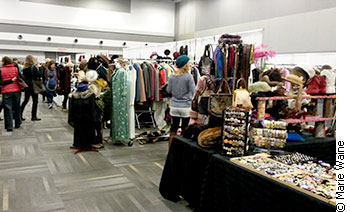
Customers browse through the vendors at the Ottawa Clothing Show
A record-breaking 60 vendors attended the Fall 2013 Ottawa Vintage Clothing Show, giving customers a lot to look through.

It feels like a time warp at the Ottawa Civic Centre. A buzz of excitement fills the air as a line twists and turns its way inside, waiting for the Fall 2013 Ottawa Vintage Clothing Show to officially begin. Men and women of all ages look as if they have stepped right off the pages of a vintage catalogue. Suspenders, mid-length skirts, red lipstick and armfuls of bracelets are everywhere.

The most noteworthy outfits seem to mash-up fashion favourites from decades past. One woman wears a polka-dot full skirt, a studded collared shirt and beat-up combat boots. Another wears a sleek shift dress with a feathered fedora hat. These outfits are as eclectic as they are witty and joyful.

The doors to the show finally open, and the buzz turns into a high-pitched squeal of excitement. Now the hunt for that one-of-a-kind find begins.

The mash-up

These one-of-a-kind vintage pieces make outfits unique. So unique, they are starting a new trend within vintage clothing: the mash-up. The mash-up mixes items from different eras into one outfit, to create a truly original look. The woman in the polka-dot skirt with boots and the lady in the fedora and shift are not the only two who have caught on.

Type “vintage fashion blogs” into Google: You’ll find many top-source posts showing bloggers in 1950s dresses paired with 1930s coats. Or glance at the New York Times’s video channel called Intersection. These videos showcase street style around the world — with, most recently, people wearing vintage pieces from all eras.

“I think, in the past, people wanted to be more true to certain eras,” says Catherine Knoll, co-organizer of the Ottawa vintage show, who says she sees the combining of different styles and eras of vintage becoming increasingly popular. “So if you wore something that was from the Art Deco era, you wanted to make sure your accessories, like your purse and your shoes, matched.”

Cocktail dress from collector Ian Drummond at the Fall 2013 Ottawa Vintage Clothing Show
This 1950s cocktail dress from collector Ian Drummond was just one treasure found at the Ottawa vintage show.

“Now,” she says, “I think people aren’t afraid to mix it up.”

“Personally, I don’t care what people think. If I feel like wearing a studded necklace with a floral dress and converse, then I will,” says Megan McClean, 20, an Ottawa fashion blogger for Broke the Blog.

McClean shops local thrift stores and vintage boutiques to find one-of-a-kind pieces for deals beyond belief, to showcase on her blog. She couldn’t agree more on mixing up these unique pieces.

“I notice, and usually admire, someone wearing a peculiar outfit that shows off their personality and one that I would never have thought to put together, over someone wearing an on-trend taken-straight-from-an-Aritzia-mannequin outfit,” says McClean.  And she is not the only young fashion enthusiast to catch on to the idea of vintage mash-ups.

“I personally love it when one person can wear a lot of different styles. I don’t think we should be confined to one style,” says Lacey Ward, social media coordinator and editorial assistant at FAJO Magazine, Canada’s leading digital fashion journal.

As the line to the Ottawa Vintage Clothing Show steadily streams inside, it is clear the attendees are not afraid to show off their array of fashion flair.

“They’re concerned with finding something unique and one-of-a-kind,” says co-organizer Knoll. “The typical vintage collector is no longer a purist but likes to mix and match pieces from different eras.”

The old and the new

Knoll says the other popular option is to pick one vintage piece and use it to showcase the rest of an outfit. Combining unique vintage finds with items already in your wardrobe is a great start for anyone who’s experimenting with vintage. Online fashion magazine DFW Style Daily agrees, reporting that now it is more popular than ever to see a mix of old and new as one style.

‘The typical vintage collector is no longer a purist but likes to mix and match pieces from different eras.’ — vintage show co-organizer Catherine Knoll

Ottawa’s boutique Victoire is hot on the heels of this mash-up trend. The Dalhousie Street shop sells a mix of new and vintage clothing and accessories. It also holds a vintage clothing sale every year. This vintage collection proves how easy it is to integrate pieces of the past into everyday style.

After all, these vintage pieces are what inspire the current trends in mainstream fashion.

“Vintage clothing is always prevalent for the trend setters and people looking for classic or funky pieces,” says FAJO Magazine’s Ward on the importance of incorporating vintage aspects into a wardrobe.

An article on FAJO’s website confirms the prevalence of the mash-up throughout North America. The article focuses on the trendy Greenpoint neighbourhood in Brooklyn, N.Y., where small, unique vintage boutiques are more popular than mass retail chains. In street-style photograph documentation, every person incorporates at least one vintage item into his or her outfit.

Individual style

Megan McClean from Broke the Blog poses in mash-up outfit.
Ottawa blogger Megan McClean poses in mash-up style, with a vintage sweater and a dress masquerading as a skirt.

At the end of the day, vintage clothing will continue to reinvent itself and find new forms of expression. The mash-up style that has evolved — whether it be mixing different eras in one outfit, or combining old and new — is just one of the new pathways to individuality through style.

“I’d say I always look for uniqueness,” says McClean about the pieces worth hunting for. “Whenever you wear your vintage finds, you’re creating a look that nobody else has. Mixing your pieces together is just another chance to show that and to branch away from the mainstream, mass-generation fashion.”

Gluten-free bakeries satisfy capital cravings

Gluten-free chocolate chip cookie sandwich at Auntie Loo's Treats in the ByWard Market

The comforting, nostalgic smell of freshly baked bread is the first thing that hits you upon stepping into Peter de Hoog and Gaetan Portelance’s Finally Gluten Free Foods bakery in the ByWard Market. The next is the realization that, despite the tantalizing aroma, there isn’t a trace of wheat on the premises.

‘You’re catering to a very desperate audience.’ — Charlotte Newton of Auntie Loo’s Treats

A gluten-free cookie sandwich with cream filling from Auntie Loo's bakery
No grain, no pain. At Auntie Loo’s, foods like this decadent chocolate- chip cookie come from alternative flours such as sorghum and quinoa.

Finally Gluten Free Foods is one of four bakeries in the capital where people with celiac disease can buy a loaf of gluten-free bread with complete certainty that it won’t make them sick. While generally in North America the choices aren’t extensive for the growing number of people who can’t consume gluten — the options often consisting of low-nutrient, expensive “boxed” foods, found in the frozen section of the grocery store — Ottawa food retailers are slowly but surely meeting the demands of the developing niche.

Celiac disease is the most severe form of gluten intolerance. Sufferers are unable to eat any foods containing or exposed to gluten, a protein found in grains like wheat and rye, because gluten hampers their bodies’ ability to absorb other nutrients. The condition currently affects approximately one in 133 Canadians, according to the Canadian Celiac Association — a “modest” figure, says De Hoog, since it doesn’t account for less severe intolerances (such as non-celiac sensitivity and wheat allergy, which result in gastrointestinal discomfort or rashes) or for unreported cases. There aren’t yet reliable statistics reflecting the increase in these less severe forms of gluten intolerance, but the buzz in public health discussion and in response to topical books like Wheat Belly certainly hints the numbers are on the rise. In their 2002 book, Dangerous Grains, James Braly, M.D., and Ron Hoggan estimate that 80 percent of people don’t produce enough of the enzymes necessary to digest gluten; they just haven’t put the pieces together yet. But when they do, there will be a lot of people unable to buy Wonder Bread anymore.

Ottawa Public Health inspection certificate
A gluten for punishment? Certified gluten-free bakers think there should be more rigorous regulation of bakeries.

“You’re catering to a very desperate audience,” says Auntie Loo’s Treats baker Charlotte Newton. Intolerant to wheat herself, Newton says baked goods, particularly bread, are very difficult to give up entirely, and so many people who can’t stomach gluten will seek alternative flours to satisfy their cravings. However, given the ease with which cross-contamination by gluten can occur — a single crumb or stray wheat flour particle can mean the difference for a celiac — shopping for gluten-free baked goods can sometimes be a minefield.

The perils of purchasing gluten-free

Right now there are four reliable gluten-free bakeries in Ottawa, according to De Hoog. Aside from his Finally Gluten Free Foods, he points to The Joy of Gluten Free, FUK (rhymes with “fluke”) Flour, and Strawberry Blonde as retailers that can guarantee products free from cross-contamination of wheat flour. Beyond this list, buyer beware.

We would challenge places that advertise as gluten-free to prove it.’ — Peter de Hoog of Finally Gluten Free Foods

Located right beside Finally Gluten Free Foods on Nelson Street, Auntie Loo’s offers some baked treats made with alternatives like chickpea and rice flour to accommodate customers with mild gluten intolerances, but because they have wheat flour in the kitchen, they warn buyers that all their products contain traces of gluten. Not all bakeries are as forthcoming: Darren Potvin, a gluten-free community activist and owner of FUK Flour in Manotick, is critical of cross-contaminated bakeries that mislead customers by touting celiac-friendly baked goods. He has had customers in tears in his shop because they’ve been given misinformation about other stores’ products.

Darren Potvin and Kathy Smart stand with an info booklet and some baked goods.
“Live the Smart Way.” Darren Potvin and nutritionist Kathy Smart work together to give advice on a gluten-free lifestyle.

“A lot of places are jumping on the bandwagon because [gluten-free] sells,” Potvin says. “But they’re not doing it right.” At the moment, the Canadian Food Inspection Agency is responsible for policing the designation of gluten-free facilities, but both Potvin and De Hoog say health inspectors just aren’t holding Ottawa businesses to account. “We would challenge places that advertise as gluten-free to prove it,” says De Hoog. He also encourages people to do their homework before buying gluten-free.

Aside from bakeries, Ottawans can find ingredients for gluten-free cooking in several places. Most supermarkets offer packaged flours like Bob’s Red Mill that are guaranteed gluten-free. There are also “gluten-free” sections cropping up in the freezer sections of some Ottawa supermarkets (Hartman’s Independent, for example). The downside is that the price tag can be a bit steep — and ditto for products sold at Ottawa’s four guaranteed gluten-free bakeries.

“You have to be savvy when buying gluten-free,” says Auntie Loo’s  baker Newton, who cites international supermarkets as a source for finding relatively inexpensive wheat flour alternatives. She says that at best, flours like spelt and chickpea can be around twice the price of wheat flour, but coconut, quinoa and sorghum flour can cost anywhere from three to five times as much.

Finally Gluten Free baker Portelance says that their flours can cost up to four times as much as wheat flour because they have to be freshly milled and shipped immediately to avoid cross-contamination, which drives up costs. A loaf of Portelance’s regular sandwich, rye or pumpernickel bread will set you back $7 (a wheat flour loaf of the same size at the grocery store might cost $3), but he says the extra few dollars are worth it because of his bread’s nutritional value — even aside from the fact that it’s gluten-free.

“People don’t need more chemicals and crap. They need real food,” Portelance says. His recipe took 600 attempts to perfect and contains two-thirds grains and seeds and one-third gluten-free starch. He claims it’s more wholesome an option than “gross,” slightly less expensive gluten-free bread in the freezer section at the grocery store, which he says is made with modified tapioca starch, too much salt, added sugar and preservatives.

Canada’s gluten-free capital?

Potvin of FUK Flour says Ottawa is one of Canada’s leading cities in providing gluten-free options, bested only by Vancouver and Toronto. He attributes this in part to efforts by community activists to provide resources (advice and recipes, for example) for people who need help living gluten-free. He says that award-winning nutritionist Kathy Smart is a “local gluten-free celebrity” who has been central in putting Ottawa on the map. Smart says that her gluten-free lifestyle show on Rogers TV, Live the Smart Way, was the first of its kind in North America.

In addition to support from Ottawa bakeries and nutritionists, Smart credits a strong Ottawa chapter of the Canadian Celiac Association, as well as the sharing of relevant recipes and cooking tips among Ottawans, with helping to bring Ottawa to the fore — despite there being only four dedicated retailers here.

Baker Peter de Hoog stands with a load of his best-selling gluten-free "Amazing Sandwich Bread"
Peter de Hoog says his bestseller is his “Amazing Sandwich Bread,” containing healthy ingredients and no gluten.

“I wouldn’t say we’re better equipped [to provide gluten-free products] necessarily,” Smart says. “I just believe that there is a strong gluten-free community.” As awareness grows regarding symptoms of gluten intolerance and celiac disease, the demand for necessary foods will also climb, she says.

Meanwhile, the guys at Finally Gluten Free Foods say the community is meeting the need for the time being: Non-designated bakeries like Trillium, Bread and Roses and the Wild Oat provide gluten-free options for people with milder allergies and intolerances, and the four designated bakeries cater to the rest.

As more people make the switch to a celiac-aware lifestyle, De Hoog says he can expect more designated gluten-free retailers to set up shop but isn’t worried about the competition. “We’ll need more places like mine that are going to diversify the market and offer people good-tasting food that’s wholesome.”

Ultimately, as in any diet, the onus falls on the individual with celiac disease or a gluten intolerance to make good choices about what to eat. And Ottawa’s gluten-free retailers have a unique opportunity, Potvin says: They’re catering to a captive market — people who will likely jump on any substitute for wheat-based treats. Retailers can take advantage of the chance to make wholesome, fresh options for people who might otherwise have only unhealthy “boxed” products to turn to.

“To me,” says Potvin, “if you live out of a box, you’ll just end up in one quicker.”

Twenty- and thirty-somethings set to turn Ottawa into arts capital

Ottawa may be set to shed its image as a sleepy government town with a recent boom in local arts and culture led by 20- and 30-somethings. “We are undergoing a 613 renaissance,” says arts blogger Ryan Saxby Hill.

The city has seen a burgeoning of cultural initiatives, particularly in the last year. According to Saxby Hill – whose blog Apartment613 has followed arts in Ottawa since 2008 – a momentum of recent years culminated in 2012 with Ottawa ‘firsts’ such as the Arboretum arts and music festival and an inaugural Nuit Blanche (an all-night arts festival held internationally), as well as magazine launches, new late-night restaurants, and international arts lectures like Creative Mornings.

Organizers say they anticipate these initiatives will continue this year, marking a shift in local arts and culture. Hip, innovative, and interesting music, art, food, and venues are on Ottawa’s new ‘cool’ menu, and the movement is growing. All of last year’s local arts and culture initiatives were successes – surprisingly so, some organizers admit.

Typographer Rod McDonald stands in front of a packed audience at SAW Gallery in Ottawa to talk about fonts and typography styles at Creative Mornings in November 2012
Typographer Rod McDonald talked about fonts to a full house for Creative Mornings at SAW Gallery in November.

“More than 30,000 people came out to the city’s first Nuit Blanche. I was blown away by the support and creativity in Ottawa,” says Megan Smith, a 30-something who co-curated the all-night arts festival, held on Sept. 22, 2012. “I am inspired as a curator and as an artist,” she says, explaining that organizers had expected only 10,000 people for the inaugural event.

The city’s Creative Mornings chapter, which is part of an international initiative started in New York City with chapters around the world organizing free arts lectures, has also been a hit, according to co-founder Michael Grigoriev, an industrial design student at Carleton University.

“Attendance [at Creative Mornings] has far surpassed our wildest dreams,” says Grigoriev, explaining that each of the monthly lectures, which started last March, has reached the capacity of 100 people at venues like SAW Gallery near the Rideau Centre. “We distribute tickets online, and they are snapped up immediately,” he says, noting the wide audience Creative Mornings attracts – from his peers to government employees and older professionals – by ensuring a variety of speakers, such as local tattoo artists, designers, chefs, and entrepreneurs.

“We have a lot to offer. We have a lot of talent in this city and opportunities to make with all that,” says Grigoriev. None of these initiatives are mandated by the City; they are all volunteer-run by “20-somethings who are realizing they should try to do something special in [Ottawa].”

“For too long Ottawa has been known as a boring government town,” he asserts. “People are tired of the status quo … tired of following Toronto and Montreal’s creative scenes and comparing themselves.”

Grigoriev, 26, is one of the millennials driving arts and culture initiatives in Ottawa. He emphasizes that recent successes like Creative Mornings and Nuit Blanche are part of a wider momentum and optimism that has been building in creative communities in the past six to 12 months, as attitudes among 20- and 30-somethings have switched from ‘Ottawa sucks’ to ‘let’s do something about it, let’s be proactive.’

Photo of the entrance to Ottawa's new Arboretum arts and music festival, held Sept. 15, 2012 at the Jail Hostel.
The Jail Hostel rocked with Ottawa’s first Arboretum Festival.

“There seems to be a critical mass of efforts and excitement lately,” agrees Rolf Klausener, a 30-something musician from Ottawa band The Acorn. “From one week to the next, people are putting on events … and just perpetuating the feeling that we are an active, thriving city.” He is his own example, having co-organized the city’s inaugural Arboretum Festival, showcasing local music, arts, and foods, on Sept. 15, 2012, at the Ottawa Jail Hostel and Arts Court downtown.

“Creative young people are not just leaving Ottawa anymore to go to Toronto or Montreal,” says Steve Harris, a chef in his early 30s who opened Two Six {Ate} on Preston Street in October. Instead, people are staying here to make their mark; they are not taking their talents elsewhere. Harris says he opened the restaurant with his girlfriend to fill a void: restaurants that offer quality local foods with full-menu service late at night. Two Six {Ate} stays open from 4 p.m. to 2 a.m. even on weekdays. Union Local 613 on Somerset Street West is another new restaurant opened by millennials, last July, to offer local foods later at night.

Stephanie Vicente, 27, a co-founder of the monthly publication Herd Magazine, which started in October to highlight Ottawa’s arts and culture, says these initiatives reflect that her generation is growing up. “All our parents are baby boomers who are getting ready to retire or already have so it is starting to open the door for us. It is now our turn to take on leadership roles in whatever industry we are interested in,” she says.

Photo of Herd Magazine co-founder Stephanie Vicente interviewing a 20-something local musician for the magazine's first issue.
Herd Magazine co-founder Stephanie Vicente interviewed local musician Adam Saikaley for the first issue, released in October.

“Everyone wants to be part of something fresh and interesting,” says Vicente, noting collaboration as another important factor in successful local initiatives. The collaboration a smaller city like Ottawa allows is nurturing the local arts renaissance, as creative communities become increasingly connected.

For example, she explains, Herd Magazine collaborated with Fall Down Gallery on Bank Street to host its launch party; this attracted more than 500 people to the gallery, providing a boost to fellow millennials who had opened that small business in 2011.

Similarly, Nuit Blanche brought business to downtown small shops, many run by 20- and 30-somethings, by partnering with them to host 120 art exhibits across the city.  The local venues included Victoire on Dalhousie Street and La Petite Mort gallery on Cumberland. Such collaborations raised public awareness of these businesses, says Vicente who attended the festival.

Photo of the two female artists who co-curated Ottawa's first Nuit Blanche in September 2012.
Nuit Blanche curators Megan Smith (left) and Lainie Towell topped up the night’s performance arts by inviting strangers to bed with them at various galleries.

New events also serve to complement older events like Ottawa Explosion (a punk music festival started in June 2011) and House of PainT (a graffiti and slam poetry festival held each September since 2003), to help build the city’s self-esteem and feed its creativity, says Nuit Blanche’s Smith.

The beauty behind the creative boom is that it is emerging from millennials’ genuine desires to do something with this city to build civic pride and community, says Grigoriev of Creative Mornings.

“We do our own things well,” he says, pointing to the innovative restaurants and festivals that Ottawa welcomed last year as testaments to local talent. “I think the city is slowly developing more discerning tastes and standards … We do not need to feel like second-class creative citizens anymore.”

Such sentiments are expected to continue this year as lessons in civic pride carry over. Creative Mornings and Nuit Blanche are gaining traction, organizers say. Herd Magazine is launching its second issue, in January 2013, and Arboretum Festival founders say they are planning more local music and food-based events for 2013.

Despite the successes of 2012, organizers admit they may need some municipal funding to grow beyond independent, small-scale festivals, lectures with restricted capacity, and free magazine.

But for now, it is simply about celebrating local talent as the city nurtures a more artistic identity, says Vicente. “I think Ottawa is finally accepting [it] is Ottawa … It is not about trying to be Toronto or Montreal.”

Homeless youth, beading for a better tomorrow

In his green collared shirt and dress pants, Michael Tremblay doesn’t look like someone who will be leaving work only to spend another night at the Ottawa Mission shelter. His co-worker James, who asked that his last name not be disclosed, says he’s still in his “couch-surfing stage.” For these two, the fight against homelessness began two years ago.

Tremblay, now 22, first arrived to the capital city by hitchhiking from his home in Nova Scotia. There were simply too many demons at home, he explained. “Every day there was family drama, family issue,” he says. “I had to remove myself from that scene.” After a month with the Occupy Ottawa movement, Tremblay eventually found himself without work for two months. “I basically McGuyvered it and went on nothing,” he says, laughing. Each day was a new challenge, he explains. He had to make do with whatever he had on hand.

Now employed at Operation Come Home’s BeadWorks workshop, Michael Tremblay, 22, arrived here two years ago on his own.

For 28-year-old James, severe depression and anxiety left him without work, pushing him into financial turmoil. The street life exposed him to a world of “long-time drug and alcohol addicts,” and he was appalled. “I needed food; I needed a safe place to be because at a lot of the places downtown, and with the street services, you come across bad people and things,” he says. “I just didn’t want to be around that.”

Then James and Tremblay discovered Operation Come Home (OCH), an Ottawa-based support centre for homeless or at-risk youth. The organization offers multiple employment programs and support services for “street youth.” Among these is BeadWorks, a workshop where homeless youth design and create one-of-a-kind jewellery. The pieces are then sold at Re:Purpose, the OCH storefront at 150 Gloucester Street.

“One day, I just set foot in here and didn’t know what the hell I was doing,” Tremblay recalls his first visit to BeadWorks. “I just sat my ass down and tried to make whatever I could.”

Similarly, James frequented OCH for their many services and stumbled upon BeadWorks. Through the program, he uncovered his talent for beading and jewellery making. Now his jewellery and t-shirt designs are displayed at Re:Purpose. For each sale, the individual youth receives 75 per cent, and the remaining 25 per cent goes towards Re:Purpose and the BeadWorks program.

Helping the homeless

OCH receives much sponsorship and support from the City of Ottawa and various companies throughout the city, such as United Way Ottawa, says OCH executive director Elspeth McKay. The OCH Board of Directors comprises distinguished members of the Ottawa community, from the Ottawa Police Services to small business owners. With this assistance, OCH is able to provide other hands-on programs, McKay explains, such as FarmWorks, where youth can learn about farming and agriculture. They also offer literary courses, like Finance Matters, to provide lessons about debt, savings and budgeting.

Located at 150 Gloucester Street, Operation Come Home hosts multiple employment and educational programs for street youth.

At the OCH’s Re:Purpose store, there are products from BeadWorks and other businesses with mandates for a social cause. Items include fruit jams made by disabled youth, or handcrafted cards with a focus on environmental awareness. McKay hopes to soon display work from young artists, including a focus on using recycled material.

“This way we have what I call a triple or quadruple bottom line,” she says. “There is this eco-friendly emphasis, and the fact you’re employing at-risk or homeless youth when you buy products from them. Then there’s the fact they have an opportunity to be creative in a safe environment.”

At Re:Purpose, Tremblay and James serve as staff members, working four days per week for minimum wage. The cash they receive mainly goes towards clothing and food, Tremblay says, though he admits it also helps him pay for his cigarettes.

McKay says BeadWorks’s focus isn’t just about providing opportunities for cash. Instead, the program gives the youth some relief from the harsh world of homelessness. “I think it gets them thinking of other things rather than where they’re gong to sleep at night or how they’re going to cope with the fact they don’t have enough clothing. These are things we take for granted.”

Yet challenges persist, McKay explains. The main challenge for Re:Purpose, and for many social enterprises, is finding a business model that is profitable and continues to address social issues. That’s where new volunteer Manjit Basi comes in.

Once the owner of the Ottawa cosmetics store The Body Shop, Basi is no stranger to successful social enterprises. The Body Shop, she explains, boasted an extremely successful business structure, while remaining true to its eco-friendly mandate. With her experience, she hopes to teach the Re:Purpose youth more about the retail world, such as how to create an inviting sales environment or market a product or publicize a good story.

Jewellery on offer at Re:Purpose. Every dollar that customers spend at Re:Purpose guarantees 75 cents for homeless youth.

First, Basi needs to ensure that Re:Purpose stocks quality products that are relevant to customers. “At the end of the day, if they don’t want to buy, you’re not going to make any money, no matter how good the cause is,” she says. “A good story with a [bad] product isn’t going do anything.”

Looking to the future

It’s a great start that Re:Purpose now showcases young, local talent, including BeadWorks’s youth, Basi says. There are more sales happening, and the storefront is heading in the right direction, she adds. For long-term growth, she hopes she can teach the young people more about pricing, and encourage them to follow retail trends. “So far, the youth are so engaged,” Basi says with utmost enthusiasm. “I think they’re so smart, so talented and hungry for knowledge.”

This is especially true for James. With the experience of Beadworks under his belt, he hopes to find his way into a college to study fashion design and launch a career.

Meanwhile, Tremblay will be adding his work to his résumé and hoping to reunite with family in Montreal and find stable employment. This desire to regain the right path is one shared among all street youth, he says, despite any drug or alcohol addictions or personal problems.

“We want to move on and find our own way,” Tremblay says. “This place has helped in more ways than I can understand.”

A capital place to film?

It’s no secret that many of America’s biggest movies are actually shot in Canada. Big-name films like Total Recall, Twilight and The Day After Tomorrow were shot in Toronto, Vancouver and Montreal, respectively. In fact, these three cities pop up in nearly every discussion of Hollywood filming in our home and native land. Other major cities, like Calgary, Winnipeg and even Halifax are mentioned from time to time.


Ottawa equates to a generic city, in a scene for the 2011 Lifetime movie Another Man’s Wife.

But what about Ottawa? What films have been shot here? This list is surprisingly short. Sure, a few well known films like Batman and Robin, The Sum of All Fears and most recently House at the End of the Street used Ottawa for part of their shooting schedule, but the city still can’t compete with the other major shooting locations in Canada.

As Canada’s fourth-largest city, and the second-largest in Ontario population-wise, Ottawa logically should have a decent number of people interested in developing the local film and television industry. Yet this list is also surprisingly short. Near the top of it is the name Neil Bregman. As founder and president of Ottawa’s largest film production company and a producer of countless films, Bregman has plenty of experience under his belt. His company, Sound Venture Productions, has evolved over the years from focusing on radio commercials and audio production to film and television productions and more. Some of Bregman’s most recent work includes producing the made-for-television movies Fugitive at 17, My Mother’s Secret and The Wife He Met Online. All three were filmed in Ottawa.

Bregman sat on the board of directors for both the Canadian Film and Television Production Association and the Ottawa-Gatineau Film and Television Development Corporation, for nine and four years, respectively. He chose to leave the CFTPA, while the OGFTDC was dissolved. Bregman worked very hard to develop a film industry for the city, but despite his best efforts, he could do only so much.

“It’s just not a production town; it’s a government town,” he explains. “There’s never really been a lot of effort into attracting business here. We don’t have a lot of infrastructure or critical mass, so it’s a struggle to work here.”

Ottawa’s filming challenges

‘We don’t have a lot of infrastructure or critical mass, so it’s a struggle to work here.’ — producer Neil Bregman

Bregman says creative and human resources are a large part of the infrastructure that Ottawa needs, to grow its industry. There needs to be equipment and rental services, production facilities and the talented people to attract other people and companies to the area. Even tax incentives, something to attract productions, prove to be a pain, according to Bregman. “Our boundary is split between Ontario and Quebec, and that makes the provincial tax credit evaluations very difficult. This makes things more complicated than necessary, and many don’t like dealing with that.”

One of the other missing pieces to the puzzle is a sound stage, a building used for film and television productions. Most other major Canadian cities all have at least one sound stage, allowing for indoor sets or even motion capture for scenes requiring extensive computer-generated imagery. Without a sound stage, Ottawa doesn’t offer enough to attract local or foreign production companies.

“All the really good people don’t stay here. It’s hard to build the critical mass to keep people here without the incentives that are necessary to attract business and keep it going here,” Bregman says. “That’s something that Invest Ottawa is trying to do.”

Putting Ottawa on the A-list


Geneviève Ménard-Hayles is the commissioner of the Film, Television, and Digital Media office at Invest Ottawa.

Invest Ottawa is the city’s not-so-secret weapon trying to do what couldn’t be done in the past: develop and grow a viable film industry. The company’s Film, Television, and Digital Media office works with the City of Ottawa to help attract film and television productions. The FTDM office also collaborates with the National Capital Commission to review applications before issuing any filming permits. Certain high-profile areas, like Parliament Hill or the city’s schools, can be filmed only under certain circumstances. For example, a horror movie probably wouldn’t be allowed to be shot inside Parliament, but a Jack Layton biography would have a much better chance.

Much of the FTDM office’s work is left in the hands of Commissioner Geneviève Ménard-Hayles. Being essentially in charge of this whole operation, Ménard-Hayles is a very busy person. In fact, when reached for comment, she had just returned from a Los Angeles trip the night before. She was there on a mission to get big studios interested in Ottawa. Ménard-Hayles acts as a sort of envoy between Ottawa and various production companies, to show them what this city is all about.

“I had over 30 appointments specifically for Ottawa, to get these production companies such as Warner, Disney and Paramount to think about Ottawa,” she says. “They were very happy to hear from us because it’s a new destination — it’s fresh. The locations haven’t been used; it’s film-friendly; and the cost of shooting is cheaper than Toronto, Montreal and Vancouver. So it’s a huge competitive advantage for our region.”

While a lot of focus has been on shooting costs, Ménard-Hayles mentions the variety of locations. “The roster of locations we have to offer here in Ottawa is something the studios are really keen to know more about and explore with us,” she says. “Being able to shoot at one location downtown, and 20 minutes later you’re on a lakeside somewhere else, is something completely different.” The short travel time between Ottawa locations may provide an edge, compared to other popular shooting destinations.

A sound idea

‘Being able to shoot at one location downtown, and twenty minutes later you’re on a lakeside somewhere, is something completely different.’ — promoter Geneviève Ménard-Hayles

Ménard-Hayles also acknowledges the need for a sound stage. “If we don’t build this, we just aren’t going to be able to grow our industry. This is what is needed to take us to the next level.” Invest Ottawa had put up $1.5 million towards the construction of a sound stage late in 2012, and several companies put in bids to receive such funding. Neil Bregman, backed by many key players in Ottawa as well as a company from L.A., had put in a bid. By January 2013 Invest Ottawa rejected Bregman’s bid without giving any reason. Bregman says the sound stage funding will go towards a company from Toronto, but details are still scarce as Invest Ottawa has remained tight-lipped.

With a sound stage in place, Ménard-Hayles says she believes Ottawa really will be a one-stop shop for many films. Bregman says he is more skeptical, explaining that a sound stage elaborate enough to attract larger productions may be out of Ottawa’s reach at the moment. “People who go to sound stages expect a certain level of facilities, infrastructure, resources and experience. They’re a very difficult thing to compete with when you’re talking about Montreal, Toronto or Vancouver.”

He says the city should expect a sound stage geared towards smaller low-budget productions, a point Ménard-Hayles also makes clear. Ottawa already has numerous companies in the city dedicated to smaller productions. These include Zed Filmworks, which co-produced the recent House at the End of the Street, and Affinity Productions, which specializes in production and post-production services for smaller companies.


A strong political lobby? The 2013 film The Perfect Boss made good use of several Ottawa building interiors.

Aside from children’s programming animation, Affinity Productions has a tendency to work with non-fiction productions, but this is something that may change in the future, according to Post-production Supervisor David Zimmerley.

“While we are not currently in the business of producing fiction, we already offer a variety of services to a number of fiction features each year,” he explains. “Our client base is very mixed, and as our client base expands in the coming years, so will the services they may require.”

Since many local companies deal with government or corporate videos, shifting their focus would be necessary to further develop the local film industry. Otherwise, Ottawa will have to rely on foreign companies, like the ones Ménard-Hayles talked to while in L.A.

Despite Bregman’s skepticism (or is it realism?), the future may be bright for Ottawa, once the sound stage is built and the city’s infrastructure is improved upon. Ménard-Hayles seems to think so.

“Ottawa has been named one of the top creative cities in Canada, but nobody has really told the story. So our goal for 2013 is to let everybody know what will be happening in Ottawa. We’re going to tell that story through what we’re doing for our film industry.”

Ottawa’s music scene: ch-ch-changing

Is live music disappearing from Ottawa nightlife? If so, the PepTides didn’t get the memo: Business is booming for the eccentric Ottawa pop group.


Barrymore’s once hosted bands as big as U2. Now weekends are dominated by electronic acts like Cosmic Gate and Project 46.

“We’re still doing well,” says singer and multi-instrumentalist Claude Marquis, whose band has pervaded the local circuit, playing Irene’s Pub, Ritual, and the Black Sheep Inn two times apiece since January 2012. “We keep getting asked to play. Wherever we end up playing, they sort of respond, ‘We got to have you back.’ ”

But despite the busy schedule of certain Ottawa bands, rumours of the live scene’s gradual demise here have gained considerable traction recently.

Over the past 12 months, two of Ottawa’s more prominent live music venues – Tucson’s and LiVE Lounge – have closed their doors. A recent ownership change at The Elmdale has threatened live music’s future at the Hintonburg hotspot. And Barrymore’s, Ottawa’s iconic rock sanctuary, has embraced the economic allure of top-40 and electronica, distancing itself from its own live music roots. This leaves but a small group of local institutions – the most prominent being Zaphod Beedlebrox, Ritual, Babylon, and Mavericks – as the city’s remaining bastions of live music. In light of the foreboding signs, there’s a discernible ambivalence among Ottawa’s purveyors of live music as to the health of the scene.

A scene in flux

“There’s lots of clubs that are still doing live music that are still doing great,” says Adam Kronick, owner and operator of Bank Street’s Babylon nightclub. “It’s hard to generalize about the whole industry of live music in the city based on a select few wanting, for whatever reasons, to make a change.”

Babylon’s proverbial king since the club’s inception in May of 1998, Kronick was quick to dispel any notion of live music going extinct in Ottawa. Despite his protestations, however, Babylon has amended its own live music mandate in recent years, incorporating more electronica and DJ performances to keep up with music’s transient trends.

“We’re keenly aware that we need to be evolving and responding to new aspects in the market,” he says. “To be still successful after a number of years, you need to evolve your business model. We’re still evolving our business model all the time.”

‘You get DJs booked constantly now. Hopefully it’s not the death of the scene in Ottawa. But it’s definitely changing.’
– Blake Brooks, pub manager

However, Kronick refuses to suggest that ever-evolving musical trends portend the end of live music in the city. “I think it’s really hard to to say from a few examples that live music isn’t going well in Ottawa. I think it’s exactly the opposite,” he says.

Blake Brooks, manager of Oliver’s Pub and Patio, doesn’t share Kronick’s optimism. He says new musical tastes represent a threat to the live scene.

“You get DJs booked constantly now; that’s what younger people are listening to,” he says.  “Hopefully it’s not the death of the scene in Ottawa. But it’s definitely changing.”

Brooks fondly recalls his formative years as a Carleton student, when up-and-coming Canadian rock bands would frequent Oliver’s pub, and boisterous crowds would gleefully croon along. These days, however, Oliver’s seldom hosts events featuring live music, and when they do, it’s certainly not marquee acts that are performing.

While renovations have played a large role in the evolution of Oliver’s – the current floor plan isn’t entirely conducive to live music – Brooks says the change has more to do with economics than anything else. “I like it when we do stuff here,” Brooks says of hosting live music, “but we just don’t do it enough, I guess.  It’s a money thing more than anything, probably.”


Thirsty Thursdays, a weekly staple at Oliver’s, features DJ performances and routinely draws large crowds.

‘Live’ not dead yet

Though the musical zeitgeist might dictate that electronica is the style du jour, Kronick points to Ottawa’s hugely popular music festivals as an indication of the local appetite for live acts.

Attendance at Ottawa’s Bluesfest – lauded as the second largest blues festival in North America – has grown exponentially since 1994, when the event became an annual staple. More than 300,000 people attended Bluesfest 2012, a 12-day musical binge highlighted by performances by Alice Cooper, Our Lady Peace and Snoop Dogg.

“There’s obviously fans that want to go see music,” says Kyla Clarke, a concert promoter who’s routinely blown away by the Bluesfest crowds.  “Why don’t they do it all the time?”

Clarke, who works for the popular Ottawa rock station 106.9 the Bear, says that contrary to popular belief, the infrastructure for a vibrant live music scene still exists in the nation’s capital; she cites the emergence of groups like the Balconies and the Love Machine as testaments to the wealth of local talent. However, it’s become increasingly difficult to get people to show up to see lesser known bands at more obscure venues, she adds.

“I think there’s probably a lack of promotion going on across the city,” says Clarke. “I think people have this idea that like, ‘Oh, no one is going to go, so I’m not going to go.’ ”

And indeed, this perception has compelled club owners to place a greater emphasis on DJ performances. Yet even though electronica has impinged aggressively on live music venues in recent years, some musicians don’t seem to mind. Marquis, whose band performed on Bluesfest’s main stage in 2012, says the two styles can coexist harmoniously.

“There’ll always be a place for both, I believe – for the DJ aspect and for live bands,” Marquis says. “I don’t think it should be a competition. There’s a place for every different kind of art form.”

In fact, Bluesfest 2012 featured an unprecedented number of electronic acts, including performances from MSTRKRFT and Skrillex. But according to Mike Rouleau, Bluesfest’s director of operations, the festival’s identity remains intact.


The retro PepTides, very much live onstage at Bluesfest 2012.

“The vast majority of the festival is still driven by bands and live music and live performances,” says Rouleau, who adds that electronic acts claimed the main stage headlining slot on just two of the festival’s 12 nights.

Meanwhile, the PepTides’ schedule remains full. Admittedly, they don’t play as often as they could, but that’s for fear of exhausting their repertoire.

“We sort of have to refuse some of them,” says Marquis, whose band has sojourned to places like Mississauga, Ont., and Fredericton, NB., in recent months to tap into different markets.  “We can’t tire out our audience by performing every weekend.”

But while the PepTides have yet to feel the blowback of Ottawa’s evolving music scene, the consensus remains that the times are a-changing.

“I’ve seen some of those DJs at those venues, and they’re packed,” says Oliver’s Brooks. “People are going to see something, but maybe it’s changed so much.”

Eco-friendly goes mainstream

Terra20
Green becomes massive at Terra20, Ottawa’s first eco-friendly department store, in one of the city’s biggest malls.

Ten years ago in Ottawa, you couldn’t find an eco-friendly store, a place that sells products that aren’t harmful for the environment, if your life depended on it. Yet at a certain point things changed. Independent local entrepreneurs started to invest in this untapped market. Today, eco-friendly fashion has definitely emerged as a mainstream trend: There are more than ten boutiques around Ottawa, a fairly large number for a small city.

But being part of the mainstream means that bigger players will join the game. Last September, Ottawa’s first eco department store was opened. Terra20, at Pinecrest Shopping Centre, boasts 20,000 sq. ft. of eco-friendly products that range from apparel to cosmetics.

Clearly Terra20 is just the first of many to come. But will eco-friendly megastores murder smaller businesses?

There are mixed opinions about this. While the argument exists that eco-friendly boutiques and department stores cater to different clienteles, some observers fear that big stores naturally will put small stores out of business because of lower prices. Others see Terra20 and the like as an opportunity for eco-friendly products to become even more popular.

Emma Inns
Adorit Boutique owner Emma Inns was inspired to open her fair-trade and eco-friendly store in Ottawa after a life-changing experience that she had, observing sweatshops in Tibet.

Two different lifestyles?

Emma Inns is the owner of Adorit Boutique, an eco-friendly small store on York Street. “I don’t support the idea of a big department store, but we’re definitely not in competition,” she says. She thinks that Terra20 will not affect smaller businesses like hers because it is aiming for a different type of customer. Inns says that there are two groups of people who buy eco-friendly: ethical shoppers and trend shoppers. Ethical shoppers make a conscious choice because they believe in changing the world through small acts, while trend shoppers think it’s cool and affordable to buy these products. Inns believes ethical shoppers would not be attracted by a big department store because they support local independent businesses.

Pamela Tourigny, community manager for Terra20, concurs. “Our intent is not in any way to siphon off the business from the smaller stores,” she says. Tourigny doesn’t think Terra20 will have an impact on smaller businesses; on the contrary, she hopes it will actually help increase sales for smaller stores by creating a larger awareness about eco-friendly products.

Bulk items, lower prices

But some see the risk that competitive prices at large department stores might steal business from the small independents. Laura Ferrari, a 25 year old who has just entered the workforce, considers herself an ethical shopper. However, she says that she would definitely go to the department store if it sold the same products at lower prices, because that would still be an ethical choice for the environment.

Nevertheless, Inns doesn’t think that lower prices will lure consumers straight to department stores. Many eco-friendly shoppers prefer the smaller stores because they offer an experience of exotic diversity. Also, these people usually love thrifting and second-hand, which are not things you would find at a department store, says Inns. “It’s a whole different atmosphere from the corporate one of department stores.” However, Inns concedes, trend shoppers will be attracted to bigger stores because they offer a greater diversity of products at one location.

Amelie Lavigne, 21, a student who shops eco-friendly, sees only good news in Terra20’s arrival. She sees a big opportunity for the environmental movement to become more popular. She argues that if it remains a niche market, it will never make much difference to the planet’s health. “The more people are aware of eco-friendly products, the more chances there are that it will become the norm rather than the exception,” she says.

The rise of eco-friendly

Customer looking at clothes
Terra20 offers customers eco-friendly products in a more organized and conventional big-floor environment.

Obviously, the opening of a department store like Terra20 means that there is already an eco-friendly Ottawa market. One reason why, observers say, is thrift. In fact, store owners like Inns say that eco-friendly did really well in the recession because many boutiques offer second-hand clothes, which are a cheaper alternative as well as a good environmental choice.

Another reason why eco-friendly is growing is that the clothes themselves have become more beautiful and fashionable, according to Sarah Barr, owner of Green Tree Eco Fashion. “These clothes are not just plain and ugly any more,” she says. Many designers now make eco-friendly clothes that are as sophisticated as the ones by the greatest fashion brands, she says. Barr also argues this is allowing the products to be separated from certain lifestyle labels. “Now you can wear eco-friendly without being considered a hippie,” she says. This is definitely attracting different kinds of people to buy eco-friendly, beyond the traditional ethical consumers mentioned by Inns.

One sign of the times was Ottawa’s first Eco Fashion Week, held two years ago. People in the capital really care about these products, and the demand for them is constantly increasing.

A little big problem

Annabelle Boudreault, 21, an Environmental Studies graduate from the University of Ottawa, agrees that eco-friendly has become a very profitable business. In fact, she says, big retailers the world over are starting to notice it. She doesn’t see the emergence of eco-friendly department stores as a negative thing, because it means that more people will have access to these products. The main problem lies in that retail stores usually seek expansion, and that is not a good thing for the environment, she says.

In fact, Terra20’s Tourigny confirms that the owners are hoping to open many other stores in Ottawa and Toronto. “We are planning an aggressive expansion in order to reach more people,” she says.

Boudreault fears that Terra20’s expansion will mean more waste production and energy consumption. “Stores have to remain local and sustainable if there is to be a real benefit for the world,” she says.

‘Some people are uncomfortable with the idea of shopping their way to sustainability.’ – Terra20 spokesperson Pamela Tourigny

There is also the baseline problem that large department stores depend on sales volume. Boudreault sees an inherent contradiction within this, because selling more means more environmental waste.

Surprisingly, Tourigny agrees: “I think that some people are uncomfortable with the idea of shopping their way to sustainability, because we really need to be reducing consumption.” That’s why Terra20 offers high quality products that people don’t have to replace constantly, she says. However, Tourigny believes a lot of people aren’t ready to abandon having nice new clothes for the sake of a life of perceived sacrifice. Terra20’s role is to fill the gap, so that such people can own nice things that are environmentally sustainable, she says.

Boudreault argues that the way stores like Terra20 choose to make money will determine whether they will be positive for the environment or not. Will they make responsible choices and remember that one of their objectives is to help the environment? Or will their overriding goal, at the expense of all others, be profit? Nevertheless, she is optimistic that eco-friendly department stores will aim for the right direction, if only for public-relations considerations: Consumers everywhere are really starting to understand the extent of the consequences if real change doesn’t take place.

“We’re coming to the point of realization where people know that we have to take action before it’s too late,” says Boudreault. “I hope that the shift will come really soon.”

Creation by destruction: the rise of glitch art

As Clint Enns pulled apart the wires inside his Atari computer, the world of the racing videogame onscreen began violently to collapse. Dozens of lines and chunks suddenly emerged from images of the sky and ground.

Glitch, please. Digital artist Carrie Gates says glitch will gain more respect once critics understand the artists’ methods.


Flashes of blue, yellow and purple static swallowed the car and roadway whole. Even stranger was the fate of the “start” sign hanging over the pavement. “Every time I’d hit a few wires together,” the Toronto filmmaker recalls, “the ‘st’ would go away and it became ‘art.’”

The chaotic footage, shown at Gallery 1C03 in Winnipeg,  is just one example of glitch art — a growing movement of artists manipulating technology to produce colourful and often abstract images. The genre has become not only the latest look in art, entertainment and fashion worldwide, but also a reflection of concerns about our technology-driven culture.

At its core, glitch art is created by running visuals through programs and devices they weren’t meant to be shown in. This is known as “databending” for images and “datamoshing” for videos. The method lets artists toy with a visual file’s code, the digital skeleton that shapes the overall image. Removing one “bone” in one spot might create a series of lines on the surface; adding a bone to another spot may change how part of the image is coloured. One popular method is “analog glitching,” the use of broken laptops, cameras and other devices to alter this file code.

Not only is it the latest look in entertainment and fashion, but it also reflects concerns about our technology-driven culture.

Because glitch artists can’t exactly control how their images will turn out, many are drawn to the genre by the element of surprise. “Errors are unexpected and exciting,” says Enns. “You can look at the canvas and say, ‘I made that? Wow that’s cool. I’ve never seen anything like that before.’” Designer and glitch artist Rob Sheridan, creative director of music acts Nine Inch Nails and How to Destroy Angels, considers the touch-and-go method to be more like cooking than painting. “The process injects new ideas, and you can react to how they feel and follow certain paths. It’s sometimes a much more inspiring way to work than staring at a blank document and relying entirely on your own brain to fill in every pixel.”

A dash of chaos

Glitching also creates vibrant and visually pleasing rays of colour, is do-it-yourself-friendly and is still very much uncharted territory. Given these features and the supportive online glitch art community, it’s not hard to see why the genre has moved steadily mainstream in the last ten years. Following the 2005 creation of the “Glitch Art” Flickr group,  more and more artists  have connected via wikis, blogs and forums to share their art, learn new glitching techniques, and support each other’s work. For example, South Korea–based artist Mathieu St-Pierre saw his “Glitch Artists Collective” Facebook group grow to 135 people after only one month. “With sites like Facebook, you can get genuine feedback on what you’re doing,” he says, adding that the glitch community has given him more confidence in his work. “It pushes you to not to make the same thing and try to be original.”

How to Destroy Angels is one of several music acts with glitched promo material. Clockwise, left to right: Mariqueen Maandig, Trent Reznor, Rob Sheridan, Atticus Ross.

Today, the glitch look has become part of our culture. After discovering the genre, Sheridan used Photoshop to glitch the album artwork for Nine Inch Nails’ With Teeth (2005) and Year Zero (2007) to reflect the industrial rock group’s chaotic sound. In 2009, Kanye West’s music video for “Welcome to Heartbreak” was glitched with datamoshing. In 2010, Colorado artist Kristopher Collins launched the glitching app Decim8 that lets users databend their photos with the touch of a button. In 2012, fashion designer Karl Lagerfeld and electronic musicians Skrillex and Diplo began using glitch in their ads, promotional images or videos. Glitch artwork and video have been exhibited in places worldwide including the Share art festival in Italy, Oslo Art Academy in Norway and the Vancouver New Music Festival. An annual glitch art conference, appropriately titled GLI.TC/H, began in Chicago in 2010 and has since travelled to the Netherlands and United Kingdom.

Meanwhile, Sheridan glitched the 2010 artwork for The Social Network soundtrack album (through databending) and for his own group How to Destroy Angels’ 2012 “An Omen EP” (through analog glitching). Sheridan says he chose glitch art to reflect the theme of information overload present on both albums. “It’s an inevitable reaction to the world becoming more digital. There’s just something cathartic about unleashing errors and chaos into ordered systems. It’s like bringing some humanity into the machine — imperfection being, really, the essence of humanity.”

The medium is the message

The unease with our culture of perpetual upgrading is carried by fellow glitch artists including Carrie Gates, a digital media designer from Saskatoon. “I’m really frustrated with the hyper-clean vision commercial technology is pushing forward,” she says. “I don’t like the idea that everything is so controlled and idealized. There’s so much more complexity to life that glitch art enforces.”

Similarly, as filmmaker Enns explains, it comments on our fixation with upgrading and obsolescence. “As an artist, it’s great: I have access to cheap cameras within months of them coming out. As someone living on this planet that’s slowly being destroyed due to overconsumption, it’s not so great. It’s one of the political aspects of glitch art, revealing that newer isn’t better.” Other artists, Sheridan notes, are driven by a curiosity or plain subversive urge. “Glitch draws in the type of people who get a new tool or a new device or new software, and think, ‘How can I use this in a way that wasn’t intended, and get interesting results?’”

Accidental “Art.” Clint Enns made the glitch video prepare to qualify on an Atari running the 1982 racing game Pole Position.

Some critics dismiss glitch as a mere button-pressing exercise that only produces jarring images. In their essay “Notes on Glitch,” glitch theorists Hugh S. Manon and Daniel Temkin note that GlitchBot, an automated Flickr account, parodies how repetitive the genre can be by randomly glitching and uploading images to Flickr’s “Glitch Art” group. Many appear as similar blocks of static. Artist Gates counters: “It actually takes a long time and a lot of practice to hone your craft. It just looks easier to them because it’s digital. Eventually, with a greater understanding of how and why these pieces are produced, the respect will come.”

But will glitch become a victim of its own success? As the look gets co-opted into big-money advertising and promotion, will it lose that very subversive bite that has made it worthy? “I don’t think so. It proves that glitch art can sooner or later stand as an art movement,” St-Pierre says. “Commercial media will get saturated with certain glitch effects, but it pressures artists to come up with new glitches and visuals to keep the movement alive.”

What’s certain that you’ll be seeing more glitch art in years to come, as new technologies continue to provide platforms — and issues — to connect artists and audiences. “Glitch art is about trying to figure out, experiment with, and demystify the technology that we’re using,” Enns says. “That impulse will keep going.”

A new chapter for library e-book lending

Ottawa Public Library
Ottawa’s public library is one of many Canadian branches fighting for more freedom in loaning best selling e-books to Canadians.

When J.K. Rowling’s latest book, Casual Vacancy, hit shelves in late September, it was already number two on Amazon’s bestseller list. The book sold over 600,000 copies in its first three weeks, and fans lined up at bookstores across the country to get their hands on a copy. Libraries quickly ran out of physical copies to lend and began compiling waiting lists for the book. But for patrons with e-readers, they too were forced to either buy the book or go on a waiting list for a hard copy version from their libraries. That’s because Canadian libraries are not allowed to loan out most bestselling books in an e-book format.

While e-readers and e-books are gaining in popularity among Canadian readers, publishers are restricting library access to bestseller e-books. It’s a move that seems counterintuitive, but publishers say it’s because they’re looking to save money. They argue that allowing libraries to lend e-books unrestricted will lead to illegal sharing and downloading of the content by users.

Restrictions currently in place include (1) allowing only a single copy of an e-book to be loaned to one person at a time, (2) limits to how many times the e-book can be loaned before the library needs to buy the book again and (3) not allowing any e-material to be loaned at all. For example, HarperCollins allows an e-book to be loaned only 26 times before the library has to purchase the license again, while Penguin Group allows only certain books to be loaned in an e-book format.  None of the “Big Six” publishers (MacMillan, HarperCollins, Penguin Group, Hachette Book Group, Random House, and Simon & Schuster) responded when contacted for comment on the issue.

But Monique Brûlé, manager of collections at the Ottawa Public Library, says these restrictions don’t look likely to be in place forever. “There is some sort of room to grow towards allowing us better access to their e-books,” she says when speaking of recent negotiations with publishers.

Fighting to go digital

A pilot project being launched this year by the Canadian Urban Libraries Council (CULC) e-Book task force is taking advantage of the discussions with publishers. The project is being considered as a breakthrough by many Canadian libraries in the tension between publishers and libraries over e-book lending. “We are looking at developing a shared portal where we would be able to purchase content directly through publishers and make that content available directly in our existing library catalogues that we use for physical material,” says Jennifer Stirling, a member of the CULC e-book task force. The group hopes to run the pilot for approximately six months to allow as many Canadian libraries to sign on as possible.

With so many Canadians now turning to digital reading, libraries need to keep up, by offering more e-books.

The pilot would allow publishers to see how giving libraries the ability to purchase e-book content directly from publishers would work, and hopefully ease the restrictions currently in place, Stirling says. The project is similar to one being launched in the United States. Stirling says the outcome of that project will help determine the success of the CULC pilot.

The pilot will also give libraries more flexibility than currently allowed through the digital distributor used for e-book lending. North American libraries use a digital distribution system called OverDrive to lend e-books. It is through this system that publishers supply e-books for libraries to use, removing any direct communication between libraries and publishers. The project will change this method, allowing for direct communication between the two groups.

Kristen Cavanagh of the Brampton Public Library says libraries need to break away from the habit of being a passive institution. “Libraries tend to accept whatever is handed to us. We need to be the people who make the decision: ‘We are not going to buy from you until you go ahead and do this,’” she says. “But that’s not really library culture; we don’t tend to push the envelope, and as a group we should.”

E-readership rising fast

There are high hopes for the CULC pilot project, which may force publishers to finally negotiate with libraries on the strict restrictions. This is because e-readership has been growing exponentially over the past few years and more and more patrons are turning to e-books. A study released in early October by BookNet Canada revealed that e-books represent about 16 percent of the overall Canadian book market. “While Canadian book buyers are still buying their books predominantly in print formats at bricks and mortar stores, there is a significant shift happening in buying and reading behaviour,” the report notes.

The Guelph Public Library noticed the trend toward e-readers and e-books a few years ago and began what CEO Kitty Pope describes as a “petting zoo.” The library hosts the weekly event where patrons can come in and test out different e-readers. Staff are trained and made available to answer any questions about the technology. Pope says this has greatly increased e-book readership at the library. “[Patrons] go to the petting zoos; they play with it, and then they perhaps borrow one of our e-readers. And then from there they say, ‘I want my own!’” She estimates the GPL spends about $5,000 a month on e-book resources to support the growing e-readership. While most other Canadian libraries don’t loan e-readers, services are made available to assist patrons with their own devices, such as links on the website and training from staff.

Loaning an e-book
Jennifer Quinlan is downloading a library e-book. E-readers have made borrowing books such that you don’t need to leave home.

With so many Canadians now turning to digital technology for their reading, it makes sense for libraries to offer content in an e-book format. All librarians interviewed for this story noted that patrons have been frustrated with the inability to borrow most bestselling e-books. Says Cavanagh, “We did a customer satisfaction survey recently, and one of the things that they identified as an increased need is more titles in OverDrive. And they’re just not available. So how do we tell customers that we would love to do that for them, but publishers aren’t willing?”

While the future looks bright for e-books in the market, it remains uncertain for libraries’ e-reading. The pilot project is a step forward in negotiations between libraries and publishers, but Pope, Cavanagh and Brûlé agree it will take time before publishers ease, much less remove, restrictions. Cavanagh’s optimism is cautious. “It’s only going to take one publishing house, and it’s got to be a big one, to say, ‘We’re going to make things available across all platforms; the libraries own it; you can lend it to someone else; you can sell it; and you can treat it like a book,’” she says. “But I think we’re a ways off: not anything happening in the next couple of years.”

Let’s all go to the drive-in

The lot at Oakville’s 5 Drive-In can hold 1,000 cars at full capacity. On discount nights during the summer (Tuesdays and Thursdays), the drive-in usually turns away a couple hundred cars. Often, the wait to enter is so long that the line of idling vehicles snakes by the massive parking lot of the Silvercity theatre a few blocks away.

Drive-in screen

Big screen, big difference. Many Canadian drive-ins offer screens that dwarf an IMAX screen, without the IMAX surcharge.

How can this summer moviegoing pastime keep up with the giant multiplex down the street? The answer: lower pricing – kids’ tickets are just $2 – and nostalgia. Brian Allen, whose Premier Theatres operates the 5 Drive-In as well as locations in Barrie, Hamilton and London, insists on playing a cheesy 1950s commercial with a dancing hot dog before the feature presentation. Otherwise, he says customers will complain.

“People love drive-ins,” Allen says. “The drive-in gives you the feelings of simplicity and serenity that audiences don’t get anymore. We offer something that is very unique and very vintage. The demand is still there.”

Several of Canada’s 56 drive-ins are still pulling in strong business, even as attendance at movie theatres declines across the country. Allen says that his chain of theatres had its biggest year ever last summer. The past year also saw the highest grosses in recent times for the Starlite Drive-In in Grand Bend, Ont., as well as the Port Elmsley Drive-In, located an hour south of Ottawa. Starlite owner Allan Barnes added a second screen last spring to ensure that hit movies could play beyond the two-week industry standard.

Low price, high standard

‘People love drive-ins. They give you the feelings of simplicity and serenity that audiences don’t get anymore.’ – drive-in owner Brian Allen

Allen’s business is just one instance of a drive-in reeling in big crowds during a time when Canadians are more likely than ever to wait and see blockbuster movies at home. Although North American movie theatres sold $10.2 billion worth of tickets in 2011, that figure is clouded by 3D and IMAX surcharges. In fact, 2011 was the least-attended year for movie theatres since 1995, according to revenue tracking website Box Office Mojo. Industry analysts predict that the steady rise in ticket prices and the success of cheaper home viewing options like Netflix have made attendance dip.

However, Canadian drive-ins located near urban markets have resurged in recent years, helped by discount pricing. While Silvercity charges close to $10 for a kid’s ticket per show, children age six to 12 can go to the 5 Drive-In for just a toonie and get a double feature.

Allen says that the films are not the only driving factor of his business. He says that the “personal sovereignty” that audiences get at a drive-in makes the experience worthwhile. “People come every week. Our following is so loyal,” Allen says. “There’s a real sense of community. There’s very few reasons for different groups to assemble anymore and the drive-in offers that. People have such an emotional connection to the [drive-in]. Who has an emotional connection to a Cineplex?”

Brian Allen

Premier Theatres owner Brian Allen shows off a hard drive that carries a new release. Instead of needing a projectionist and several massive reels of film, Allen can plug this portable hard drive into a digital projector and let a film play unsupervised.

Although drive-ins are frequently thought of as an arcane pastime, there are still more than 400 sites operating throughout North America. When Statistics Canada last surveyed theatre attendance in 2006, attendance at national drive-ins had grown more than 20 per cent from 2003. These gains coincided with a 6.9 per cent drop in admission price and five new locations opening.

The latest drive-in to prosper in Canada is Stevie Rae’s South Western Drive-In. The theatre opened for business temporarily in Tilbury, Ont., last summer. Although the theatre was scheduled to halt construction only for a two-week preview in July, a town permit later extended this lease to two months, due to bigger-than-expected crowds on opening week.

Kelly Impens, who owns the drive-in with her husband, Steve, says that a lack of nearby family entertainment has helped the theatre thrive. There hasn’t been a drive-in near Windsor since 1989. “It’s been gone for so long that everybody appreciates it coming back,” she says. “There were a lot of people that grew up on the drive-in, and I think they started to go away because it was hard for [these theatres] to get the first-run movies, which is totally possible for the drive-ins now.”

Social media helped to spur demand for the new theatre. Stevie Rae’s had close to 5,000 Facebook fans before it opened its gates last July. The drive-in’s first screen accommodates 178 vehicles, while a second, smaller lot is set to open in the spring.

The demand for digital

Many of Canada’s 56 drive-ins still pull in strong business, even as attendance at movie theatres declines nationwide.

Some drive-ins are doing so well that their owners have already raised enough money to install digital projectors. This year, Hollywood studios will ship new releases only on hard drives that can be shown on these projectors. This way, distributors can save thousands of dollars normally spent on film reels by making a hard drive copy for about $60. Many Canadian drive-in owners have already upgraded; however, this shift will make it difficult for smaller, independent theatres to stay in business.

Starlite owner Allan Barnes says that digital technology is an annoyance. “It’s a technological change we didn’t need,” he says. “It’s not offering anything more to the customers in terms of quality presentation. The only reason it looks better is because it’s brand-new equipment.”

Allen, who spent $80,000 apiece on digital projectors for his drive-ins’ 11 screens, disagrees. He tested out the different formats by screening a reel of 35-millimetre film on one screen and a digital copy next to it. When he contrasted the picture side-by-side, Allen says he was surprised by the difference. “It was like an old floor wax commercial,” he says. “The 35mm looked yellow against the digital. The digital was white. The colours really popped.”

Cars in the late afternoon

Field of dreams. Audiences embrace the outdoor setting and the low prices, and some drive-ins are thriving.

This upgrade can be an expensive fee – more so than for multiplexes. The cost for regular exhibitors to buy new digital systems is between $50,000 and $75,000 per screen, less than what Allen paid. Due to the outdoor location, the massive screen size and the longer distance from the booth to the screen, drive-in owners need projectors that are more powerful. While cheaper equipment is expected to hit the market for screens less than 30 feet wide, many drive-in screens are larger than that.


Even though many are still pulling in strong business, some of Canada’s 56 drive-ins are bound to close this year. The cost of moving to digital could drive nearly 20 per cent of all smaller theatres out of business. Meanwhile, Canada’s two largest film exhibitors – Cineplex Entertainment and Empire Theatres – have converted nearly all of their auditoriums to digital.

Regardless of these closures, Allen insists that the drive-in can still flourish as a spot for Canadians, since owners can cater to audiences in original and unusual ways. Among the features at the Premier drive-ins are a beach volleyball court and a playland area for kids. “There’s very few reasons for different groups to assemble anymore, and the drive-in offers that,” Allen says. “People can bring their babies; people can smoke; people bring their puppies. We have dog stops for all the dogs…You give them free kibble. We do all that kind of stuff that gives people a warm, fuzzy feeling. It’s a unique business. We let people experience the uniqueness in their own way.”