Capital City’s comics culture

Granted, Ottawa isn’t famous for its urban underground scene.  But where comic books are concerned, this city is quickly proving the industry, and even local naysayers, wrong.

Buy local. Dominic Bercier and Kristopher Waddell of Ottawa’s Mirror Comics, with two of the publisher’s titles.

With half a dozen shops across the Ottawa area, a local independent publisher, and a surprisingly successful spring 2012 convention, the nation’s capital may finally be proving itself a contender in the Canadian comics market. “Since Ottawa Comic Con, the cat’s out of the bag,” says Dominic Bercier, the co-founder of Ottawa independent publisher Mirror Comics, chuckling.

Bercier is referring to the Ottawa Comic Convention, a two-day event held at the CE Centre in May 2012 (previously held as a one-day event at Lansdowne Park). Organized by the same group that plans the Montreal Comic Convention, the 2012 Ottawa event drew over 23,000 in attendance and over 100 vendors – both exhibitors from stores and individual artists’ booths.

Rob Spittall, owner of the 13-year-old Comic Book Shoppe on Bank Street, says they weren’t expecting those kind of numbers, admitting, “We would have been happy with 5,000.” Spittall says the success surprised even the attendees. “We had a lot of people saying, ‘Wow, this is Ottawa? I didn’t think we could pull this off.’”

As for the exhibitors’ experience, Bercier and Mirror Comics editor-in-chief Kristopher Waddell say that their sales figures were a happy shock. Waddell says Mirror’s sales for the Ottawa convention were equal to what it had made at Toronto’s Fan Expo, though with only a fifth of Toronto’s attendance numbers.

Back issues on offer at Myths Legends & Heroes. Some first editions can cost hundreds, even thousands.

In retrospect, maybe no one should have been surprised by Comic Con’s explosive success. Scheduled just before Toronto’s Fan Expo and Montreal’s Comic Con, the Ottawa event enjoyed a timing and a location that were convenient to both Toronto and Montreal. But mainly Comic Con was a success because comic books are a rising tide in North America, and Ottawa, like neighbouring Montreal and Toronto, is tapping into it.

Beyond Canada

The market isn’t a small one. Diamond Comics Distributors, Inc., based in Timonium, Md., reported a $414 million market in North America in 2011. These numbers don’t account for online, independent sales or merchandising, with comics being just the tip of the geek iceberg. Small comic book shops across the United States have also reported an increase in sales. Though Diamond has yet to release the 2012 numbers, Rob Zedic, owner of Myths Legends & Heroes in Vanier, says this year has been his best since opening in 2004.

He says his clientele range from 20 years old and up, many looking to rediscover characters from their childhood or to fill gaps in their collections. “Most of the kids that come in here are brought by their parents,” he says. Spittall says that in the last five years demographics have changed dramatically. Though customers traditionally have tended to be males between ages 25 and 45, Spittall says now 30 to 40 per cent of clients are female.

Girls read comics, too.  Contributing to a noticeable demographic shift, a fan browses back issues at Silver Snail.

For Mirror Comics, Ottawa was the clear choice for their headquarters. While Toronto and Montreal are known art hubs, Bercier says Ottawa is more accepting of local artists. “You tell people you’re an artist in Ottawa and they’re like, ‘Wow, that’s really cool.’ In other cities it’s more ‘been there, done that,’” Bercier says.

Spittall’s Comic Book Shoppe, which sells Mirror Comics publications among others, holds a variety of events for the community, from art sales to girls’ nights in the Shoppe. Spittall also isn’t afraid to refer customers to other shops if he doesn’t have something in stock. “It is a business, but it works better when we work together.” It’s this thriving and cooperative spirit that Waddell describes in one line: “Ottawa is geek chic.”

Spittall says Comic Con, expanding to a three-day event for 2013, still has a lot of growing room, and his Shoppe continues to see more and more new faces. Still, some misperceptions linger. “To most people, the stereotypical comic book reader is the guy from The Simpsons: a cave-dweller living in his mom’s basement. Sure, you can find that guy, but most of the people there were not him. A lot has changed; now there’s something for everyone.”

Eat to the beat

We’ve all seen the images: Teens and young adults, shouting with glee, jump up and down to a beat that an onstage disc-jockey (DJ) mixes for them while strobe lights pulsate across a sea of raised hands. And while we expect to see a DJ at a club or bar, mixing music for partygoers, having a DJ at a restaurant seems like an odd idea. Yet more and more restaurants throughout Ottawa are now bringing in DJs, to guide guests through their meals, one song at a time.


Music is atmosphere. DJ Phil, background right, spins tunes for diners at The Cornerstone Bar and Grill.

For example, Empire Grill, The Cornerstone Bar and Grill and Steak Modern Steakhouse and Lounge are three ByWard Market restaurants that have incorporated DJs into their nighttime atmosphere, creating a subtle interaction between the patrons dining and the music in the background.

“There’s a lot of value to having somebody that’s able to control the emotions of the people around them,” says Robert Hawley, a DJ who plays at various ByWard Market clubs. “Restaurants are starting to realize that, and they don’t want a stagnant, boring playlist.”

An essential part of the craft, according to many DJs, is being able to read the mood of the crowd. Having a live DJ in a restaurant who is playing music based on the desired dining experience creates a certain atmosphere that can encourage people to stay for another drink, increasing the restaurant’s revenue, says Kyle Churchman, bar manager of Empire Grill and a local DJ himself.  It’s a way of getting the customer to stay longer, he says.

‘There’s value to having somebody that’s able to control the emotions of the people around them.’ — Local DJ Robert Hawley

“[A restaurant with a live DJ] is the kind of place that is trying to hold their crowd throughout the night,” says 24-year-old Steven Borchuk, who enjoys eating at restaurants with live DJs.  “When there’s someone actually there, it’s more conducive to people having a few more cocktails,” he says.

And the restaurant live DJ does more than just improve the spot’s atmosphere and increase the stay-length of guests.  He or she is also a way for restaurant owners to enlarge their market by appealing to a younger crowd — a crowd that is more open to the idea of a DJ playing music during dinner, a crowd that is more likely to be out a few nights a week, instead of just one, says Logan Hedmann, manager of Fat Tuesday’s.

“[Restaurant owners] want new blood,” says Hedmann.  “They want new potential customers, young customers who are going to keep coming back.”

Mixing it up


DJ Zedd works the controller on stage, mixing beats for crowds at the Ottawa club Liquor Store Party Bar, in October 2012.

Liquor Store Party Bar in the ByWard Market, a combination bar-dancefloor-club that aims primarily at a twenty-something crowd, exemplifies the current, DJ-prone shift in music culture. Recently the club underwent renovations to increase visibility of its new stage and maximize its dance floor capacity.  It will be putting in more lights and better sound equipment, allowing it to host shows for well known, international DJs, says general manager Justin Murray.

“We figured there’s no spot downtown that [people] can actually have big [live music] events at,” says Murray. “Our capacity is higher than any other bar in [the ByWard Market], so we figured it would be a good opportunity to open up on off nights, [midweek], for DJ shows.”

Right now, the sound that Liquor Store Party Bar is promoting on DJ nights is Electronic Dance Music (EDM), a popular DJ genre characterized by repetitive beats using synthesizers and heavy bass drops. In the past few years, the increased popularity of EDM has led artists such as Britney Spears and Justin Beiber to incorporate it in their music.  (See sidebar: “A Brief History of EDM”.)

From clubs to restaurants

Picking up on the increased demand for DJs by young people has encouraged many restaurants to try and accommodate DJs in their dining atmosphere. “They’re bringing [DJs] into restaurants because [this generation of young people] want to listen to it in restaurants instead of bars and clubs,” says Hedmann.

However, the youthful EDM sound isn’t right for all restaurants, says Liban Hassan, a local DJ who has played at Cornerstone. “When you have a formal restaurant, you shouldn’t be working against its identity.”

A restaurant can be successful with a DJ as part of the ambiance, but if the music doesn’t fit that spot’s atmosphere, it can also lose them customers, says Jamie McConnell, a manager at Steak Modern Steakhouse and Lounge. “When I go to a restaurant, I’m there for good food and booze. I’m not there for the music the DJ is playing,” he says.

But whether playing EDM or classic pop, DJs in restaurants look like they’re currently here to stay.

“You have to give people what they want,” says Hassan. “And people want music.”

Spicing up Ottawa’s street food scene

Curried pumpkin soup, crispy polenta with porkbelly and homemade donuts may not seem the kind of food acquired at roadside, but thanks to a new batch of street vendors, that’s just a sampling of what’s being served on Ottawa streets.

Ottawa foodies have been chomping at the bit for the vibrant street food scene that’s been trending in the U.S. for several years, with gourmet food-on-wheels available in almost every major city. (Portland, Oregon, in particular has become known as the capital of street food.) Thanks to an October 2012 Ottawa city council vote, the city seems finally to be moving to embrace this latest food craze.

In an attempt to change Ottawa’s reputation as the “city that fun forgot,” councillors voted to add 20 new spaces for food trucks and carts on city property, bringing the total city spots to 64, in hopes that the addition will help foster the kind of vibrant and eclectic culture that’s become synonymous with street food.

“We see this as an opportunity to complement not just our festival and fair scene but also the other things we have going on, with a unique street food opportunity,” said Councillor Mark Taylor, the man at the helm of the project.

Young adults’ obsessions with food and social media, together with the time pressures of urban lifestyle, are fuelling street food’s surge.  “Foodies” depend on their favourite food trucks to deliver gourmet satisfaction in a fraction of the time and for a fraction of the price of the traditional bricks-and-mortar restaurant.  The enthusiasm has even spawned a television series, Eat Street, which documents some of the most popular food trucks in North America and the U.K., whose offerings range from creative spins on the hot dog (including one smothered in macaroni and cheese) to such exotica as crocodile gumbo.
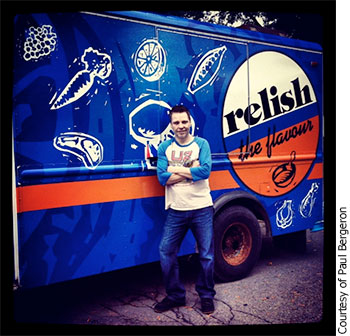
Paul Bergeron stands in front of his truck "Relish"
Paul Bergeron at his eye-catching “Relish” truck: a rotating gourmet menu so popular that he’s often sold out before 3 pm.

Ottawa’s street food scene has seemed lacking for enthusiasts like Kathy Ferguson, an Ottawa-based blogger for Eat Street’s website, who has eaten at more than 110 food trucks across North America. It’s no surprise, she said, that Ottawa’s conservative nature has kept it from fully embracing the trend.

In the last few years, however, trucks like “Relish,” “Stone Soup Foodworks” and “Trailer Pork Boys” have opened, providing Ottawans a convenient taste of both the staple and gourmet food options. Many of these gourmet food trucks were at the time required to open on private property, due to the city’s prior restrictions on street vending. But the newly authorized spaces will allow trucks to do more business on city property.

Paul Bergeron, owner of “Relish” — a food truck parked at the University of Ottawa campus whose offerings range from gourmet macaroni and cheese to chimichurri beef hamburgers and even gluten-free fare — said it’s not surprising that people are interested in street food. In fact, he said, in many cultures, especially in Asia, street food has always been the best way to eat.

“Everyone else has known that for hundreds of years; it’s just taken Canada a little longer,” said Bergeron.

The trucks themselves are as bold as the food they serve. “The Feisty Jack,” a truck in Toronto that offers updated classic British food, is covered in the image of a Union Jack (with teeth!) and boasts the slogan “Keep calm and aim for the mouth.”

Part of the draw, according to Ferguson, is the personality of the vendors themselves, and their passion for food — something that shines through in Bergeron’s ever-changing menu.

“I just want to put out a good product.  And I like to see the reward that I get usually instantly,” said Bergeron. “That’s what keeps me going.”

Good food, fast

“The compelling nature of street food is kind of the same thing that compels people to go to festivals and fairs,” Councillor Taylor said. “People, especially the younger generation, want to be wired in and hip, and they want to feel connected to their community in entertaining and integrative ways.”

A major goal is that Ottawa food trucks will act as a draw for tourists, Taylor said. Having good, unique, immediate food available will tie into a mindset of being able to venture out for a day in the city without having to worry about food. Many of Ottawa’s trucks operate year-round, but thrive during summer festival months when tourism and foot traffic peak.

The reality is that food trucks do not have a single audience; they appeal to anyone looking for good food, fast. Both of the trucks on the University of Ottawa campus cater primarily to the student population, while trucks like “Chef on Wheels” or the hot dog cart at Bank and Laurier sell mostly to the business people in the downtown core. Trucks operate throughout town, appealing to all sorts of demographics: late-night snackers or just anyone rushing for lunch at noon.
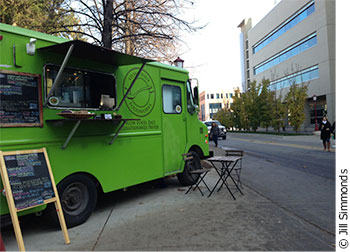
The Stone Soup Food works truck on the University of Ottawa campus
Green machine: Stone Soup Food Works is open Monday to Friday, serving grateful students at the University of Ottawa.

Social media are part of the trend. Bergeron keeps fans updated on his truck’s daily menu via Facebook and Twitter and has even expanded into photographing his food with help of his iPhone and Instagram account. In some other cities, followers can download iPhone Apps which direct them to the nearest mobile vendor based on their own GPS location.

According to Jennifer Demarre, co-owner of Ottawa’s “Trailer Pork Boys” (a food truck serving classics like pulled pork sandwiches), a social media presence is just as important as a great menu.

As to why Ottawa has lagged in the food truck phenomenon, Demarre blames a number of prohibitive laws. For example, until 2007, hot dogs were among the only things allowed to be sold on city streets. Further, due to space restrictions, most Ottawa trucks are stationary all day, while trucks in U.S. cities often are allowed to follow the crowds.

Furthermore, says Demarre, weather conditions here differ from those in Portland and Los Angeles. In the end, harsh winters that reduce foot traffic and complicate truck maintenance may yet prove too much of a barrier for any real street food community.

‘Please, sir, can we have some more?’

The 20 new spaces will be awarded through a selection process wherein a panel (including Councillor Taylor, an Ottawa Public Health representative, a Canadian Culinary Federation member, a local restaurateur, and others) will judge prospective vendors. “It’s going to be kind of a talent contest,” Taylor said.

The city received 61 applications for the new spots (45 applications for trucks, 16 for carts) and will announce the recipients in early 2013. Vendors are being judged based on business plan,  “unit design,” vendor experience, “overall readiness” and “menu diversity and innovation,” Taylor said.

A cup of Stone Soup Food Works' homemade tomato and kale soup
Fresh off the truck: Stone Soup Foodworks makes all its soups, sandwiches and tacos with local and organic ingredients.

Prior to the council vote, there have been 69 food trucks operating in Ottawa, of which only 19 have been allowed on city property. Many trucks, like “Relish” and “Trailer Pork Boys,” operate on private property. The new city-property spots are located throughout town, some near Sparks Street Mall, Confederation Park, and Dundonland Park, as well as in the St. Laurent mall area and in Stittsville. Notably lacking are spots in the ByWard market.

The hope is that the initiative will emulate Vancouver’s highly successful 2010 pilot project (see sidebar).

Critics of the selection process say it’s unfair for the city to regulate applicant-vendors’ menus and that just because someone might lack food-industry experience doesn’t mean he or she wouldn’t thrive with street food. But the goal, Taylor said, is to encourage a variety of different food options and a little ingenuity, to add spice to Ottawa’s stale street scene.

However, Councillor Rick Chiarelli was firm in asserting that it is not the city’s place to determine vendors’ menus. The city, he said, shouldn’t try to outguess the business people — they know what their customers want. Chiarelli explained that the city would never try to regulate a restaurant’s menu, so why meddle with an applicant-vendor’s menu?

The panel’s criteria will not affect existing vendors, but the hope is that such criteria will encourage a more diverse range in available street food.

“We can’t always stay the same; it’s got to change,” said Terry Scanlon who has been selling hot dogs and sausages on the corner of Bank and Laurier Streets since 1982. “This is a good time for it to change, especially in the capital city.”

The street food industry provides a unique opportunity for vendors, as it does for patrons, Scanlon said. As compared to opening a restaurant, starting a food truck or cart business requires much less investment and risk, while providing great potential for creativity and an entrée to the culinary scene.

So, will street food prove to be Ottawa’s ticket to a new life as Fun City? While people like Ferguson are hopeful, Chiarelli maintains it’ll take more than a few gourmet hamburgers to reinvent Ottawa.

“If you’re looking for fun,” Chiarelli said, “the city government is not the place that’s going to provide it.”

View Ottawa Food Trucks in a larger map

Consignment shopping’s new lease on life

If money weren’t an issue, I wouldn’t stop consignment shopping; I would just buy more. This isn’t a remix of Barenaked Ladies’ “If I Had a Million Dollars,” but the gist of Joanna Hauser’s sentiments on clothes shopping. For Hauser and others in Ottawa, consignment shopping is about the adventures it entails, the unique chance at acquiring certain labels and styles, and giving new life to previously loved items, as well as about the savings.

Hauser, 42, works in marketing but finds time at least once a week to go to her favourite local consignment stores, including Bella in Bells Corners, My Sister’s Closet in Kanata and Ragtime Vintage Clothing downtown. She says she goes often because with consignment shopping you never know what you’re going to find, or when you’ll find it. Part of the appeal is the adventure.

Purse

Joanna Hause’s Dooney & Bourke purse, bought on consignment.

“It’s kind of fun to go in and find a really well loved bag, and you bring it home and you make it your own,” she says excitedly. Recently, she says, she came home with a well-worn purple, Italian leather, Dooney & Bourke purse from My Sister’s Closet for only $36.

Consignment stores offer styles and brands beyond what you would find at the Rideau Centre and other local malls. Hauser prefers consignment stores to mainstream ones because she finds things she likes more easily. Generally, most items are one of a kind, so Hauser figures she’s less likely to see someone else wearing the same shoes or shirt as her. “You’re not going to look like everybody else. ’Cause nobody wants to look like everybody else,” she admits through a laugh.

Malorie Bertrand, Editor-in-Chief of EF Magazine, an online sustainable-fashion publication, says, for her, the importance of consignment shopping is environmental more than monetary. Bertrand, 26, values the concept of recycling clothing and keeping as many items out of landfills as possible. But she also agrees about the adventure that these stores offer: “I enjoy the hunt of riffling through the racks and finding unique pieces and putting together outfits.” Bertrand’s favourite Ottawa consignment stores include Ricochet Resale on Richmond Road, Young Janes on Dalhousie Street and AMH Style on Wellington Street West.

AMH Style: part of a new wave

AMH Style

That boutique look: AMH Style in Ottawa specializes in high-end brand names and unique designer labels for women.

Alison Hughes, co-owner of AMH Style, agrees that many of her customers are looking for something different that not every Ottawa store is going to have. AMH Style carries a number of exclusive labels: “We get Jimmy Choo, Prada, Fendi,” Hughes says, explaining that she and her sister hand-pick all of their inventory. The selection mostly comprises brand names and designer labels that you can’t buy elsewhere nearby, she says, “brands that not even Holt Renfrew in Ottawa carries.” Hughes attributes this to the different brands that people buy when travelling or shopping online, that are reflected in the clothes they bring in to resell. As well, Hughes adds, other shoppers are drawn to consignment shopping because of the savings and, perhaps more commonly, the eco-friendly aspects of it.

AMH Style typifies a new breed of consignment stores, different from the traditional model, that are popping up in Ottawa to offer a shopping experience more similar to a high-end boutique. This includes preselected inventory, visually appealing displays and great customer service. The old consignment stigma is “stuffy, blah, used clothing, etc.,” says Hughes. It used to be that people shopped consignment because they had to, not because they wanted to.

Catching on in Ottawa

Consignment shopping is no longer something you try to hide; instead, it’s very popular.

But Hughes thinks people are starting to understand what consignment is now, versus what it used to be. She says consignment shopping is no longer something to try and hide from people; instead, it’s very popular. Over the last few years, there has been a rise of “new breed” consignment stores in the city. Among these are Bella Women’s Consignment Boutique, that opened nearly five years ago, Ricochet Resale, from just over a year later, 2009 and AMH Style which will celebrate its second anniversary in May. And this expansion has not been limited to the city; in recent years, Hughes has seen more consignment stores opening in the suburbs, for example in Barrhaven and Carleton Place, meaning that consignment is now more accessible than ever. In fact, the focus of consignment stores is also diversifying; unlike in the past, when the majority of regional consignment stores dealt in vintage pieces or bridal wear, there has been a rise in stores specializing in children’s clothing and high-end women’s clothing.

Along with the stores, Hughes says, she has also noticed a tremendous rise in the number of shoppers for second hand. Many in the city will actually head to a nearby consignment store before going to the mall, she explains. Bertrand agrees; in her opinion, consignment shopping is much more acceptable than it was even five years ago. “Now a lot of people say they don’t like to tell their friends about this store [AMH Style] because they’re afraid they will scoop everything up,” Hughes says, laughing.  She adds that consignment shopping will only continue to grow in Ottawa as more people embrace it.

Who shops consignment?

Malorie Bertrand

Malorie Bertrand, in a whole outfit from consignment: The black leather Oscar de la Renta flats cost her $18.

Amid consignment shoppers’ rise, Bertrand has watched the trend become especially popular with younger generations: “What we consider to be the trendy youth of today, without stereotyping, prefer second hand.” For one, it’s cost effective and eco-friendly, and consignment shopper’s find themselves with a unique selection, different from the latest trends in stores. Many like the ability to create their own looks with unique pieces that help them stand out or by restyling old pieces in modern ways, rather than choosing from what’s laid out for them in a mainstream store. While young people may be driving this change, it is definitely not confined to youth. It embraces shoppers in their mid-to-late teens all the way up to anyone who’s “fashionable at heart,” as Hughes would say: “It’s more like a style state of mind – trendy, fashionable and stylish.” Nathan Armstrong, manager at Ragtime Vintage Clothing, would agree; he believes it’s not always about the cost of things, but the unique selection and styles that draws people to the store. “We get everyone from street kids to millionaires and everyone in between.”

But in some cases the stigma is not entirely gone; some shoppers are still turned off by the consignment idea, possibly relating to a cleanliness issue. “Especially shoes,” says Hauser who still has the occasional person raise an eyebrow when she tells them she shops consignment. “People seem to have a hard time with shoes, yet they walk around a gym change room in bare feet!” Others just don’t have the time and energy for the hunt, and prefer the convenience and large selection of mainstream.

Bertrand believes that consignment is the future. She says she tries to proselytize: Each time a friend compliments something of hers from a consignment, she jumps at the chance to tell them. She hopes that this will give them the idea to check out a consignment store when they otherwise wouldn’t have.

Says Hughes, “the more people who know about it, the better it is for everyone.”

Viral madness: How ‘Gangnam Style’ changed the world

Step with your right leg; step with your left. Back to the right leg; right one more time. Hands out in front; then one fist clenched over your head, elbow slightly bent, making a circular motion. But chances are you already know this dance move because, like more than a billion others around the world, you’ve seen it. Yes, we’re talking about “Gangnam Style”: the most popular YouTube video ever.


Psy and friends perform “Gangnam Style” at Seoil College in Seoul.

“Gangnam Style” is a song by South Korean artist Psy. It is also one of the most powerful dance phenomena we have ever seen. It has taken over bars, clubs, sporting events and even political debates, all because of one viral video.

“Gangnam Style” was released on July 15, 2012, and received about 500,000 views on its first day. It reached one million views at the beginning of August, and by the week of August 28 it was number one on YouTube Top 100 Music Videos.

On December 21, 2012, it became the first online video to be viewed one billion times. As of mid April 2013, it had had 1.523 billion views.

‘I think it’s one of those things like car accidents; you can’t help but look.’ — Viral video expert Kevin Nalty

This all despite the widely held opinion that, as a matter of fact, the music isn’t very good. “I think that it wasn’t so much the song itself, but sort of the whole mojo of the video,” says viral video expert and YouTube comedian Kevin Nalty, admitting he doesn’t like the song. “I think it’s one of those things like car accidents; you can’t help but look.”

They all do Gangnam

The scene is Alumni Stadium, home to the Boston College Eagles football team. The Eagles are losing to the Notre Dame Fighting Irish on a beautiful New England fall 2012 Saturday night.

It is in the second quarter, after the BC marching band’s rendition of “Call Me Maybe,” that the familiar sights and sounds of Psy’s “Gangnam Style” hit the 44,500-seat stadium’s big screen. The band plays along; the fans belt the words. Most importantly, they all do the dance. They always do the dance. The cheerleaders do it; the fans do it; even the mascot does it. It is the only music video that plays on the big screen all night. And just about everyone in the stadium has seen it, as a couple of now-famous dance moves prove.

This is what happens when Internet culture seeps into real life. “I think what happens with something like this […] at some point it’s almost like a commodity you trade with,” says Nalty. “‘Did you see that?’ is basically code for ‘I’m in early; I’ve already seen it; I’m hip to it.’ It’s sort of a badge of honour.”


San Francisco Giants radio announcers Jon Miller (left) and Dave Flemming celebrate the team’s World Series win, Gangnam style.

But what is really incredible about “Gangnam Style” is how it has reached older generations — ones that didn’t grow up with the Internet, ones that are known often for criticizing their children’s music. These generations are not only embracing “Gangnam Style”; they are celebrating it.

On several instances, well-respected, world-renowned people have proven they can’t get enough Gangnam. United Nations Secretary General Ban Ki-moon danced “Gangnam Style” alongside Psy during a photo op at UN headquarters. London mayor Boris Johnson, at a Conservative party conference in October 2012, told delegates, “‘Gangnam Style’ is very good. The Prime Minister and I danced ‘Gangnam Style’ the other day, you will be shocked to discover.”

President of the International Criminal Court, Song Sang-Hyun, mentioned it during a speech to the UN Security Council. U.S. President Barack Obama mentioned it, saying to WZID FM in New Hampshire, “I just saw that video for the first time… I think I can do that move.” Never has an Internet fad spread so quickly and so powerfully, and through such impressive ranks.

Here to stay?

So how do we explain such an explosive transformation, from Internet sensation to pop icon? Psy has something to do with it. “There’s just something about this guy that’s so opposite your common pop singer,” says Nalty. “Overweight, goofy, but clearly confident in himself.”


All the right moves. South Korean pop artist Psy’s “Gangnam Style” is the most viewed YouTube video of all time.

“The common ingredients are there,” Nalty continued. “It’s interesting; it hasn’t been done before; it’s catchy; it’s new. Dancing and music are always good ingredients in a viral video.”

Wall Street Journal Korean Correspondent Evan Ramstad says the video’s madcap attitude is atypical of Korean pop videos. “The dance adds to it, because it is both funny and easy to imitate,” says Ramstad. “The bass-rhythm groove is also memorable and unmistakable when you hear it.”

“Gangnam Style” is the most powerful example of how viral video can impact our culture. But it is just one of many.  “It’s sort of like a fabric of society,” Nalty says of viral video. “We all sort of consume it, and nobody’s left out.”

“Gangnam Style” and other viral videos like it create a societal bond because of their ability to reach such a mass audience. But Gangnam’s eccentricity and downright silliness is what sets it apart.

Says Nalty, “After a while it just becomes a cliché. I think once it gets to a point where everybody’s universally familiar with, it begs to be satire. I think we’re all looking for something a little offbeat.”

Music in Ottawa: not dead, not even resting

Ottawa has no local music scene. The venues are small; the crowds are young; the bands always leave for bigger cities. That is what people keep hearing, anyway.


Under a confetti shower, Keek lead singer Conor Whitehead salutes the crowd at an all-ages show at Maverick, in December.

Promoter Peter Roumeliotis moved to Ottawa from Montreal two years ago. “I was told Ottawa doesn’t have a scene,” he says. “But when I got here, I was like, ‘What are you guys talking about?’”

The venues are smaller and the kids may be young, but so what?

“What I’ve realized is that Ottawa’s scene is more intimate. In the pop-punk, metal and hardcore scenes, you tend to get the same 150 to 200 kids that come out to all the shows,” says Roumeliotis.

Roumeliotis, who promoted in Montreal for over a year, says that in a bigger city the crowds are more sporadic. He says it was common to have certain shows draw sparse crowds and was often hard to fill large venues.

So, Ottawa’s local music scene is a steady one, but why?

Venues are smaller here, and the kids may be young, but so what?

A friendlier scene

Alex Brownlee, from the Ottawa-based band Constraints, says a big reason is because your hometown is the place to build your fan base.

“If you’re not liked by the kids in your hometown, chances are people won’t like you in other towns either,” he says, laughing.

Constraints have now started to draw a bigger crowd in the greater Toronto area and have done some bigger summer tours by pairing up with bands in other cities and countries.  But Brownlee says it starts at home — it’s all about networking and whom you know, which is why they do so well playing at home regularly.


Ottawa-based band Keek: from left to right, Marek Lubanski, Kyle (Willy) Williams, Matt Belanger, Conor Whitehead and Kyle Megill.

Conor Whitehead of the Ottawa-based band Keek agrees.

“When we started off we could play a show, and maybe 30 people would show up, and they’d all be close friends,” he says. “We go where the kids are; we used to play a lot of high schools and hand out flyers and hop on social networking like Twitter and Facebook, and that’s what really got our fan base going here in Ottawa.”

Keek is a pop-punk band that can draw a crowd of five to six hundred kids, says Roumeliotis. But that’s only possible at an all-ages show — another reason why Ottawa has a thriving scene.

Downtown, places like Maverick, Café Dekcuf and Ritual host all-ages shows. Adam Kronick, the owner and operator of Babylon nightclub on Bank Street, says doing all-ages shows is important for showing support for Ottawa artists.

In Montreal, this is in jeopardy, Roumeliotis explains.

“Basically for smaller shows and for emerging artists in Canada, we had a venue called Underworld, and it was the only venue that would do all-ages shows, for kids who are like 15, 16, 17,” he says. “As of December 31, Underworld’s going to be a bar full time, and that’s going to affect the music scene really bad.”


Alive and kicking. Fans sing along at Keek’s Maverick show.

Roumeliotis says venues are the important thing in a local music scene. In Ottawa, he says, the size of the rooms is perfect: smaller than first-rate music scenes as in Toronto and Montreal, yes. But this is a good thing.

“In Montreal a band like Down With Webster would play Metropolis, which is like 3,000 people; over here they’re going to play Bronson Centre, which is barely 1,000 people, so it’s definitely a more intimate scene,” says Roumeliotis.

Route 401 to Toronto

He says in promoting in Ottawa for the last two years, he has sold out shows much more easily than in large venues in Montreal.

Of course, there are some drawbacks to the intimate Ottawa scene. Brownlee says Constraints do see risks in playing Ottawa regularly.

“There is the issue of over-saturating yourself in Ottawa,” he says. “By playing a show every two weeks, you can go from having people come out and being really excited to a point where they get bored of you. So you have to space out the shows, for sure.”

Whitehead says Keek will eventually leave the city for bigger opportunities but not for lack of the local scene. “Ottawa’s been great to us, and we’ll leave when we’re ready to leave.”


Keek performing. “We go where the kids are,” says Whitehead.

Roumeliotis agrees that Toronto is the inevitable next step for most Ottawa — and even Canadian — bands, in hopes of finding a record label. But local is important.

“I have kind of an unofficial rule with bands, that if you can’t dominate your hometown then I can’t see you dominating any other city,” he says. “All the bands that are big right now can do ten times as many people here than by going to another city.”

So if the venues are smaller, and the kids are young, and the bands are leaving for bigger cities, why would that mean the local music scene is dead? Local bands are building a huge fan base and a name for themselves, and Roumeliotis says the small-town city of Ottawa has much to offer.

“Ottawa just has a smaller scene, but it’s a great scene, and it’s definitely still alive.”

Yarn bombing: the kinder, gentler graffiti

The urban landscape doesn’t belong solely to spray paint cans in the hands of Banksy wannabes anymore. There’s a new graffiti in town, and it hides in the branches of trees, is as bold as the statues that it keeps warm at night and is ready to make you smile with its “cute” and fuzziness.


The statue outside Ottawa’s Library and Archives Canada building, after falling prey to a yarn bomber’s craft.

Known as yarn bombing, it’s the global movement that looks to soften the harsh city landscapes with wool and yarn installations. From bright, tea-cozy-like knitted pieces on lamp posts and bike racks to statues with their own sweaters and scarves, yarn bombing contrasts the gray concrete of the urban jungle with wool’s vivid colours and designs. Unlike paint on brick, yarn bombing can be removed from any fixture with little to no trouble, using just a pair of scissors.

It all started in the winter of 2005 when 37-year-old Magda Sayeg wanted to bring a little warmth to her Houston, Texas, neighbourhood by knitting a little cozy for the doorknob of her boutique. Sayeg then began masking other things like lamp posts and stop signs, and even started a yarn bombing group called “Knitta Please.” Now considered the mother of yarn bombing, Sayeg came to attention when photos of her handiwork popped up on the Internet, inspiring other knitters to go drape in public. Since then, knitted and crocheted installations have cropped up all over the world in many different shapes and sizes. Sayeg has even been commissioned to yarn bomb Mini-Coopers, motorcycles and office air ducts. “I didn’t intend for it to become this global movement,” said Sayeg in an e-mail. “So, it’s become an an exciting and unexpected journey for the last six years.”

Yarn gone viral

‘Police have better things to do than arrest people for putting dollies on lamp posts.’ — yarn bomber Joann Matvichuk

This past summer, Canadian Joann Matvichuk, 45, declared June 11th as “International Yarn Bombing Day” on Facebook. The Lethbridge, Alta., mother of two, is a regular yarn  bomber, covering lamp posts, bus benches, crosswalk buttons and fences. She says she came up with the idea at 3 a.m. one night, invited some of her friends to document their own work in group but didn’t expect it to catch on.

“I just thought it would be a neat idea if everybody that did this did it at the same time and how many people would notice? Would they notice?” Matvichuk said over the phone. “I didn’t expect it to be as big as it turned out.”

Her Facebook group amassed just over 4,500 “likes” and dozens of photo contributions from yarn bombing fans all around the world. The group documents a yarn-covered bench in Spain, a giant skateboard monument in California, an eye patch for one statue in Italy, pom-poms hanging on trees in Australia… The list goes on. This kind of digital mobilization has helped the yarn bombing community grow.

“Photographs of what we do totally inspire people,” said Matvichuk. “You look at at it and go, ‘Why didn’t I think of that?’ Or, ‘I could do that and put it on this, instead.’”


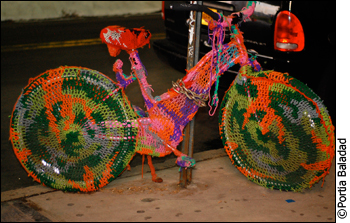
A yarn bombed bike left under the Brooklyn Bridge in Brooklyn last summer.

While many may think of knitting and crocheting as grandmotherly, yarn bombing sets itself apart with its diverse community of devotees. Both women and men, young and old, venture out to cover whatever tickles their fancy. Leanne Prain is the co-author of Yarn Bombing: The Art of Crochet and Knit Graffiti, and considers herself a yarn bombing historian.

Like all art forms, knit bombing has its critics. Prain says she receives e-mails from time to time that knock yarn bombing as a “waste of wool.”

Twenty-one-year-old McGill University student and avid knitter Bogdana Dragomir says it would take a very clever project for her to take up yarn bombing.

“Wool is expensive and it takes immeasurable amounts of time to knit something substantial,” said Dragomir. “Why would I waste that in an act that would be construed by authorities as vandalism?”

In fact, most city by-laws define graffiti as “one or more letters, symbols, etchings, figures, inscriptions, stains howsoever made or otherwise affixed to a property or other markings that disfigure or deface a property” with exceptions of pre-approved murals. Yet Matvichuk says she’s heard of police officers helping yarn bombers install their artwork. “In most cases, police have better things to do than arrest people who are putting up dollies on lamp posts,” said Matvichuk.

Generally, yarn bombing isn’t an offensive art form. For Prain and Matvichuk, the goal is the same: to put a smile on a stranger’s face. Then there are the yarn bombs that gently nudge people towards the unexpected or ignored. It may be the forgotten bike on a New York City street or the banister along the Rideau Canal in Ottawa. According to the New York Times, Philadelphia-based artist Jessie Hemmons made a neon-pink sweater emblazoned with the words “Go see art” and placed it on the Rocky Balboa statue in front of the Philadelphia Museum of Art. She said wanted to encourage visitors to visit the museum rather than quickly snapping a picture of the famous statue and leaving.

A labour of love


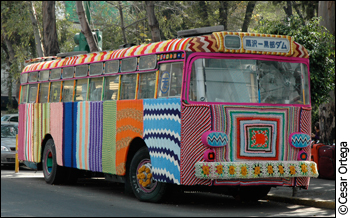
This gorgeously decorated bus in Mexico City was the handiwork of Magda Sayeg, the mother of yarn bombing.

Contrary to popular belief, yarn bombing isn’t spontaneous. To execute a good yarn bomb takes time and carefully planning. Bombers have to come up with the idea and size up their target to ensure a snug fit before knitting. The knitting itself can be tedious, lasting anywhere from 24 hours to weeks, depending on the target’s size. Then, in the dim of night or even in broad daylight, the bombers sew and tie their works on the target, often leaving no trace of their identities. Similarly to paint graffiti artists, some yarn bombers prefer to work under a pseudonym.

The yarn bombs can last anywhere from ten minutes to years. Matvichuk says she’s noticed some of her pieces disappear soon after installation, assuming people have taken her cozy artworks home. If they haven’t been taken, yarn bombs last as long as they can stand the weather or until the creator thinks they’re too worse for wear to stay up any longer. According to Prain, one of her tree-branch yarn bombs has lasted for almost three and a half years. She was hesitant to give out its exact location for fear of it being taken down.

Prain says that yarn bombing is a great tool for community building and hopes that it gives people a greater appreciation of textile art. Prain has always seen art as a positive force, especially street art. Whether painted or knitted graffiti, art should always be available to public. While she is busy with book tours and maintaining her website, yarnbombing.com, she helps to plan big projects, for which a number of people are eager to put their needles together and participate.

“It’s something that has the ability to communicate and inspire people from all walks of life,” said Prain. “Knit graffiti is really this tactile, soft medium, and there’s something sentimental about yarn and textiles. It’s wonderful to place something in a place that will surprise somebody and hopefully delight them.”

Celebrating Ottawa’s local food

A tall, thin man dressed completely in black walks through the grounds of Ottawa’s Museum of Civilization. He’s wearing long coattails that flutter in the keen October breeze, and a top hat is planted firmly atop his head. In his right hand he carries a picnic basket.


Dining out. Hundreds of excited foodies gather on the Museum of Civilization grounds for Harvest Noir’s eccentric all-black picnic.

Tourists and museum-going families stare in confusion as he saunters down the steps towards the museum’s Adventure Park, but as he turns the corner, it becomes very clear where he’s headed.

Settled in the grass, with a magnificent view of Parliament and the Ottawa River, 800 picnic-goers have assembled, dressed in their finest and most outlandish black attire, to picnic and celebrate local food at Ottawa’s very first Harvest Noir.

Harvest Noir is one of the many new local food-based events taking over Ottawa’s cultural scene. Focusing on the area’s diverse farming community and the rich selection of produce, meat and dairy found so close to the city, organizers aim to make people more aware of their carbon footprint and of the good food close to home.

Black ties and picnic baskets

The event is based on the idea of Diner en Blanc, a gourmet flash-mob picnic that started in Paris and has spread to major cultural centers around the world. Harvest Noir diners pay for tickets, sign up to an email list, pack a locally sourced picnic basket and await the last-minute information on where and when to meet.

Participants dress extravagantly in tuxedos, ball gowns and fascinators, bringing local, gourmet food, their best china and elaborate table dressings. The atmosphere is vibrant and the diners are excited—talking, giggling, and admiring each other’s dishes and costumes.

‘We’ve lost connection to where our food comes from; it’s wrapped in plastic and totally anonymous.’                                  — organizer Greg Searle

There’s a veritable sparkle under the gloomy October cloud-cover as guests bustle around to perfect their table set-ups. After weeks of speculation, the event is in full swing, and the enthusiastic attendees feel like they’ve been let in on Ottawa’s coolest secret. What more could you expect from hundreds of like-minded foodies brought together for this one spectacular event?

Food isn’t served by the Harvest Noir organizers (it’s a strict bring-your-own-picnic rule), and although $40 a ticket seems rather steep for a dinner party with no dinner included, there are over 800 people in attendance, all toting baskets full of locally made or sourced meals. From La Bottega sandwiches and farmers’ market goodies to full three-course meals from Les Fougères, the selection is impressive and truly showcases Ottawa’s growing and diverse food scene.

After dining, the crowd moves indoors for a dance party complete with live music and performers, which seems to be enjoyed to a certain degree, but it’s the local food element that really drives the event. This isn’t surprising considering the number of new, trendy organizations popping up to promote Ottawa as a foodie city. Harvest Noir was, for the most part, a party celebrating Ottawa local food.

A wave of  local food events

Greg Searle, organizer of the event, said that after stumbling across the Diner Blanc event in Montreal last August, all he could think of was how Ottawa needed something similar.


New food events like Harvest Noir use social media like Twitter and YouTube to connect with the widest audience possible.

“I didn’t know if Ottawa was hip enough for it, but it was worth a try,” said Searle. “I think that something is changing in Ottawa. There’s a growing recognition that official culture is not enough. I think Harvest Noir proved that Ottawa is definitely hip enough, and maybe even thirsty for more events.”

Although Ottawa is often seen as a sleepy government town, criticized for lacking culture and a dynamic food scene, the landscape is certainly changing. Events like Harvest Noir, the Ottawa Foodie Challenge, Dishcrawl Ottawa and Bon Appetit are creating an accessible, fun, vibrant culture of eating and socializing in the city. Over the past few years, Ottawa has been moving into what prominent food blogger Hilary Duff refers to as “the new way to do food.”

Duff, known for her blog, Hilary Makes, as well as for being the restaurant critic for Ottawa XPress, says that although there have always been wine and food shows in the city, they are generally outrageously priced and thus not accessible to everyone who is interested in food. She says dynamic new events like the Ottawa Foodie Challenge and Dishcrawl Ottawa are more open and adventurous, and are often seeing more diversity and media attention than the traditional tasting shows.

“I think the unfortunate thing about Ottawa’s food reputation is that a lot of tourists don’t venture out of the Byward Market, so the dynamic food scene is overlooked,” says Duff. “Events like Dishcrawl are helping Ottawa step into a new world—one of accessible food, appreciation of the city’s offerings, and one where anyone who wants to be a foodie can be.”

After starting in Ottawa last June, the San Francisco-based Dishcrawl has sold out its events within hours. Focused on certain sections of the city, it is a progressive dinner: people are led to four “mystery” restaurants to try four different plates. Duff says it’s supposed to expose people to restaurants they haven’t heard of and dishes they haven’t tried before.

‘Ottawa is stepping into a new world, one of accessible food.’
— food blogger Hilary Duff

Social media is a key factor in getting a new generation of foodies out and about in the Ottawa food scene. Harvest Noir was promoted almost solely through Twitter, Facebook, and the circulation of an intriguing YouTube video invitation.

Searle credits these new media tools with drawing in a varied crowd. “We had a really big demographic at Harvest Noir. People ranged from 18 to 75. Using Facebook, Twitter, and YouTube helped us get younger people, and then the younger people invited their parents,” says Searle.

He adds, “The event had its feet in two worlds. It has one foot in Old World Paris, and the dining culture there, and the other foot in flashmobs and DJ’s and partying. Social media probably accounted for over half of our guests.”

Carolynn Lacasse, who organizes the Ottawa Foodie Challenge, says she thinks the people of Ottawa are craving the fun experiences you find on Queen Street West in Toronto. People love to go out and be part of a cultural community, so the events and the restaurants popping up everywhere in Ottawa are helping them do that.

Embracing Ottawa’s farms

The overwhelmingly positive response to Ottawa’s hipper food events is something that is encouraging the appreciation of local food, and even creating buzz around what’s being grown in Ottawa.

“People are realizing that Ottawa and the surrounding area has so many farms, and is a great place to get your food locally,” says Lacasse. “They’ve always been there, but people have been talking more about it, so I think that’s why we’re more aware and that’s partially why the food scene has opened up.”

Harvest Noir is a perfect fit into the growing mainstream movement of buying local. Canadians have been participating more and more in the “buy local” and “100 mile diet” phenomena because of the negative reputation of imported foods and a concern about their carbon footprint. The Dieticians of Canada say that although the 100 mile diet isn’t possible for everyone, they encourage Canadians to choose local foods to help support agricultural producers and protect the environment.


Ottawa’s farmers’ markets are fantastic places to find an array of local produce, and no plastic wrap in sight.

Searle says the theme of harvest was integral to his event because it’s one of the most important traditions, particularly in Canada where we have so much to enjoy.

“We’ve lost our connection to the place where our food comes from—it’s wrapped in plastic and totally anonymous, and we don’t know how far it’s travelled, what kind of fields or farmyards it came from,” says Searle. “We’re headed into a future where that’s not going to be realistic anymore. Preparing for an energy-constrained future means getting reconnected with our local farms and having a local food system.”

The future of Ottawa’s food scene seems to be promising. The addition of even more food events, creating buzz through social media tools and promoting the idea that anyone can be a food lover, means that more people are going to be getting involved.

“The more food events, the more that people get into the food scene,” says Lacasse. “We need more events like Harvest Noir, to bring out more fun, creative, cultured people of Ottawa. I’m always having new food experiences, and I just hope I can help bring that to other people.”


Related Links

Harvest Noir

Dishcrawl Ottawa

Ottawa Foodie Challenge

Bon Appetit

Just Food

Savour Ottawa


Front page photo courtesy of Hilary Duff.

Why sewing is back in fashion

It was love at first sight for Isobel Vaisanen. When asked how she got involved in a sewing class, the 11 year old recalls the moment of her infatuation. Her local Greely, Ontario, sewing club holds an annual fashion show that features pieces by members; Isobel attended as a fifth grader.

“I was amazed at how they did the sewing,” she says, “and I really wanted to join.” Which she did that following summer.

Fast forward, and Isobel is now into her second year of the craft, mastering projects that include clothes and full-sized quilts. Her most prized possession: a dress she hand-made for her fifth grade graduation. “A lot of people thought it was the best dress they’ve ever seen,” she says.

"sewing"
Craft apprentice: Kianna Levine, 14, makes a quilt in sewing class.

Janet Pray is executive director of the National Sewing Council in the United States. The council is responsible for attending craft shows across the country and educating the public on the ins and outs of sewing. She says that Isobel’s story is just one example of a current trend: young sewers joining.

“We’ve definitely seen a rise in youths sewing,” she says. “We meet new, young sewers at almost every event, and the number is continuing to grow.”

While statistics on youth involvement remain elusive, a current general rise in sewing’s popularity is amply attested. For example, according to Time magazine, there are about 35 million sewing hobbyists in the United States, up from 30 million in 2000, while annual sales of Singer sewing machines have doubled since 1999, to 3 million.

Runway dreams

When asked why more young people are joining a craft usually associated with oldsters, Pray is quick to reply: “Project Runway! It’s created a brand-new way to look at sewing.” Project Runway is a reality TV series, now in its sixth season since 2006, that showcases wanna-be designers vying to have their patterns shown in New York. Pray says the show’s popularity “has shown teenage girls that sewing can be both a career decision and a creative outlet.”

‘Project Runway has created a brand-new way to look at sewing’ — expert Janet Pray

Sherry Pettigrew works at Dragonfly Fabrics in Ottawa, where she teaches a beginners’ sewing class. Over the years she has noticed a steady climb in numbers of teenaged students. Some, she says, have joined to better their chances of getting accepted into fashion schools such as Ryerson’s, in Toronto.

Tori Hill, 17, has been sewing for the six years. When asked why she began, she echoes the dream of many girls her age. “I’ve always wanted to be a fashion designer,” she says. “The skills I learn here allow me to make my own designs.” Like many young fashionistas, Tori hopes one day to see her clothes on the catwalk.

But it’s not just career ambition that draws young people to sewing, says Pray.  Because so much youthful creativity these days is expressed through electronics, she argues, a hands-on productive activity like sewing can provide special gratification. “If a young girl makes a clutch bag, she’s made something she uses all the time. She gets total creative control.  And to hear all the positive feedback from family and friends is a feeling like no other.”

Cost effective

Anne Warren has been teaching sewing for over 20 years, currently for the Kid’s Sewing Company, a program in Nanaimo, BC, designed specifically for ages eight to seventeen. Warren has more than 30 students and runs three-hour classes five days a week. She says her enrolment is up, which she attributes to a shaky economy. “When the economy is down, my numbers usually go up.” She says sewing is less expensive among the hobbies and is often a better fit for a families on tighter budgets.

Michele Santerre owns The Running Stitch, a quilt store in Kanata, Ontario. She says the boost in young sewers has to do with fabrics being available for purchase by Internet. “Younger people can now find fabrics cheaper online.” Because fabric prices have gone down in this way, she says, youths can join a hobby that was once too expensive. She says the influx of young sewers has resulted in her “buying more modern fabrics.” Further to attract younger customers, Santerre has begun advertising with Groupon, a website that offers a daily deal on the most “popular things to do, see, eat and buy” and that provides users with a “daily coupon,” good at a local merchant.

"class time"
Hamilton’s students enjoy their sewing class’s relaxed setting.

A ‘sewcial’ scene

And not least of all, the social element has contributed to sewing’s popularity with youth, according to Pray. In fact, her organization, the National Sewing Council, recently adjusted its marketing strategy, to aim at younger sewers by highlighting social benefits. “The social aspect, that’s really where we’re going with our marketing, to attract the younger generations,” she says.

Danielle Hamilton agrees. For the past nine years she has taught sewing out of her Ottawa home to students as young as seven. She runs a two-hour class, usually capped at five students, every Monday and Thursday night. Students spend most of the class time at sewing machines, but can also be seen cutting out fabric patterns on the floor of the basement-level studio.

Hamilton says her class is in high demand, due to the chance it gives young people to be creative and learn valuable life lessons: “They’re learning how to be patient. They’re learning self-esteem, and they’re learning how to celebrate their own as well as their classmates’ successes.” She says that since schools no longer offer programs of this type, some students experience a creative void, and sewing is one way to fill it. An informal survey of Hamilton’s students reveals a range of motivations.

"clothes"
The bounty of self-reliance. Less expensive fabrics available online now have more youths making their own clothes.

Erin Wilson, 15, started Hamilton’s class amid dreams of becoming a fashion designer. But it’s the social setting that has kept her coming back for six years. “The girls in my class, I’ve really bonded with them,” she says. “We’re not just friends; we’re like a family.” Another student of Hamilton is Sophie Laurin, 14. Much like Erin, she says it is the first half hour of class, when all the kids talk, that is most important to her. When asked just what a bunch of teenage girls talk about, she grins before answering: “Gossip. We all love to gossip.” Laurin started to sew after she quit playing soccer. Her decision to switch hobbies has greatly benefited her wardrobe. “I’ve made dresses, capris, vests, shirts, a whole bunch of things,” she says.

And for others, learning to sew is a chance to join a family tradition.

Robyn Boucher was one of Hamilton’s youngest students when she enrolled four years ago, at age seven. Now in sixth grade, Robyn remembers why she joined: “My grandma used to sew, and so does my mom.” And that has developed, she says, into “a love for making shirts, skirts, shorts and tops.”

Not only is it fun; it’s useful. When her brother bought a pair of pajamas that were a tad too long, Robyn came to the rescue. “I took them and I hemmed them down to his size,” she says, as she smiles from ear to ear.

Where the teen books are

Fourteen-year-old Madelyn Newman doesn’t have Twitter and spends about 15 minutes a day on Facebook. But give her a book and she will read for hours.

Right now she’s splitting her attention between Ned Vizzini’s young adult novel, It’s Kind of a Funny Story, about a New York teen who finds himself in a mental ward after he attempts suicide, and Never Let Me Go, Kazuo Ishiguro’s 2005 novel about a boarding school full of child clones bred for the harvesting of organs. She’s read many of the works of Stephen King and is now embarking on the challenge of Shakespeare with delight.

“I’ll go on Facebook if I have absolutely nothing else to do and I have no book,” she says.

Newman’s reading habits fly in the face of conventional wisdom that says that teens don’t read. The statistics are pretty grim. A 2004 report called “To Read or Not to Read” showed that only 22 percent of 17 year olds read for fun: a drop from 31 percent in 1994.

And yet, over the last five years, Canadian book giant Indigo has seen sales of young adult literature increase 150 percent, while the company’s overall sales have struggled. Recently, the company announced that it would increase the sale of lifestyle products while pulling back on its book stock. But Indigo’s young adult list just keeps growing.

Coming of age

The slow boom in teen lit began in 1997 with the first installment in a book series about a boy named Harry Potter.

“Rowling decided to do something that is going to change everything in publishing,” says Anita Silvey, author of 500 Books for Teens (2006). “She decides to age Harry one year with each volume, which means that by the third and fourth volume — which are selling more copies than any other book in the world — we now have a teenager at the core of the story.”

The Harry Potter series
Magical influence. J.K. Rowling’s Harry Potter series has energized and utterly reshaped the young adult book market.

Anyone with an Internet connection knows what happens next: Pottermania builds into a multibillion-dollar franchise; Rowling becomes the richest woman in the U.K.; millions of children and adults eagerly devour the seven-part series until it comes to a close in 2007. Happy ending.

But things were just beginning to change for the teen literature industry.

“We’re now in a post–Harry Potter world,” says Silvey. “The minute you have a formula of the best-selling book in the world with teenagers in it, everyone in every [publishing] house was looking to see, Is there any way we can duplicate the success?”

Thus began a flood of fantasy, sci-fi, paranormal and dystopian novels for teens, all striving to capture Potter’s success. It was quite a departure from the prior standard teen literature.

“The young adult novels they developed in the ’50s, ’60s, ’70s, they were all realistic fiction about teens having problems,” Silvey says. “They were all Catcher in the Rye.”

A best-selling book with teenagers in it? ‘Everyone asked, Is there any way we can duplicate the success?’            — book expert Anita Silvey

In 2005, another book aimed at the younger set became an international bestseller and merchandising sensation: Twilight. Another trajectory everyone knows: All four books in the series occupied the New York Times Best Seller List, and Twilight-mania is still at fever pitch, with the final movie installment on the horizon. But the story doesn’t stop there.

Keeping lightning in a bottle

Between the Potters and the Twilights, a steady community of avid readers, teens most definitely included, has risen up from the Internet and vocalized their voracious thirst for books. Authors and publishers are now using the Internet to find and connect with fans, learn what the trends are, and serve up exactly what teen readers want, often with impressive results.

John Green is a novelist whose first book, Looking for Alaska, won the 2006 Printz Award, which recognizes excellence in young adult literature. Since 2007, Green has been building an online fan base through video blogs, message boards and Twitter. In June 2011, Green announced the title of his most recent book, The Fault in Our Stars, along with a promise to sign every single pre-ordered copy of the novel. Within hours, the book was the number one bestseller on Amazon.com and Barnes and Noble. At the time, it was unfinished and without a cover.

Author John Green
Youth-market novelist John Green has found wild success online.

Green, whose fans also include adults, is one of many young adult authors who has a presence online. Widely-read writers like Libba Bray (A Great and Terrible Beauty), Maureen Johnson (13 Little Blue Envelopes), Scott Westerfeld (Uglies) and even Judy Blume (Tales of a Fourth Grade Nothing; Are You There God? It’s Me, Margaret) have taken to Twitter and blogs as places to talk one-on-one with their fans.

“They have placed themselves where teens might go. The young adult writing crowd is very, very present in this cyber-space community. It gives them a chance to connect directly to their readers,” says Silvey.

Biblio file sharing

Indigo representative Lisa Huie says the company is taking full advantage of the popularity of teen literature. Last year, the company launched their Teen Read Awards, with 15,000 teenage fans voting online for their favourite novels. The company hosts regular events and promotions for their lucrative teen literature branch, but the true engine of buzz is of course teenagers themselves.

“Reading is and always has been a social activity. It started with book clubs; now it’s text messaging,” says Huie. She adds that teens have no problem using the Internet to find out more about their favourite authors.

“It’s always been a part of their lives,” she says. “Why wouldn’t they use that tool to leverage their experience?”

“This is obviously a culture where they share with each other what they find,” says Silvey. “Whether it’s the latest style or the latest book they’ve read, there seems to be an enormous underground movement of passing things around to friends.”

“Brianna [Wiederhold, 14] and I will read something and tell each other to read it,” teenager Newman says. Both girls have been devouring the James Patterson sci-fi series Maximum Ride. “Brianna read it, and then I read it, and then we got everyone else to read it because we thought it was so good.”

With the movie business churning out film adaptations of popular teen novels at a feverish pace (coming soon is the highly anticipated movie version of Suzanne Collins’s The Hunger Games) there’s some question as to whether the teen literature craze can last. But Silvey doesn’t see this boom going anywhere. The reason? Demographics: The teenage population is bigger than ever.

“There’s a huge teen bubble moving through the population,” says Silvey. “There are a lot more teens, and there’s a lot more publishing for them.”

So while Rowling has moved on to bigger and more virtual things post-Potter (namely, the creation of Pottermore, an “exciting online experience” based on the books), there seems to be no stopping the young adult authors and publishers looking for their own runaway hit.

In the meantime, readers like Newman will be reaping the benefits.

Canadian hip-hop claims respect

An unsigned Canadian rap artist known for playing Wheelchair Jimmy on the hit TV series Degrassi took the rap scene by storm in 2009. Drake’s So Far Gone was the fifth-best-selling rap album of that year, with over 100,000 copies sold in the first two weeks of release.

A year earlier, Kardinal Offishall’s collaboration with American R&B artist Akon for the single “Dangerous” reached number five on the Billboard Hot 100. This made Kardinal the first Canadian rapper with a major chart hit in the United States.


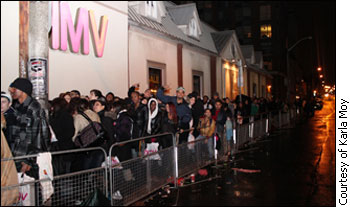
Thousands waited in the rain at Toronto’s Queen Street HMV for Drake’s Take Care album signing, November 2011.

But the international breakthrough came when K’naan’s single “Wavin’ Flag” became the official Coca-Cola theme song of the 2010 International Federation of Association Football World Cup (FIFA). The song has since been a chart hit in at least 16 countries worldwide.

Now more than ever, Canadian hip-hop artists have emerged as mainstream stars, breaking into the American and international markets.

Although some call it a passing trend, many industry professionals see the recent exposure as representing a steady Canadian movement that’s just now become more prominent.

“The Canadian hip-hop scene has been going strong since the 1980s. Artists like Maestro and Michie Mee paved the way for the success of right now, which can’t be dismissed as a coincidence,” said Chris Jackson, a broadcast technician at CBC Radio. “This is not a copycat movement; Canadian artists are just mastering their craft better than ever, and the hard work is paying off.”

Jackson has been active in the hip-hop music industry for 25 years. As Senior Creative Director at Toronto-based rap label EasPark Productions in his spare time, he notes the Internet’s role in providing the platform for Canadian artists to expose their music.

“The Internet’s broken down the physical walls — it’s so much easier now to get music from artists around the world,” said Jackson. “Local artists used to be more self-contained in their own cities, but now they’re able to expand and grab hold of the larger market.”

Drake’s success

Such was the case with Drake’s So Far Gone EP, which was certified gold in July 2010 for sales exceeding 500,000. The Toronto-born rapper (real name: Aubrey Drake Graham) had garnered mild success locally with his previous efforts, Room for Improvement in 2006 and 2007’s Comeback Season, but these were nowhere near the accolades to come.

Jackson says that it’s partly luck but mostly because of digital exposure that Drake’s third effort caught the attention of wildly successful American rapper Lil’ Wayne. This resulted in Drake signing a 2009 multi-million dollar recording contract with U.S. label Young Money Entertainment.

The label, founded in 2005, has since released five number-one albums, including Drake’s debut studio effort, Thank Me Later, in 2010.

“So Far Gone was by far his greatest effort to date, so the quality was there. But without the Internet to expose the music, Lil’ Wayne would never have heard of Drake,” said Jackson.

Toronto’s Flow 93.5 radio host Jeni McKenzie acknowledges that while rappers like Drake and Kardinal Offishall have certainly tapped into the American market, any real prominence for Canadian artists is impossible without their being signed to U.S. labels.


Prince of the city. Kardinal Offishall, with radio host Jeni McKenzie, at his Toronto Christmas charity bash 2009.

“There is definitely a unique hip-hop movement in Canada, but in order for these artists to go mainstream, they can’t rely on Canadian record labels, which don’t have the financial backing,” said McKenzie.

She notes the strictly local success of artists like Classified and Buck 65, who are often played on Canadian radio but who have yet to be signed on an American label.

“Young Money and Lil’ Wayne had the financial resources to promote Drake’s albums and create his marketing brand,” said McKenzie.

She says it was part of their business marketing strategy for Drake to proudly represent his roots in Canada. Often referred to as “Toronto’s hometown hero,” he consistently name drops his love for the city in his lyrics.

“I know for a fact Lil’ Wayne sat Drake down and told him he needed to make his album at home, film his music videos behind Toronto backdrops and surround himself with the city’s support,” said McKenzie. “He’s a smart businessman; he’s making sure the city belongs to him.”

She adds that Drake’s marketing strategy has been beneficial for other local artists coming up.

‘Up North Wave’ a branding ploy?

Anupa Mistry, a Toronto-based freelance journalist who covers hip-hop, agrees with McKenzie.

‘It’s become cool to say you’re from Toronto.’ — freelance journalist Anupa Mistry

“Drake often brands himself as being a part of an ‘Up North Wave,’ which is partly mythological, a branding ploy,” said Mistry. “The spotlight he’s created does, however, bring attention to other Canadian artists who otherwise wouldn’t have had the exposure.”

For example, she said, there’s the Toronto-based Airplane Boys, recently featured in Complex magazine. And The Weeknd is an artist whose rise to success is directly related to being promoted by Drake on Twitter. The Weeknd was also asked to open at the yearly OVO concert series founded by Drake. Sold out for the past two years since its formation, the concert is known for having special guests like Stevie Wonder and Jay-Z.

“Maybe in the past Canadian artists put out their music without relating back to their roots.  But now, with Drake putting the spotlight on them, they’re more prone to capitalize on that,” said Mistry. “It’s now become cool to say you’re from Toronto and to feel like you’re a part of a movement.”

OVO Fest
Canadian bakin’. Hip-hop artist The Weeknd, opening for Drake, at Toronto’s OVO Fest in July 2011.

Jackson agrees that in addition to the Internet, it took a big “marquee” star like Drake or Kardinal to bring the spotlight to Canada.

“It’s definitely something local artists should take advantage of, because this doesn’t happen often,” said Jackson. “Now more than ever, artists in Canada should focus on making sure they put out unique music to capture an audience.”

McKenzie can only hope that the “Up North Wave,” even if fabricated as a brand, continues to bring attention to Canadian talent.

“There are so many different cultures expressed in our hip-hop.  Shad has the African influences; Classified’s got the East Coast; and Kardinal has the reggae beats,” said McKenzie.

“We’ve got a bunch of amazing talent here that is different from the rest. And it’s exciting.”

My fair neighbourhood

On a Sunday afternoon, the construction crews are absent from Somerset Street. Their machines litter the eviscerated asphalt, seemingly abandoned. Despite the silence and stillness, it’s not hard to imagine them in motion. From Booth to Preston, and on to Spadina, the street is hemmed with fences and pylons, piles of gravel and chunks of what used to be pavement. Many Somerset businesses remain open even on this Sunday, but a peek through their windows shows that most are almost empty.

Excavator on Somerset
Bad: Machines made a mess of Somerset Street in fall 2011.  

The machinery and debris represent Phases Three and Four of the Somerset Street West reconstruction. Phase Three began in summer 2010, and is planned to complete in Summer 2012. Phase Four began in summer 2011, and will likewise complete in summer 2012.

For the time being, the reconstruction is, to put it bluntly, an eyesore. But the street’s ragged edges aren’t going to be permanent; as part of the reconstruction process, the City of Ottawa asked local artists to submit proposals for a public art project to be incorporated into the construction.

This part of the makeover is likely familiar to those who have been to Preston Street or Wellington Street West following their brushes with heavy machinery. Both those neighbourhoods feature public art. For Wellington Street, eighteen marble statues were completed in 2010. For Preston Street, fifteen granite columns called Postcards from the Piazza were completed, also in 2010. Both projects fall under the City of Ottawa’s program allotting one percent of reconstruction-project funds to creating public art.

For the gutted stretch of street on Somerset West, this program means some much-needed beautification. For this particular project, the city also found itself exploring new territory artistically. The call to artists requested that proposals focus around light, and placed emphasis on the use of new media such as video,  sound and LED.

‘Public art really has the potential to accelerate the way a community sees itself.’            — artist Ryan Stec

On the street where art lives

Public art has an important role to play in the health of communities. Eric Darwin lives in Ottawa’s west end and writes the blog West Side Action, where he often addresses the Somerset reconstruction. While he has expressed some frustration with the construction process, he is very supportive of the public art program. He says that public art brings art to a more accessible level.

Darwin has attended several open houses for the City’s public art projects, and was in attendance at the October 6 event for Somerset West. Darwin was quite impressed with the entries he saw there, he says.

Somerset Bridge Area
Better: The bridge on Somerset will have its new, blown-glass light fixtures by summer 2012.

“Art has many functions,” he says. “It brings communication, and brings people out to talk about something.”

Darwin says that the Ottawa west end has been lucky to receive so many public art installations. He adds that such projects are a unique opportunity to give residents and visitors a sense of the neighbourhoods’ history.

“You can really tell the story of the neighbourhood,” he says. “I think it enlivens our street. There’s no reason public spaces have to be dead.”

The one-percent-for-art program has existed since 1985.   The program, which is responsible for many recognizable projects around the city, is an important one, says Melissa Ramsden of the city’s Public Art Program. She says that public art projects bring a lot of value to the neighbourhoods they occupy.

“It’s important to give artists a chance to respond to the city in a creative way,” says Ramsden.“It also gives the community access to art, and for some could break down the barriers formed by galleries.”

With a little bit of competition

The call to artists for the Somerset West reconstruction went out in spring 2011, with the deadline for submissions being July 11 of that year. The area designated for the project is the bridge area over the O-train tracks on Somerset, northwest of Preston Street.

The selection process has two stages, according to Ramsden. First comes the submission of proposals; for Somerset West, 16 entries were submitted. This was then narrowed to a shortlist of five artists. The next stage includes an open house, where residents are invited to respond to the shortlisted proposals. The Somerset West open house, on October 6, was attended by around 100 people, says Ramsden.

“The community feedback helps inform the final decision, and it’s a great way for the community to get involved,” she says. Residents who attend the event are invited to write comments, which are passed to the jury, which completes the process by selecting a winner. The jury is composed of local artists, a community representative, a landscape architect, and the planner for the reconstruction project. The projects are judged according to various criteria, including artistic merit and their ability to directly address the site itself through historical or visual references, as well as to look to be engaging to the public.

Postcards from the Piazza
Best: Preston Street is one of several Ottawa neighbourhoods to have its own art features. Plans are similar for Somerset.

This process has gone largely unchanged since 1985, says Ramsden. She says she considers the process a good one. Darwin also voiced his support of the way that the City incorporates community feedback into the selection process.

Why can’t the City…?

The experience of working with city hall was not ideal for everyone, however. One artist shortlisted for the commission, Ryan Stec, experienced some frustration during the selection process. Stec stresses that he feels the program is an important one and a good effort overall, but he says the City’s approach to incorporating new media into this project created some friction.

The trouble began when Stec’s team’s first several ideas, including use of radio frequencies and interactive lighting to create a unique experience for pedestrians, were rebuffed by the City for being impossible to accommodate. Part of the problem, Stec says, was that the Public Art Program has not worked with new media before.

“It’s not usually a place that can accommodate our art,” he says. “I don’t think the City as a whole is welcoming to our approach.”

Ramsden says that some of the restrictions placed on artists were due to the need to accommodate Hydro Ottawa’s parameters for putting art on hydro poles. Certain standards were set out as a result.

Despite his frustration with the process, Stec emphasizes that the City should keep the program. “The only way for the process to get better is to keep doing it,” he says.

Just you wait

On November 7, 2011, the City of Ottawa announced the winners of the commission for the Somerset West public art project. Charlynne Lafontaine and Ryan Lotecki will be making flame-worked glass sculptures to attach to existing light features.

‘There’s no reason public spaces have to be dead.’ — community activist Eric Darwin

Lafontaine says her experience with the proposal process was very positive. This is her first time designing a public project, and the first commission she has won.

“It feels fantastic; I feel validated,” she says.

She also expressed excitement about working with the City, and said that the application-and-selection process was quite helpful to her: “I appreciated having parameters; it helped to direct my work and keep me focused.”

Charlynne Lafontaine
Part of the makeover team: Charylnne Lafontaine is a sculptor who will be helping to reinvigorate Somerset Street.

The two artists will address the theme of transformation, with glass-blown sculptures of seed pods morphing into flowers from one end of the bridge to the other. Intersections in Chinatown will also receive glassworks as decorations; however, Lafontaine says they have not yet decided on the nature of these decorations.

Despite differing experiences in working with city hall, all of those involved emphasize the importance to communities of public art, and say they feel the public art program is on the right track.

“Public art really has the potential to accelerate the way a community sees itself,” says Stec.

Summer 2012 is the proposed conclusion for the Somerset West of the construction, and hopefully the new face and new artistic features will make the neighbourhood’s hibernation worth it. For the time being, however, Somerset West will have to enjoy its beauty sleep.

Fashion with a ‘Gypsy’ twist

It all started with a young woman who had too many clothes and not enough closet space. Aria Leroux is and always will be a collector of stuff. Just step across the threshold of her boutique, Gypsy & Co., at 209 Gilmour Street, and you’ll know exactly what I’m talking about. For example, it might take you a few moments to realize that the vintage bicycle you’ve been admiring and wondering about (the one leaning casually against the picture window) acts as a kind of welcome mat, signalling that you’ve arrived.

The shop is chock-full of vintage finds — 1980s crop tops and high-waisted pants, ’60s mod colour-block dresses and miniskirts, bell-bottom pants of the early ’70s — all moderately priced and at your fingertips, waiting for a new home among the quirky and imaginative patrons who frequent Gypsy & Co. in search of that one-of-a-kind item.

And find it you will. Leroux makes use of every single inch of her tiny space: To your left and right, rows of clothing line the walls. Antique furniture items, scattered throughout, display an array of vintage baubles and jewelry on pretty silver trays. A plant hanger from the ceiling houses a collection of sunglasses. Like pieces of artwork, necklaces hang from tacks pushed into the walls.  A gilded, high-backed couch at the shop’s front provides customers with a comfortable perch on which to watch the world go by.


A soothing abundance.  As well as clothes and jewelry, Gypsy offers a cafe section where clients can sip tea and feel at home.

An alcove at the back of the room serves as the shop’s kitchen, which is not just for show. Leroux and her business partner, Veronica Michelle, also operate a cafe. Each menu item is named after the ladies’ favourite “local faces and places,” says Michelle. “The Rockalily” (a sandwich made of granny smith apple, peach chutney and old white cheddar cheese) is named after the burlesque troupe that Leroux and Michelle belong to. And a music store called Record Shaap operates in the boutique’s basement, selling CDs and vinyl records. Leroux doesn’t own the record store but says she often gets owner Matty McGovern to supply music for cocktail and costume parties hosted at Gypsy.

Opened last spring, Gypsy & Co. is still a new kid on the block, yet it was nominated this past October for “Best Vintage Shop in Ottawa” by Ottawa (X)Press, the city’s alternative weekly entertainment guide. Other contenders included Ragtime, Young Janes and Attic, and although Ragtime snagged the coveted title, Leroux says she is honoured to have been included among such vintage veterans (“Ragtime’s been around for, like, 30 years,” she mentions) and says it was “totally mind-blowing” that Gypsy took first-place runner-up.

In fact, Leroux — who began by selling clothes online and who recently opened a second Gypsy & Co. store, on Dalhousie Street — says she was surprised just by the nomination itself. But then again, a self-deprecating attitude is part of her charm.

Gypsy’s price tags are marked no higher than $200 — a rarity in the finer vintage clothing business — and even in that range they seem a bargain: The pricier pieces tend to be unique staples of vintage fashion that you’d be crazy to pass up. “This space is as student-oriented as it can be without having to close,” Leroux says of her prices.

In fact, Gypsy’s prices are meant to be competitive even with huge retail clothing outlets such as at the Rideau Centre. For Leroux’s loyal customers, buying local trumps buying corporate any day. And it’s the ultimate form of recycling, she says.

Seeking that edge

Leroux makes an impression personally, as well. With fiery red bangs cropped neatly across her forehead, a number of facial piercings dotting her top lip and cheek, and a curvaceous figure that could rival Marilyn Monroe’s, she reminds me of a friend’s cooler big sister.

‘This space is as student-oriented as it can be without having to close.’ — owner Aria Leroux, on her prices

And why has Gypsy & Co. developed such a loyal following in its short history so far? Part of the answer surely lies in Leroux’s work ethic and ability to adapt quickly to supply and demand.

There are lots of people in the vintage clothing business in Ottawa right now, she says, so she relies on resourcefulness to help her shop stand out. “I might not get every beautiful ’50s prom dress that you can occasionally find in, like, the back bin at Value Village. You know, it’s me and like, eight other people that are fighting for that. But I’ll take something that someone else might overlook and be able to turn it into something equally amazing.”

This conscientious approach is evident in many aspects of her boutique. In addition to the (as she says) “painstakingly handpicked” garments and accessories that line the shelves and racks, Gypsy & Co. carries a plus size and menswear line, two things that Leroux says the Ottawa vintage scene currently lacks.

Regarding menswear particularly, Leroux says she absolutely put her foot down, pledging to carry a decent collection. The shop boasts a sizable array of sports jackets, coats, pullovers and sweaters.


Accessory treats.  Vintage baubles and jewelry are served up temptingly, throughout the shop, on antique boudoir trays.

Originally from Vancouver, where vintage has always been a “huge fashion staple,” she now uses her West Coast connections to keep Gypsy supplied from beyond Ontario. Her last big hometown haul came east in four large suitcases, none of which was packed with any of her own clothes. Other pieces come from the Maritimes, and the shop features Leroux’s own handmade line, recycled from used clothing (“Unless it’s a rag, it can be turned into something else” she says) and vintage fabric and material.

Timeless elegance

“Vintage fashion is almost like antique hunting,” says Cate Lorimer, a contributor to The Genteel, an online fashion magazine. “You almost become, like, a collector.” Lorimer goes only to thrift shops for her clothing and says she often finds items for pennies that look like something you could grab off the rack at H&M.

“It’s just become such a fashion movement: having something vintage or used. It has a special ring to it now,” Lorimer says. A lot of the appeal comes from runway and media-reported trends, she adds.


Fashion sphinx: Gypsy & Co. owner Aria Leroux in her element.

Lorimer says she has noticed many celebrities opting to wear vintage-inspired gowns and suits on the red carpet and notes that consumers, both men and women, look to awards season as a way to inspire day-to-day clothing choices.

Part of vintage’s appeal is its aura of longevity, Lorimer adds: “The things that you do see in a vintage store are usually the things that are so classic and timeless that you can wear them forever. There’s something really special about that.”

And Leroux’s selection certainly mirrors this ideology. Every piece passes through her skilled hands. She spends anywhere from half an hour to three hours on each garment, depending on how much restoration it needs. Pieces from the ’40s and ’50s require some research beforehand. This way, the original design stays as authentic as possible. Before it hits the racks, each piece is professionally laundered.

“I’m such a romantic. That’s really what it is. That’s what it comes down to. And to be able to breathe life into these garments, these physical manifestations of history, is really amazing to me,” Leroux says. “And just making people happy.”

Says Gypsy customer Jessica Hewson, “It makes me feel like I just stepped through a time portal to the 1950s or ’60s. I love it, almost as much as I love shopping in my grandmother’s closet, where things are free!”

“If I could design a perfect place I wanted to go, this would probably be it,” jokes Leroux, gesturing around the shop. “It’s like, it’s a vintage store and there’s a record store in the basement and, oh, guess what? They have vegetarian food.”

Luxe, Calme et Volupté