The Sixties come swinging in again

High above the clouds, men in business suits and women in bright, Jackie Kennedy–inspired dresses smoke cigarettes, drink chilled vodka and dine on a freshly carved roast served to their seats by an Air Canada stewardess.

The year is 1966 and a young Linda Meckling is just beginning her stewardessing career.

After an extensive interview process, including strict physical requirements, Meckling had been selected. She says she was excited and ready to travel. She then spent 37 years travelling the world, making sure she attended the regular weigh-ins and never forgetting her hat, gloves and girdle. She says she has many “silly stories” and fond memories from those days.

Lately, Meckling says she has been receiving calls from friends to chat about the TV Show Pan Am, about a group of young stewardesses flying around the world in the 1960s.

“I think it is such a fun show; it’s kind of a spoof on the time period. It’s true that the supervisors were very much there and the girls looked fabulous, absolutely tremendous, but there are a lot of things [in the show] that would probably not go,” she says.

The swinging ’60s


Glad all over.  An early-’60s inspired dress from Top Shop, worn by Ottawa fashionista Christine Sirois.

Pan Am wasn’t first, of course: The wildly popular Mad Men, about advertising executives, is has been the first successful TV series to take viewers back to the early sixties.  And this ’60s resurgence isn’t limited to TV. The era, both early and late ’60s, has become a trend in contemporary arts and entertainment, most notably in fashion.

Runway shows for the past year have featured early-and-mod-’60s-inspired patterns and pieces. The venerable New York Times has covered fashion stories showcasing the revival of the early and late ’60s. Local news media, like the Ottawa Sun, reported early-’60s-influenced pieces as fashion essentials for this past fall. Fashion magazines locally and abroad, like Vogue and LouLou Magazine, have featured mod-’60s-shaped dresses with a contemporary spin, incorporating patterns and fabrics from this decade.

But what is it about the 1960s that so appeals today?  Meckling says she thinks it’s because the ’60s were a more carefree era.

“Shows like Pan Am are just fun. It’s a fun thing and maybe people just need that kind of release,” she says.

Many experts agree that in today’s anxious and conservative society, looking to a more idealistic, positive time provides comfort and inspiration. Anne Gorsuch, a history professor of University of British Columbia, shares this view.

“In so much of the world there’s a sense of pessimism about the future; the ’60s offers a moment where people thought they could do something, and they stepped up to do something,” Gorsuch says.

‘The ’60s offers a moment where people stepped up to do something.’ — history professor Anne Gorsuch

The 1960s saw significant developments in such areas as civil rights and women’s rights. Gorsuch says this is because the 1960s were an optimistic time, and people felt secure enough to push for change.

“People felt empowered, and I don’t think people generally feel that way right now,” she says. So audiences today are nostalgic for the positive ideals of the ’60s, and the entertainment and fashion industries have caught on.

“I think Mad Men hooked into this nostalgia,” says Gorsuch. “It’s a way of explaining who we are now. It’s a period of romanticism, so it’s attractive.”

Elegance of the classic ’60s 


A method to their madness. Retailers like Banana Republic, above, are tapping into ’60s nostalgia.

The early ’60s were a more traditional period than the later part of the decade, when people began to demand change, says Tracy Penny Light, a professor of history at the University of Waterloo. The early ’60s in North America were conservative, politically and socially, and this attitude was reflected in fashion. The average middle-class woman wanted to emulate Jackie Kennedy’s tidy and traditional look, says Penny Light.

Both the fitted, patterned dresses of the early ’60s and the mod dresses of the late ’60s have appeared recently on runways and in Canadian fashion magazines. But it’s not just in women’s fashion: For example, Banana Republic recently launched a ’60s-influenced line of men’s suits, referencing Mad Men in the ad campaign.

Finding true vintage or early-’60s-influenced pieces has become a popular trend, says Julie Yoo, owner of I Miss You Vintage Fashion Boutique in Toronto.

“I’m seeing a lot of a return to the classic ’50s and ’60s even on TV,” says Yoo, “so we are seeing a real resurgence of that.” Yoo says she thinks the allure of early ’60s pieces is their charming, feminine, hourglass shape.

“They’re great classic pieces. Clean and easy cuts, very feminine, figure flattering, easy to wear separates, and not fussy,” she says.

Rebels with a cause


Obnoxious orange from the outrageous ’60s. Ottawa fashion lover Sarah Van Den Berg in a late-’60s dress, a vintage find.

In Canada and the United States, the early ’60s paved the way for significant social and political change later in the decade. With the election of Pierre Trudeau came more liberal ideals, and with them a society that wasn’t afraid of living outside the box. Women were no longer restricted to pieces illustrating their femininity; instead they began to break tradition and wear mod dresses. Later, both men and women grew their hair and wore flared jeans, dispelling the traditional gender roles with their clothing.

The current revival of early and late ’60s isn’t limited to arts and fashion: Large-scale social movements like Occupy Wall Street and the Arab Spring suggest that our modern era may be — more than just infatuated — inspired by this period.

Adam Green, a professor of history at the University of Ottawa, believes that people today find inspiration in the 1960s probably because it’s the best example of a decade that rejected conservatism, restriction, and discipline.

“I think the ’60s for most people represent the complete opposite; it was the heyday of no boundaries, no rules,” says Green. Green says societies cycle between liberal and conservative times. He says when society is leaning towards change this desire is represented in art first, because art is about pushing boundaries.

“We are in a very small-C conservative time here, in the United States, the U.K., France and just about everywhere, but art is always ahead of its time. What happens in art today happens in society tomorrow,” he says.

“The stuff that we are seeing now in terms of fashion, music, and TV is an indication that maybe in five years or 10 years there will be another swing back into a more liberal time,” he says.

Until then, we can live vicariously through our TV screens, pretending to be in the more simple and optimistic ’60s.


Nerdlesque: worshipping the geek gods

From the number of video games that Del Roba references in casual conversation, her Xbox gaming console must have provided marathons of dedicated play.

Now, that Xbox is shattered in pieces — smashed by Roba not as a result of a frustrating loss, but because she needed to wear it to her job.

Roba, whose real name is Frankie, is the founder of the Ottawa-based Browncoats Burlesque, a one-year-old burlesque troupe that celebrates fringe-culture enthusiasms in an onstage form of burlesque now burgeoning in North America called “nerdlesque.”  Browncoats Burlesque — a reference to the cult TV show Firefly — features acts with such nerdy themes as cult movies, comic books and video games (hence the costume composed of Xbox hardware).

Browncoats Burlesque
Geek chic. Ottawa’s Browncoats Burlesque troupe features Del Roba, top, and Foxie DeVille, second from left.

Browncoats Burlesque is one of several burlesque troupes across North America to showcase nerdlesque, but this quirky subgenre has grown in popularity only within the past two years.  One early notable troupe of this emergence was formed in 2008 under the name Nerdlesque to be a monthly burlesque series exploring nerd culture.  Since then, most major U.S. cities with a strong burlesque presence showcase nerdlesque acts, such as the Flaming Dames’ nerdlesque-themed show at Chicago’s New Millenium theatre company, or Skill Focus: Burlesque in Orlando, or Whedonesque Burlesque in Seattle.

For Roba, Browncoats Burlesque has been a labour of love.  The self-professed nerd says she had seen the Devil Dolls burlesque troupe in Ottawa and was inspired to create her own burlesque show, based on something she knew best.  And what what she knew best, she says, was nerd culture: video games, cult movies, science fiction series and other interests typically classified as “geeky.”

Conveniently, her first recruits for the show were friends from her live-action role-playing group, or LARP.  (LARP is an activity in which players create settings and characters and improvise scenes in a real-life setting, creating challenges for their characters not unlike storylines in video games.)

Dorks in short shorts

As risqué as burlesque is, the performance art attracts people with a variety of day jobs.  The performers with Browncoats Burlesque include workers for several branches of the government, a chef, and a neuroscience researcher.

A burlesque show can feature various sideshow performances, but the defining acts showcase performers — usually women — removing their clothes.  The main difference between burlesque dancers and other strippers is the tongue-in-cheek humour, which satirizes the sexualization of stripping.

Roba says that, friends and supporters aside, their audiences tend to span a variety of demographics.  She says that nerdlesque has a strong marketplace appeal.

“Nerdlesque is definitely something I think people can get behind. I find people are more able to relate to the performances than with some other styles of burlesque,” she says. “Most people can feel for the awkward nerd just trying to be cool.  Nerdlesque, in many ways, is a form of ‘fan fiction’ amongst the many that make up ‘fanculture’. That equals an army of nerds that could possibly get behind nerdlesque.”

‘My influences are ballet and video games.’ — Foxie DeVille

Aside from group numbers, the members of Browncoats Burlesque write and choreograph their own acts.  Under the wide umbrella of “nerdiness,” the range of ideas seems unlimited.

You’ll find, for example, a fervent Batman fan parading as the villains Poison Ivy and Harley Quinn, and an avid gamer pulled off a complicated ode to the computer game Tetris.  Performers say nerdlesque allows them to express and embrace the niche interests of their personal lives.

Foxie DeVille (who has asked to print her stage name to preserve her privacy) says she already had a background in burlesque before joining the Browncoats Burlesque.  The classically trained dancer lists-off a number of Hollywood influences that attracted her to more complicated choreography, such as a dance using large fans.  Despite her traditional training, she says she feels inspired by creative opportunities with the pop culture references.

“My influences are ballet and video games,” she says, noting the unusual marriage of the two hobbies.

At last Halloween’s show Freeks N Geeks, Roba performed a number based on the cult film Attack of the Killer Tomatoes, which she says she chose based on her passion for critically and commercially unsuccessful movies.  The emcees gave the audience red balls to throw at her during the performance, symbolizing a downpour of tomatoes from the film.  Though at first uncertain whether the audience would participate, she says that she was so impressed with the audience’s gusto in their throws that she cheerfully smiled and thanked the crowd when she was supposed to pretend she was dead.

“Audience interaction is pretty awesome,” says DeVille.  She says that although the audience doesn’t always understand the reference, they engage with the comedy and light-hearted nature of nerdlesque, more than with other burlesque shows.

Enthusiastic audience responses like these have encouraged the spread of nerdlesque troupes and individual acts, which in the United States now range from Seattle to New York City.  Montreal and Toronto feature individual nerdlesque acts, but Browncoats Burlesque is currently the only full-time, nerdlesque-only troupe in Canada.

Revenge of the nerds

NYC Nerdlesque
Software and hardware. New York City’s Nerdlesque boldly goes nude where no nerd has gone before.

Chris Chappell is a co-producer of the New York City–based troupe Nerdlesque, which is a joint venture between Sneaky Snake Productions and Captain Sharky’s Historical Gender Equality Reactualization.

Chappell says he suspects that the rise in nerdlesque groups across North America can be attributed partly to a general cultural shift.

“There’s this really complicated intersection of hipness and nerdiness,” says Chappell.  “There’s a mainstreaming of a lot of these [nerdy] things.”  In other words, “geek is chic”: It currently is trendy to celebrate the otherness of traditional nerd interests, and this new value is reflected onstage.

He says that in North America nerd pride is on the rise. “People have really incorporated that into their idea of culture.  And [nerd appeal in the arts] is happening organically as a result.”

Yet Chappell says there is a danger of not sufficiently honouring the original material from which nerdlesque troupes draw their references, indicating concern about taking away some of the substance of nerdy sources after they’ve hit the mainstream.  Still, he says nerdiness is a “vibrant trend and community,” and his troupe is proud to be a part of that.

For Browncoats Burlesque, whose acts have such personal significance to the performers, honouring the nerdy references is a priority.

Above all, though, the performers insist on one key component.

“Basically, we want everybody to have fun.  That’s all we’re really trying to do,” says Roba.

Even if it means smashing her prized Xbox for the show.

One story. Thirty days. Fifty thousand words.

Amidst her whirlwind writing schedule, Kelley Armstrong got an idea: She wanted to write an urban fantasy book for young adults. She had already been a New York Times bestselling author since the seventh book in her Women of the Otherworld series, but with a young adult plotline floating around her mind, she wanted to try something new.

With so many tight deadlines, she wasn’t sure how to fit the new book into her schedule without potentially wasting months if she discovered she wasn’t suited to the young adult genre.

“I couldn’t afford to give up three months or so of my time to find out,” the Aylmer, Ont.–based author says.

Her agent suggested she take part in National Novel Writing Month, an annual challenge for writers everywhere to write 50,000 words in a single month—November. That way, if her book didn’t turn out well, she would have wasted only a month.


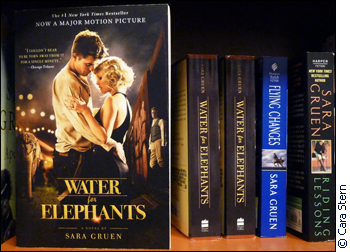
Bestselling book and box office success Water for Elephants began life as a NaNo novel.

She took up the challenge, produced a first draft, and about two and a half years later, released the first book of that new trilogy, Darkest Powers. These young adult books went on to be her most successful, and brought her for the first time to the top spot on the New York Times Best Sellers list for children’s chapter books.

This year, she once again took part in the National Novel Writing Month challenge, affectionately known as NaNoWriMo, and even as NaNo — an appropriate nickname since “nano-” means tiny. Armstrong is among a number of people who have found success through their NaNo novels. Sara Gruen’s Water for Elephants and Erin Morgenstern’s The Night Circus both began life as NaNo stories.

However, most of the 250,000 participants are not professional writers, but rather use the challenge to try their hand at novel writing. Many don’t ever intend to publish their work.

“One of the purposes of NaNoWriMo is to take novel writing from something you would do one day, to something you would do today,” says Jill Ainsworth, municipal liaison for the Ottawa chapter of the challenge. In her role, she schedules group writing sessions, the kick-off party, and the “thank goodness it’s over” party.

“You give yourself permission to suck, because you’re writing so fast and so much in such a short period of time, and you edit later,” she says, adding that last year, the Ottawa area’s roughly 500 WriMos (as participants like to be called) wrote a total of 15,409,086 words.

Safety in numbers?

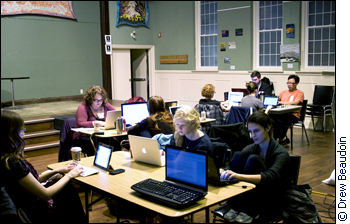
Participants gather in coffee shops, libraries, bookshops, and even on the Toronto subway. They can be recognized sitting with their laptops or notebooks surrounded by cups of coffee, often in groups, scribbling away as they try to reach the 1,667 words per day to hit the challenge’s goal.

Ainsworth says writing in a group during the challenge gives WriMos an opportunity to socialize and give each other advice and motivation.

Skeptics remain: ‘We’re in a supercharged media world, and everyone thinks there’s a fast, quick way to do things.’
— writer Seymour Mayne

While it can be nice to write with others, Armstrong warns it can make the challenge more daunting as you see some friends making much faster progress.

“It can have a negative effect of people feeling like they are not accomplishing what they should be,” she says. “The point is not, as far as I’m concerned, to write 50,000 words. It’s to write as much as you possibly can in one month.”

While there are some full-length novels that do end at about 50,000 words, such as The Great Gatsby by F. Scott Fitzgerald, Armstrong says in general, a complete adult novel is around 100,000 words.

Seymour Mayne, a poet, short story writer, and professor of creative writing at the University of Ottawa, says he’s skeptical of these short-deadline challenges.

“I’m more concerned with the quality of literary work,” he says. “I’d rather somebody take their time and write the book they had to write.”

He acknowledges that these challenges can be useful for some people, but stresses that it shouldn’t be about rushing to skip the hard work.

“We’re in a supercharged media and social media world, and everyone thinks there’s a fast, quick way to do things,” he says. “But I think things have to work out organically.”


Graveyard shift: Toronto WriMos at an overnight “write-in”.

Armstrong says she’s clear that a writer will not produce something publishable within a month, but it’s a good way to test a new idea, and it can get you on the path towards a publishable manuscript.

“What I write in one month is by no means what I would let anyone even see,” she says, explaining that she spends months editing and rewriting her stories but that using NaNo deadlines for the first draft helps speed up the process. “That goes with all of my first drafts.”

There is some debate in the NaNoWriMo community about how agents perceive the challenge. Would they throw away a query letter for a manuscript as soon as they read it was first written in a month?

Sarah Heller, literary agent for the Helen Heller Agency in Toronto, says no.

“For me, when I sign someone on, it’s definitely not unheard of that we work editorially prior to sending out anything to publishers,” she says, explaining that she takes on many new writers, and even represents Armstrong’s young adult series.

However, while it is not necessary to conceal that it was written for NaNo, the fact wouldn’t particularly pique her interest either, she says, and thus is irrelevant on a query letter. She adds, she’s more interested in a good story idea and a letter that shows the author has done research and understands how the publishing industry works.

Stop procrastinating

Drew Beaudoin, the municipal liaison for the Toronto region, says he has been trying to get his 2010 NaNo novel published. He spent months editing it before sending it to one publisher, which gave him his first rejection letter.

Since then, he has continued to edit, and is hoping to send it out to more publishing companies as soon as possible.

“A lot of first-time writers don’t seem to realize it’s just a first draft and you do need to edit it,” he says. “For a NaNo novel, you need to do a complete overhaul of it to bring it up to a publishing standard.”


Kelley Armstrong’s NaNo draft created the Darkest Powers series that made her a #1 New York Times bestselling author.

He says he’s heard of agents receiving a pile of manuscripts as November ends, all from people who finish their novels and send them out immediately.

Heller says she hasn’t noticed a spike in December, but finds more people send in manuscripts in January. She attributes this to people deciding their New Year’s resolution is to finally get their novel published. However, it’s possible that some of these post-New Year’s manuscripts come from WriMos who have spent their winter holidays editing their novel, with a goal to get it to agents in January, Beaudoin says.

Despite the very tight deadline, most people seem to think it’s a good idea to try out the challenge.

“It’s nice to stop censoring and just write,” says Kris Rothstein, an associate agent for the Carolyn Swayze Literary Agency in White Rock, B.C. “I think almost anyone can benefit from the constraints.” However, she adds, it’s good to have put in some thought beforehand.

Armstrong echoes this sentiment; it’s crucial to have an outline so that there’s no time wasted trying to figure out where the story will go. And although she recommends the challenge as a way for would-be novelists to find out if they like writing every day, she recognizes that not everybody will be successful. Still, she says that shouldn’t stop you from pursuing a career as a writer.

“If you can’t do your 50,000 or if you find that writing that fast does not work, never think that means you cannot write,” she says. “If it works for you, great, but if it doesn’t, and you still want to write, find a different way of writing.”

Quidditch for muggles

The seeker darts across the field on his broomstick when he spots the golden snitch—a university-team wrestler, dressed in gold—taunting him from the audience. The snitch is wedged among 20-something-year-old Harry Potter devotees torn between watching the coming confrontation and protecting their homemade magic wands

Devoted Harry Potter fans are turning their favourite fictional sport, Quidditch, into reality; trading lacrosse sticks for broomsticks and basketballs for quaffles. Though they can’t fly, their love for the boy hero is enough to fuel their imagination — and their broomsticks.
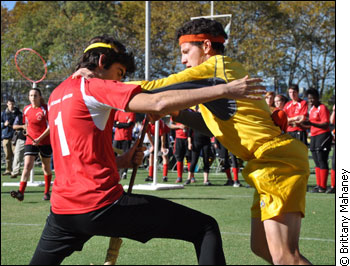
A seeker (left) braves a stalwart defence, trying to capture the flag attached to the golden snitch’s shorts.

“The snitch has been spotted!” the narrator yells, attempting a British accent.

Attention turns to Carleton University’s chaser, who is racing down the field with a quaffle (a volleyball to ordinary Muggles) under her arm. This isn’t an easy task, as she must sidestep the flying bludgers (dodgeballs) that the beaters are throwing at her. “Beat her! Bludge her!” chants a crowd of impassioned Ohio State fans in the audience. If it weren’t for the incessant cheering, it would be difficult to tell where each person’s allegiance lies, as both Carleton and Ohio sport red jerseys.

Amid this chaos, Carleton’s seeker focuses on his golden target and tackles the snitch to the ground, grabbing the flag around his waist. The Quidditch game is over and Carleton is victorious in its second game at the fourth annual World Cup in New York City’s DeWitt Clinton Park.

On a sunny day that seemed too hot to be November, with a backdrop of towering Manhattan buildings, Carleton took the field against 45 other teams at the World Cup. The Nov. 13–14 event, which is organized by the overarching International Quidditch Association, drew over 20,000 spectators and 757 players this year.

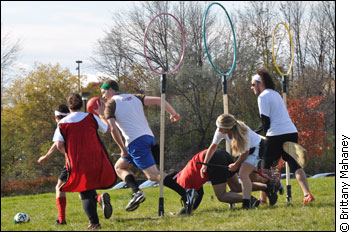
You needn’t believe in magic to see that Quidditch is now being taken seriously as a university sport. Carleton is one of 400 universities across the world to create a Quidditch team since 2006, inspired by J.K. Rowling’s Harry Potter series and the unforgettable scenes from the movies. The sport is a combination of football, dodgeball and tag, and is surprisingly demanding.

For the love of Harry

Andrea Hill, 20, captain of Carleton’s team, says children who grew up with Harry—literally, being about Harry’s own age as the books were released—are now adults and don’t want to let go of their favourite hero. Many of the players are of this age, about 20 or 21.  And Harry is easy to identify with: At core, he faces struggles that are universal.

“He may be able to fly on a broomstick and transfigure matchsticks to needles, but he is self-conscious, struggles with schoolwork and has a short temper that more often than not lands him in detention,” Hill says. “The books have taken a very fantastical element and grounded it in something normal people can relate to.”

Tabitha McDonald, 20, a keeper for Carleton University who recently wrote an English essay about the heroism of Severus Snape, starts giggling with the other girls at the mention of Daniel Radcliffe. She holds an icepack on her injured leg and mentions she is also nursing a broken rib. For McDonald, playing Quidditch is worth the pain. While she describes the team as a bunch of like-minded nerds, Quidditch also serves a deeper purpose: a way for her to connect with her favourite childhood series. It prompts memories of reading with her parents and the impatient wait each year for the next book to hit shelves.

“My whole year was centered around reading the next book,” McDonald says. “Quidditch was this sport that I had dreamed was a possibility, and then I heard about it and it was probably one of the happiest days of my life.”

At the World Cup, one could easily note that some players draped velvet Gryffindor cloaks over their shoulders or could recite Hogwarts-type incantations on command. Beyond obvious incentives to exercise and socialize, Harry Potter seems to have struck a deeper nerve with these Quidditch players, touching of their self image.  In fact, the cultish loyalty of players leads naysayers to deem Quidditch obsessive.

Why has Harry Potter remained so popular with young adults? “It crosses a lot of gaps and speaks to everyone,” McDonald explains.

‘Quidditch was this sport I dreamed was a possibility. Then I heard about it and it was probably one of the happiest days of my life.’
– Tabitha McDonald

Sherry Aske, a keeper for Carleton, remembers reading Harry Potter as a child and dreaming of running away to Hogwarts when she was upset. Aske, now 20, she says her love for the series will never waver.

“Reading works the same way for me now when I get stressed. I always liked it because you can escape from the everyday world. It’s like therapy,” she says. “I think it doesn’t matter how old you get but you don’t—I hope, anyway—you don’t lose your imagination.”

Paramedics were on hand at the World Cup, wheeling several overzealous players off the field on stretchers. Commentators occasionally narrated in Parselmouth (the language supposedly spoken by snakes), and there was that brunette dressed in navy blue who kept introducing herself as the head of Ravenclaw House.

The dark side

Whether this sense of whimsy is light-hearted or serious is arguable.  Turning fantasy into reality might do long-term damage to our collective imagination, says Susan-Anne Cooper, a professor of children’s literature at Carleton.

“People are quite happy to have it be literal, at which stage it’s not fantastic: There’s no room for make-believe or imagination,” Cooper says. “If people become completely literal-minded and lose the capacity to imagine, then we’re in big trouble.”

In this vein, Cooper points out, anyone can see Hogwarts Castle, visit Ollivander’s wand shop or sip butterbeer at Universal Studios’ new Harry Potter theme park in Florida. At least Quidditch players have to pretend they are flying (until hoover-boards become mainstream).

Beyond the physical incentives to play Quidditch, players feel closer to their favourite boy hero, Harry Potter.
A magic moment: Carleton throws the quaffle through the hoop, in a home-field game.

But Irvin Khaytman believes the sport shouldn’t be taken so seriously. Khaytman is a member of New York’s community team—the only team not tied to a university or high school. For him, Quidditch isn’t just a fantasy realized, it’s also a way to connect with likeminded people and to exercise.

“I’ve never been athletic, so to join a team full of nerds who just run around on brooms in capes and act goofy, it seems like an amazing time.”

Khaytman says he’s nostalgic for the series because he grew up with Harry and was the same age as his favorite characters when he read each book.

“It’s your past,” he says. “Everyone’s been at school; they’ve had the school bully; they’ve had the school teachers that you love and hate; they’ve had the evil assistant principal.”

Now, in the swirl of work and stress, Khaytman says playing Quidditch brings him back to a safe space.

Back in Ottawa, Carleton is competing against Saint Lawrence University on home ground. Nine-year-old Maliha Sarwar sits in the crowd with her mother and brother, munching on a licorice wand she bought in support of the team. Currently, the family is reading Harry Potter together and watching the movies after each book. Maliha represents a new generation that is growing up with Harry and his friends: she even dressed as Hermione last Halloween. Now, at the game, she watches team captain Hill, whose face is swathed in red war paint, tackle a male player two feet taller than she.

“I think it’s a very good game; I like Quidditch,” Maliha says. She repositions her glasses and waves her candy wand as she says, “I think I’d like to play one day.”

Related Links

Audio Visual Slideshow: Why Quidditch players love Harry Potter

David Dixon’s ‘true patriot’ design


Genius at work? Dixon in his Toronto office.

David Dixon’s career as a fashion designer seems like a fairy tale in a business that is competitive, undersized and financially strained. Dixon has managed to rise above these conditions; in fact, Sun Media has described him as being a world ahead of Canadian fashion designers.

With 15 years’ experience, Dixon is currently leading the fashion industry here in Canada. He is one of two Canadian designers to have a partnership with Town Shoes, but is the only one to have two collections available exclusively at Town Shoes.

Dixon was hand-picked by Mattel to design their Barbie-inspired collection, and is constantly involved in prestigious fashion events such as “Behind the Scenes with Canada’s Top Fashion Designers,” hosted by the nonprofit support group Toronto Fashion Incubator (TFI).

Dixon’s work is regularly featured in the pages of top Canadian fashion media Flare, Fashion and Elle Canada. He has shown at LG Fashion Week in Toronto and Ottawa Fashion Week, and had his first showing at Montreal Fashion Week this past fall.

His clothing is sold internationally, in the United States, Kuwait, United Arab Emirates, Switzerland, Germany, Hong Kong and Tokyo. His celebrity fans include Jann Arden, Pamela Anderson, Meg Ryan and Jennifer Love Hewitt.

Dixon’s success comes from tapping into the demand for affordable, accessible luxury.

Dixon passed a major milestone with his 2000 collection, which he showed at The Docks in Toronto. He received a standing ovation and a cover page on the National Post saying he’d arrived.

The key to Dixon’s success is his raw talent, says Rania Abdulla, a stylist working on her first collection and a professor in Algonquin College’s fashion department, “He has been around for some time, and his design is international. It can suit any climate and all tastes, which in the end is what makes designers successful.”

Like most fashion designers, Dixon began by producing high-end, exclusive pieces: The David Dixon collection begins at $600 and is well received, but the high price point keeps it out of the hands of many. However, Dixon has found greater success in creating collections that are affordable and widely available.

His second collection came when he was chosen by Mattel to create an affordable line of women’s clothing inspired by the doll Barbie, for her 50th birthday, in 2009. The line reached phenomenal success, but was available only through The Bay.


Lots of colour, florals and stripes typify Dixon’s Barbie collection. A perfect mix of professional and girly.

Now, Dixon has launched his third collection, Studio by David Dixon, which he describes as a “similar flavour, but totally different colour palette, look and feel.” The Studio collection ranges from $150 to $395 and is available at many boutiques, as well as at The Bay. Dixon’s success comes from tapping into the demand for affordable, accessible luxury.

After being a regular at LG Fashion Week for years, Dixon unveiled his Studio collection in Montreal in 2010; it was his first time participating in the city’s fashion week. Studio is a playful and elegant collection. It conjures up images of women sipping tea in a garden or martinis on a yacht. There is a lot of red, blue, florals, stripes and simple cuts.

A few weeks after MFW, on November 9, 2010, TFI featured its first annual fundraiser, “Behind the Scenes with Canada’s Top Fashion Designers.” Hosted by David’s brother, Glenn Dixon (interior designer and TV personality on the W Network’s Take This House and Sell It), the event had guests flying in from New York, Vancouver and London. It brought David together with top Canadian designers Lucian Matis and Joeffer Caoc to present their Spring 2011 collections in an intimate setting where they revealed their challenges and inspirations and took the audience behind the scenes, from the concept to the catwalk.


At Toronto’s 2010 fashion week, CBC TV news anchor Anne Marie Mediwake modeled a Dixon dress cut from African fabric. It was then auctioned off to raise money for African grassroots groups.

Flare’s editor-in-chief, Lisa Tant, skipped the Scotiabank Giller Prize ceremony to attend. She tweeted from the show, “I remember David Dixon and Joeffer Caoc’s 1st New Labels show (about 15 years ago). I thought they were better than the major designers then.”

Before Dixon was designing clothing for real women inspired by Barbie, he was designing clothing for his Barbie dolls as a toddler. David and brother Glenn grew up in Toronto’s High Park neighbourhood, the youngest of six children. Glenn recalls having fashion-design competitions with David throughout their youth. “I gave up eventually; his sketches were just too good, I couldn’t win.”

It was on May 2, 1981, when an episode of The Love Boat guest-starred fashion designers Gloria Vanderbilt and Bob Mackie, playing themselves, that David realized his calling. “That’s when I first saw I could make a career out of what I was doing for fun. It looked so glamorous; I thought, this is the job for me. Literally the next day, I began sketching.”

Dixon dreamed of studying at Parsons School of Design in New York City, but his Toronto-native parents refused to let 17-year-old Dixon move to the Big Apple. He instead graduated from Ryerson’s school of fashion, and apprenticed under Alfred Sung.

Just one year after he set up his first studio at TFI in 1995, Dixon was named City of Toronto New Designer of the Year and Yorkdale New Designer of the Year. He now serves as the volunteer President on the TFI Board of Directors, as well as offers his mentorship services to young talent.

Canada’s quality fashion market

Canadian fashion, like many industries, suffers from brain drain. Alexandra Gunn, fashion editor at Ottawa Life magazine, says “I know a lot of designers make the move to the U.S., which is kind of sad because we would have a bigger fashion scene if most stayed. But business is bigger down south, and there are more opportunities to succeed.”

Dixon admits that Canada has one-tenth the market of the U.S.; however, he says, what we lack in size, we make up for in quality. In Canada, the name on the label means little compared to the feel of the fabric and the quality of the stitch. Canadian fashion is based on quality products, not licensed brand names. Canada has designers who sell their products at all the same stores as Dolce & Gabbana, but the same recognition isn’t there, says Dixon.

Dixon explains that brands such as Dolce & Gabbana make most of their money from licensed products such as sunglasses or perfumes. “It’s an accessible luxury: Whereas someone can’t afford a $4,000 coat, they can afford an $80 bottle of perfume.” Dixon knows that if his clothing sells or receives media attention, it is because of his talent, not because of a mass-marketed brand name.

To make it in the fashion industry, diversity is a necessity. Dixon says the challenge every day is to create pieces that a conservative politician in Ottawa would wear, but that are versatile enough for a small-town wife from the Maritimes to also feel comfortable in.


The future enfant terrible at age four. Today, Dixon notes his “love for mixing textures and patterns at such a young age!”

“No other designer is breaking into Canadian culture like he is,” says Gunn. “He was able to build a very strong, loyal following staying in one spot. I think staying in Canada may be a risk for some designers, but for Dixon I think it was the right move. He wouldn’t have got his Town Shoes deal if he didn’t stay, and having your own line is a huge achievement—but having a shoe line with Town Shoes? That is huge!”

Dixon remains a dedicated family man. He would never consider relocating, because his family is his support system. He and his partner of almost 17 years, Jeff (a teacher at the Etobicoke School of the Arts), have two adopted boys, Josh, 9, and Liam, 12. The family resides in Mississauga but has a cottage on Lake Waseosa in Muskoka, where Dixon likes to relax and catch up on his tabloids.

Dixon says family is “the most important thing to me; it’s the rock to stand on. It’s the key to success for any individual. No one is self-made.”

Quartier Vanier: nowhere to go but up?

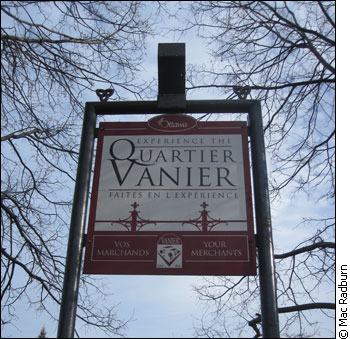
At the east end of Cummings Bridge, minutes from downtown Ottawa, a sign at the corner of Montreal and North River Roads announces, in elegant 17th-century-style typeface, your arrival in Quartier Vanier.

The “Quartier” moniker is a recent addition to the traditional “Vanier,” part nod to the area’s largely francophone roots, part re-branding effort for a neighbourhood of the nation’s capital widely seen as down on its luck.

A Quartier Vanier sign installed by the area's BIA.
A good sign? Vanier’s entry points now sport handsome boundary markers, courtesy of the local Merchants Association.

Influenced by sensationalist media stories, many Ottawa residents have come to view Vanier as synonymous with problems such as crime, homelessness, prostitution and drug abuse.

These days, however, Vanier seems to be going through a renaissance of sorts. Though still plagued by social and reputation issues, the area is also seeing gentrification as people gauge the potential of Ottawa’s most notorious ’hood.

Residential property sales prices are up almost 20 per cent this year, according to Roch St-Georges, a real estate agent specializing in Vanier. “I was very surprised by the increase in selling price in the Vanier area,” St-Georges said, explaining that many clients are tearing down older houses to replace them with new ones. “There’s definitely a turn-around happening. It will take time, but it is definitely on the right track.”

Young professionals with families are flocking to the neighbourhood, due in large part to its continued affordability and proximity to the downtown core. With the recent gentrification of the Hintonburg area, Vanier now stands as the final major downtown neighbourhood to undergo urban renewal. City of Ottawa statistics indicate rising rent costs, along with a growing population. Developers are also investing in the area, constructing multi-unit properties in hopes of profiting from Vanier’s newfound trendiness.

On the cultural front, there have been positive steps as well. Montreal Road, the community’s beleaguered main artery, is being cleaned up. Alongside the pawnshops and payday loan businesses, new restaurants and shops—Bobby’s Table and Bridgehead, for example—are opening, and improvements are being made to existing structures.

‘There’s definitely a turn-around happening. It will take time, but it is definitely on the right track.’ – Roch St-Georges, real estate agent

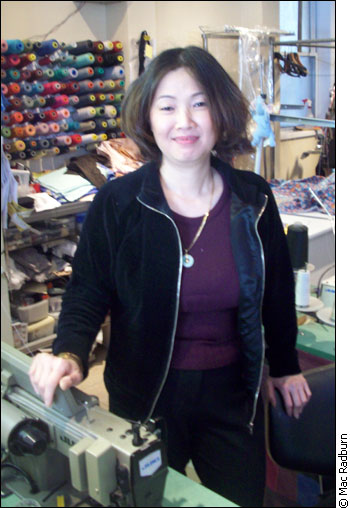
Lang Chi Dang, the owner of Fantastic Tailors and Cleaners on Montreal Road, recently had the facade of her business completely re-done in stucco, at great expense. She says with all the positive changes in the community, her investment will pay off and could inspire others to follow suit.

Street appeal is a high priority for Dang. She says in the past, customers would express safety concerns about walking from their cars to her business. “If you drive by and you see something that makes you feel insecure, you wouldn’t stop your car and step out,” Dang said. She added, “We’ve had problems. Sometimes people come to ask for money, and there’s prostitution,” she said. “Right now there is less and less.”

Ottawa Police Service statistics reflect what neighbourhood residents already know—today’s Vanier is a safer place to work and live than the Vanier of the past. News stories from the Vanier area historically dominated Ottawa media crime coverage. Past police figures indicated more Vanier criminal activity than the city average, with less than half of all Vanier residents reporting that they felt safe when walking alone at night.

The situation has improved in recent times, however, with crime rates declining steadily since 2006, and total Criminal Code offences dropping 10.2% in Vanier in 2009. Residents also report seeing less blatant criminal activity on side streets and along Montreal Road.

Lang Chi Dang stands with her sewing machine.
Local business owner Lang Chi Dang is pioneering the neighbourhood revival.

The largest change to this stretch of road is still to come, when the Wabano Centre for Aboriginal Health completes its expansion plans for a 25,000-square-foot building (conceived by famed architect Douglas Cardinal, who designed the Canadian Museum of Civilization). To be built atop and around the existing Wabano building at Montreal Road and Altha Avenue, the new structure will serve as a Vanier landmark and completely change the streetscape, says Carlie Chase, the center’s director of initiatives. Featuring natural materials and undulating panels of glass, the $14 million-plus centre will lend itself to the revitalization of Vanier, providing valuable services and sparking further gentrification, says Chase. “It has a ripple effect. We certainly anticipate [that] the beauty of this centre—and the heart of this centre and the service impact this centre will have—will change the entire community.”

On a sunny Tuesday afternoon, the area around the centre’s future location seems ready and reflective of positive change. The sidewalks bustle with residents and passersby. People enjoy an outdoor drink on a pub patio, while multiple construction crews are busy installing new stucco facades to buildings. Then, without warning, a man on the sidewalk sways violently as he throws a cigarette butt to the ground. After an extended fumbling with his belt buckle, he undoes his pants and urinates on one of the storefronts, seemingly oblivious to passing pedestrians and cars.

In response to community complaints over similar incidents and concerns over crime, the Quartier Vanier Merchants Association has launched several initiatives over the past few years to improve safety and livability. Beautification and graffiti-removal programs have been initiated and a farmers’ market started, and regular foot patrols take place with hired security services and the Ottawa Police Service.

A freshly re-stuccoed building in Vanier.
A nice facade. This newly re-stuccoed building, hosting a family restaurant and a gentlemen’s club, typifies Vanier’s duality.

Still, despite the many signs of positive change in the area, residents and community leaders seem to temper their optimism as they grasp the challenges the community must unite to overcome. “There are barriers to change,” says Rideau-Vanier city councillor-elect Mathieu Fleury, who, in the October 2010 municipal election, defeated longtime incumbent Georges Bédard. Seen by many commentators as the face of the new Vanier, Fleury must find a way to balance the tensions between old and new, to successfully usher in future change.

Some Vanier constituents have already come to him with concerns over condominium developments, such as those on Landry Street, aimed at hoped-for middle-class residents. “Although people are in agreement with intensification, they do not want to see 20- and 30-storey buildings being built in the middle of residential communities,” Fleury said.

Indeed, the opening of new shops and restaurants, the perception that social problems are on the decline, the influx of new residents and the construction of trendy condos have some boosters pegging Vanier as the “next Westboro.” Though Fleury takes such remarks as a compliment, he says that Quartier Vanier will forge its own distinct path.

“There needs to be investment, there needs to be a facelift on main arteries and there needs to be community involvement through all of this. But it will be Vanier’s way—not another Westboro.”

Wicca’s widening spell

At Mavericks Bar on Rideau Street, it’s dark and people are masked. Intricately detailed, glittering masks hide many female faces. Some men wear Merlin-like hats. Decked in cloaks, robes and other attire reminiscent of centuries past, people form a circle.

Centered stands an altar, with an athame (a double-edged dagger) symbolizing the element air, and a cup of water representing the element water. Quiet drumming sets the mood and individuals of all ages hold hands with their neighbours. A suited man wearing a top hat beats his cane in harmony with the drumming. Skeletons made of pâpier-maché and chicken wire hang, swaying above the bar’s stage, reflecting the room’s energy.

This is Samhain, one of the biggest Wiccan holidays.

Samhain is based on the ancient Celtic tradition of honouring the dead on Oct. 31, the marking of winter, when the veil between our world and the spiritual was believed thin. During this time, the Celts—who occupied Britain and other parts of northern Europe in the centuries before the Middle Ages, and whose descendants still inhabit Ireland, Wales, Brittany, and parts of Scotland—would dress up and feast. Scary costumes were believed to frighten the bad spirits. This is where our holiday Halloween comes from.

While Wicca’s origins date back to Europe’s prehistory, Wicca as a modern pursuit was popularized by Englishman Gerald Gardner in the 1940s and 50s. It is based on an ancient Celtic framework, borrowing many Celtic traditions—for instance, nature worship and the use of lunar cycles to chart time. “Wicca” is an Old English word, which connects etymologically to our “witch” and “wicked.” Some practitioners of Wicca call themselves Wiccans, but others may call themselves witches.

According to a 2007 New York Times article, Wicca is the fastest growing religion in the United States, based on a survey by the City University of New York that discovered 130,000 Wiccans in the United States in 2001 as compared to 8,000 in 1990.

By now there may be more, especially as such surveys may under-report: Not all individuals are open about religious affiliations.

Professor Shelley Rabinovitch, a Wiccan, teaches courses in religion, women studies and anthropology at Carleton University and the University of Ottawa.  She says it’s important to note that Wicca is the fastest growing religion outside of immigration in North America. She says Wicca is growing largely because it’s empowering for women and because of its “autonomous” nature—meaning that Wicca employs no scripture, clergy or institutional body.

‘The idea of Wicca is that every person is their own priest.’
– Bart Cormier

The majority of Wiccans believe in at least one God and one Goddess. Individuals can relate to this divine feminine, which many other religions don’t worship, Rabinovitch says, adding that some individuals find it hard to connect with one-male-God-based religion such as Christian denominations offer.

Says 33-year-old Mary Pletsch, an Ottawa Wiccan, “Too much university English has taught me that if you’re constantly using the pronoun ‘He, He, He,’ you get a subconscious bias towards the male.”

Pletsch poses with the Wiccan pentacle around her neck. With reference to Wicca, she says "I'm not doing it because it's been done for 100 years.ot doing it because it's been done for 100 years. I'm not doing it because somebody told me to. I'm doing it because it's meaningful and it works."
Mary Pletsch with the Wiccan pentacle: a five-point star, with magical associations, also known as a pentagram.

Wicca’s autonomous nature helps worshippers understand and connect with divine figures more personally, Pletsch says.

“The idea of Wicca is that every person is their own priest,” says 34-year-old Bart Cormier, a Wiccan of Kanata.  He adds that it’s healthy to take charge of personal spiritual growth.

Autonomous as Wicca is, its moral code—“An [If] it harm none, do what ye will”—is what unites all Wiccans. Basically, Wiccans may do as they want as long as their actions don’t hurt anyone or anything.

People are asked to fill the chairs that form a circle. “All the cool kids are doing it,” shouts Bart. The crowd laughs. The hooded high priest, who’s leading the ceremony, “draws the circle” by walking its perimeter with the athame to create protective, sacred ground. With a broom, a blonde woman sweeps the perimeter of the circle to symbolically remove unwanted negative energy. The high priestess, another leader of the ceremony, calls the “quarters”—spirits of the East, West, South and North. The drumming intensifies.

Wicca is a form of paganism (an umbrella term for non-mainstream, polytheistic religions). Like Christianity, for example, Wicca has many denominations: Gardnerian, Alexandrian, Georgian, Odyssean and more. They undoubtedly share similar values but may have different rituals, says Rabinovitch.

There are also many Wiccans, such as Pletsch, who may not necessarily belong to or identify with a denomination and who choose to customize.

Raised as a Lutheran, Pletsch says she felt little connection to God growing up. But looking back on her childhood, she says she had instinctive knowledge that the jackal meant something to her. She would carve the jackals out of ivory soap bars and keep them in her room.

This made sense when she researched the ancient Egyptian god Anubis, the masculine jackal-headed gatekeeper between life and death, and began to connect with and worship him. She also began to worship the ancient Egyptian feline goddess Bast, a figure that for her symbolizes protection.

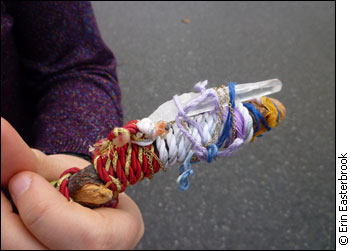
Pletsch's wand is used in magical workings. The colours are symbolic: red for power, white for purity of intent, silver for female energy, gold for male energy and the green ribbon and fruit represent abundance. " A lot of people seem to think that magic is breaking the laws of nature and doing crazy things...Magic is about working with the laws of nature," she says.
Mary Pletsch’s wand: a stick of wood, decked with symbolic colours and items, used in magical workings.

Reached for comment, several Ottawa mainstream religious leaders differed in their views of Wicca. Father Alexander Pihach of Ottawa’s Annunciation Orthodox Cathedral says that customizing one’s religion doesn’t work in the long run.

He says it leads to new denominations; disagreements happen and people leave to start another. That’s why there are between 30,000 and 40,000 denominations of Christianity, he says, and the downfall is the loss of needed unity.

Wicca may be popular now, but Pihach says religions come and go. “It will function for a long time,” he predicts. “But then it will fade out.”

Pastor James Drennan of Ottawa’s Alta Vista Baptist Church describes religions that cherry-pick religious elements or religions that amalgamate others as “syncretistic”.

“I don’t believe [syncretism] is valid,” says Pastor James Drennan, of Alta Vista Baptist Church in Ottawa. He says people can follow whatever path they want, but it comes down to truth—an objective standard.

“Categorically, [Wicca is] what they call a false theological system. Wicca does not represent truth,” he says. He clarifies that any syncretistic religion is not valid.


Wicca’s perception problem. In an unknown painter’s rendering of the famous 1790 Robert Burns poem “Tam o’ Shanter,” the terrified Tam barely escapes a coven of malicious witches.

But Rev. Dr. Dana Fisher of the Anglican Church of St. John the Evangelist in Ottawa says that all religions borrow things from other religions.

For instance, she says the story of Noah and the flood found in the Hebrew Scripture, and respected by Christians, was a story from the Babylonian Empire long before the Jews had it. “Each group cuts and pastes stuff whether it be doctrinal or ritual,” says Fisher. Therefore, Wicca is hardly the only syncretistic religion, she says.

Although Pastor Drennan criticizes the cherry-picking of religious elements, Rabinovitch says this is neither good nor bad.

“But it means it’s a challenge when you start talking about things like pagan community. The concept of community is what unites religions around the world,” she says.

She says witchcraft is misunderstood, as there are positive and negative connotations associated.

The girl to my right, new to Wicca, dips her popsicle stick into the bowl of steeped mugwort—an herb associated with the unconscious, said to increase psychic abilities—that’s being passed around, and tastes it. “What does it taste like?” I ask. “Bitter,” she says. The girl to my left laughs at us. “It’s a plant,” she says. A bowl of honey is then passed around to return to consciousness.

Cormier says because of the negative connotations, Wiccans are often portrayed as Buffy-the-Vampire-Slayer-style lunatics.

Rabinovitch disputes the emphasis on syncretism or cherry-picking in certain criticisms of Wicca.  What’s important is the difference between good and bad people, she says, not the fact that someone is a witch.

For example, she says that just because former colonel Russell Williams is a bad person doesn’t mean that everyone in the military is bad.

They repeat a song that finishes with “They will know that we are pagans by our love, by our love; yes they know that we are pagans by our love.” By now, the skeletons are really swaying.

Some First Nation natives have accused neo-pagans of taking their spiritual components in a colonialist manner, says Cormier.  That’s why Wiccans need to do their research, he says, to respect the traditions the elements come from.

“I think Wicca in its current form is an attempt to reconstruct a face that has since ceased to be practised,” Cormier says. “There’s always an attempt to look backwards to things that we find resonate with us today.”

The ceremony ends, and it’s time to dance. Everyone is invited to sign the Book of the Dead, used to commemorate deceased relatives. A red pentacle flashes on the brick wall as the congregants get their groove on to Michael Jackson’s Thriller.

‘Hollywood North…east’? Ottawa vies to be a moviemaking capital

Within the daytime serenity of Ottawa’s Shenkman Arts Centre, the phone never stops ringing in Roch Brunette’s small office.

With a one-person staff, Brunette is the general manager of the Ottawa Gatineau Film and Television Development Corporation (OGTF), a government-funded organization formed in 2003 to connect foreign film producers to the resources and locations they need to shoot in Ottawa.


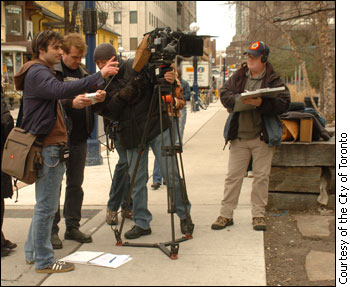
Papineau Street in Gatineau lends a vintage look for the filming of Jack Kerouac’s On the Road, starring Garrett Hedlund (centre).

Brunette does a lot more than location scouting. He actively “sells” Ottawa to filmmakers, spending most of his time personally calling and emailing people in Los Angeles and New York City, then helping them scout locations once they agree to check out Ottawa. Since government dollars don’t go very far, Brunette can’t travel much and so does most of the legwork from his desk.

His stamina seems to be paying off, though. “What we’re seeing is a lot more direct calls from New York–based producers because they heard about Ottawa being a cool place to shoot,” he says.

Between 2008 and 2009, foreign location and service production decreased by 18.2 percent in Canada, according to a Canadian Media Production Association study. Brunette says 2009 was a bad year for Ottawa, too. But in September–November 2010 the city suddenly saw about 12 months’ worth of filmmaking, with $50 million in production volume of  hitting the city in just three months.

Part of this new-found attention from American filmmakers is due to the good word on two big productions successfully shot in town this summer.


With two major U.S. productions here in summer 2010, headlines claimed Ottawa as the newest Canadian filmmaking hotspot.

In August, film crews made over Gatineau to look like 1940s Colorado to shoot the movie version of Jack Kerouac’s classic novel, On the Road, a $25 million film produced by Francis Ford Coppola and directed by Walter Salles, starring Twilight alumna Kristen Stewart. In the same month, L.A.-based producer Aaron Ryder shot his latest horror flick, The House at the End of the Street, in Ottawa, as a co-production with local company Zed Filmworks.

Both producers found what they were looking for—from locations to talented actors, extras and editing crews—in Ottawa: proof that the city just might have what it takes to be a filmmaking hotspot.

“He’s going to come back,” Brunette says of Ryder, whose film crew didn’t really know Ottawa existed before the summer. “The first question these producers ask when you mention Ottawa is, ‘What is Ottawa?’ But then they get here, they shoot their movies and they ask, ‘Where were you all this time? How come you weren’t on the map?’”

Located between two well-established film hubs, Toronto and Montreal, Ottawa is often off the map for foreign film producers simply because it’s too small, says Peter Finestone, commissioner of the Toronto Film and Television Office.

“Ottawa has a variety of looks on any given day, but Ottawa maxes out pretty quickly compared to Toronto,” he says. “There is much more infrastructure here [in Toronto]”.

‘We’re seeing a lot more calls from New York–based producers because they heard about Ottawa being a cool place to shoot.’ – Roch Brunette

Another obstacle for local production is the presence of federal government, says location scout Ainslie S. Wiggs.

“I find it very challenging to work here because people have a government mentality, and the art of filmmaking is just something that doesn’t necessarily fit into that box,” she says. Because of the three levels of government in Ottawa, she says there are more permits needed for shooting on streets, especially in the downtown core near Parliament Hill

However, Brunette says crews are starting to choose Ottawa over Toronto because rental space is cheaper, locations tend to be closer together and there’s less traffic here.

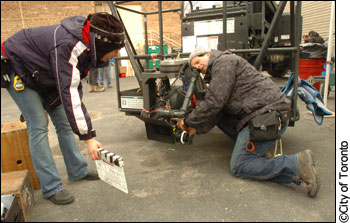
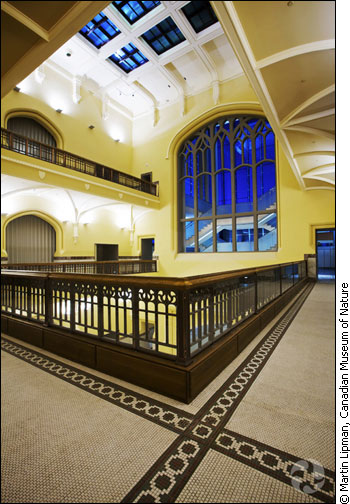
Furthermore, Ottawa has appeal for film producers because of its attractive outdoor spaces and old-fashioned architecture. According to Wiggs, 19th-century buildings like the Museum of Nature have been used for period pieces, and bigger homes in the small towns outside the city often play host to productions.

Another boost to runaway production has been increased tax incentives. In 2007 the Ontario government increased foreign-service tax credits by 38 percent, according to FilmOntario.

And finally as a cause there is enhanced government support.  FilmOntario’s research efforts and work have led to an extra $200 million from the Ontario government for the province’s film industry for 2010–2012.

Ottawa’s recent growth in foreign film production can be measured in various ways: not least in its effect on local businesses. For example, Ottawa’s Zed Filmworks, a rising star in the Canadian production world, was founded in 2007 and has so far produced several films, with four in development in 2011. Meanwhile, Sound Venture Productions, which has been in Ottawa for 30 years mainly as a producer of government and corporate videos, recently expanded into film and television production.

Angie Sakla-Seymour, owner of local talent agency Angie’s Models and Talent, says she submitted four of her actors to audition for an American film shooting in Ottawa this fall and all four got small speaking roles.


Film star Lou Diamond Phillips (left) shoots a scene in Gatineau Park for the 2009 U.S. TV horror series Carny, set in Nebraska.

“It is night and day… it has grown so much in the past ten years,” she says. “It was slow when I started and they would just ask for extras for films, or they brought in actors from Toronto, Vancouver or Montreal, but it has totally evolved.”

Film productions are a blessing for the local economy, Brunette emphasizes. In its five days of shooting, On the Road put about $250,000 straight into the local business, he says. About half that money went to hotels, food and other expenses while the American crews shacked up in Ottawa.

But while the benefits for the city are clear, the OGFT still has a lot of obstacles to overcome in keeping local film production on the rise.

“Ottawa is certainly not perfect,” says Brunette, but after the past few years he says the OGFT knows how to connect film producers in the city with the resources they need. Location scout Wiggs agrees. She credits Brunette as a “driving force in this town to make it easier for people to come here and film.

And Brunette is on his way to opening another door for the local industry: a new facility for film production and other media industries in Ottawa. He hopes to gain government funding this year for the OGFT to build a multipurpose studio for film shooting, animation and special effects, scheduled to be in use by about 2012.

“We’ve got so much creative energy here in Ottawa,” he says. “Our mandate is to foster local community growth, while at the same time positioning Ottawa as film-friendly. This is how we can do it.”

Barrymore’s: dead and walking?

The Barrymore's middle aged clientele bopping to 80s music on a Sunday night.
Grey power: The dance floor on an ’80s-request Sunday night.

Tipsy twenty-somethings, decked out in Wayfarer sunglasses, fanny packs, neon nylon windbreakers and fishnet stockings, bop to all-request ’80s music atop a stage. Middle-aged Ottawans sway side-to-side or bop equally, to music they’ve requested, from what may be the decade to which their twenties belonged. This is Barrymore’s Music Hall and its clientele on a Sunday night, better known as ’80s Night.

To those swaying side-to-side, I pose a question: Do you happen to be reminiscing about the good old days at Barrymore’s? Though it now draws a crowd only on Sundays, Barrymore’s at its height did not need a nostalgia night to attract people.

Opened as a disco in 1977, Barrymore’s quickly transitioned and was a rock ’n’ roll club by 1979. Throughout the ’80s, Barrymore’s was known as Ottawa’s answer to New York’s Studio 54 and was host to such legendary acts as U2, B.B. King, R.E.M., James Brown, Tina Turner and the Tragically Hip.

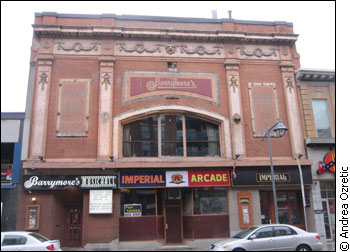
Today Barrymore’s faces all the challenges of a modern nightclub, but is also regarded as an important space that holds many memories for people in Ottawa. Yet despite such strong public sentiments, Barrymore’s has consistently been unable to recapture its 1980s buzz. Even the building—an architectural marvel nearly a century old, formally known as the Imperial Theatre—now shows a weathered façade, deemed an eyesore by many.

The run down Barrymore's exterior.
The Barrymore’s Bank Street exterior embodies faded glory.

The venue has undergone several ownership changes since 1991. Owners have included Eugene Haslam (the man behind Ottawa dance club Zaphod Beeblebrox) and then Randy Lanctot. During the ’90s Barrymore’s still had big-name acts like Radiohead, Bo Diddley and The Commitments. The venue was also used for CD release parties.  Allan Wigney, a journalist currently working on a book about the music scene in Ottawa, says that Lucinda Williams’s performance at Barrymore’s in 1998 was the last big act he recalls there. During the late ’90s and early 2000s, there were local bands with original music performing, but eventually it became more and more cover bands.  Wigney attributes the decline of original music at Barrymore’s to Haslam’s departure in 1999.

The most recent change happened when Montreal-based club owner Vince Simeone purchased Barrymore’s from Randy Lanctot in August 2008. Business at Barrymore’s hasn’t been bustling, and opinions of its latest owner have been lacklustre.

“Without a visionary kind of ownership, it lost its way. New owners who are from out of town, they have tried to put into place the tried-and-true ‘We’ll put in the formula disco night or themed disco night,’ ” says Denis Armstrong, Ottawa Sun entertainment columnist.

“You have a lot of very interesting people who live in Ottawa, a lot of creative and dynamic people, but the city needs to have places where these people can collect and socialize,” Armstrong adds.

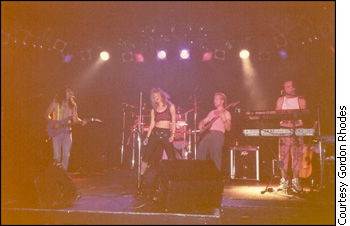
Gord Rhodes ran the club from 1978 to 1991 together with his wife, Sherry Rhodes, and her father, Sonny Thomson. Gord is primarily attributed for bringing in the acts.

“I just told them, ‘You’re playing Montreal one night, and two nights later you’re playing Toronto, and you got all these other days off. Why waste your time? Come and do two shows in one night,’” said Gord.

People performing in the 80s on stage at Barrymore's.
The scene in the good old days.

Sherry Rhodes says they had a great team in the office. Bob Jones came in during the later years as the promotions manager. Sherry describes Jones as having “a pure white Mohawk with pure white extensions that went down to his waist.”

“We had three generations of music between us.” Says Sherry, “ Gord was the ’50s and ’60s: he’s a few years older than me. I was the ’70s, and Bob was the ’80s and ’90s.”

She describes her dad, Sonny Thomson, as the night keeper, there to make sure everything ran smoothly. He once saved Canadian legend (and Guess Who veteran) Burton Cummings from being attacked onstage. Cummings signed an autograph for Thomson that night: “Dear Sonny, thanks for keeping me out of the hospital.”

Despite the acts and the crowds that Barrymore’s was able to bring in, the business still had its challenges. “We didn’t have a lot of capital. We would lose money, win on others. We took some big losses; we were never in a really comfortable position,” said Sherry.

‘Without a visionary kind of ownership, it lost its way.’
– Denis Armstrong

Gord says that larger organizations like the NCC and the Jazz and Blues Festivals had larger backings that made it hard for him to compete. He says that he would break the acts into Ottawa’s scene and lose money doing it, and when it was time to bring them in again and make a profit, the festivals would offer the acts big money to play at a free outdoor concert.

“It’s not a fair business at all; I was very fortunate to be able to do as good as I did,” said Gord.

“If I had the chance I would take it [Barrymore’s] back because I think my husband, Gord, was the perfect promoter,” said Sherry Rhodes.

A different nightlife

Armstrong describes an Ottawa nightlife that has changed dramatically since the 1980s. He sees ’80s Night at Barrymore’s as a diluted version of the past.

“It’s sort of like the zombie version, because they were dangerous times, risky times, sexually, socially. There was a lot going on—people having sex in the bathroom, people doing coke on the dance floor—and now we don’t even allow smoking in the clubs,” he said.

Gord says the introduction of stricter drinking and driving laws was a detriment to his business: “It wouldn’t work now. Drinking and driving laws, television’s too good, there’s just too much going on.”

Many echo the idea of by-laws as being detrimental to Barrymore’s.  Says Armstrong, “You know, people would go to these places to have fun, relax, let their hair down. They don’t want to do it while policemen are hanging over their shoulder, breathing down their neck.”

George Syriannas is a relative of Simeone, and the manager at Barrymore’s. He admits that it has been a challenge for reasons including the by-laws.

“The problem is Barrymore’s can fit 1,000, but the city of Ottawa stepped in here with the by-laws and all these other things over the years, and they said, ‘Stairs, exit this, that, and capacity 420 that’s it, that’s all.’ ” says George Syriannas.

‘People in Ottawa like to complain, but then they don’t man up.’ – George Syriannas

As a result of the lower capacity levels, he says that Live Nation, the company that promotes and book bands at venues, will not book them at Barrymore’s, turning instead to bigger locations.  Without the ability to bring in bigger names, Barrymore’s is struggling to attract a crowd.

Also, Syriannas says, people want to see live bands playing their own music at Barrymore’s, but financially Barrymore’s does not benefit from this format. “There are smaller bands and smaller promoters that want to book Barrymore’s, but again it comes down to money. They don’t want to give us any money from the cover.”

Forfeiting cover would not be such a problem if people were spending more at the bar. However, that is not the case, as Syriannas explains.

“Best-case scenario is we put 360 people in here. The average person will spend $10; when you do the math, we sold $3,600 in those two or three hours. Out of that take taxes; take out $1,000 that I need for my staff; take then my cost, and I’m down to nothing.”

Syriannas says the only alternative Barrymore’s can afford is booking cover bands, a popular and successful format used in Byward Market venues. But even this has been a challenge.

He explains that the previous Saturday they widely advertised that Barrymore’s would have a cover band, and that there would be no charge to get in. Fewer than one hundred people showed up.

“People in Ottawa like to complain, but then they don’t man up,” adds Syriannas.

All this contrasts with Barrymore’s in its ’80s heyday. Gord recalls it was not easy back then, either, but they found a way to make it work.

“It was very, very difficult to do it,” says Gord, “getting people to come out and see shows. You know February the 27th; it’s 40 below; we’d have eight or nine hundred people there. It was very amazing. But if you wanted to see the act, you had to come out.”

Jumping on the ‘Pay what you want’ bandwagon

There’s no price tag on Crush Luther’s most recent album, Some People Have No Good to Give—no price tag not because it’s online but because it literally has no set price. The Toronto-based pop-rock band has jumped on the “Pay what you want” bandwagon.

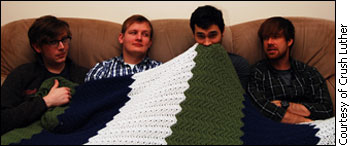
The four members of Crush Luther snuggle under a blanket
Crush Luther’s Shael Fox, PJ Herrick, Luther Mallory and Matt Leitch: staying warm through more than just their fans’ gratitude.

Crush Luther first released its album on its MySpace page and iTunes for digital download before it hit stores two weeks later. When it was online, listeners paid whatever they wanted for the album. Or they could pay nothing at all.

U.K. rock band Radiohead popularized “Pay what you want” in 2003. The tech-savvy musicians decided not to renew their contract with EMI, and took on their next album without label support. They released In Rainbows on the band’s website, for digital download. Listeners could pay what they wanted, if they wanted to pay anything. An MP3 format meant there were no middlemen, such as record label executives or distribution partners, to claim a part of the band’s profits.

Radiohead made more money from this digital album than from all other online sales of their albums combined, said the band’s lead singer, Thom Yorke, in a Wired magazine interview. That’s partly because EMI hadn’t been giving them any money for digital sales, he added.

Still, other musicians have found limited benefits in offering “Pay what you want.” When Nine Inch Nails frontman Trent Reznor produced the 2007 album by breakbeat artist Saul Williams, The Inevitable Rise and Liberation of Niggy Tardust!, Reznor and Williams released only a digital version. Over 154,000 listeners downloaded it; only 18.3 per cent of them paid for it.

It seemed “disheartening” that fewer than one in five downloaders felt it worth $5, Reznor said in a blog post on the Nine Inch Nails website. “We spent too much (correction, I spent too much) making the record . . . and nobody’s getting rich off this project,” he wrote.

A tactic for promotion and goodwill

But where Reznor and Williams and Radiohead had money motives, other artists since then are viewing “Pay what you want” simply as a promotional tool. The goal for Crush Luther’s release of Some People Have No Good to Give was to get word out on the band’s new album, said Darrin Pfeiffer, president of Crush Luther’s label, High 4 Records.

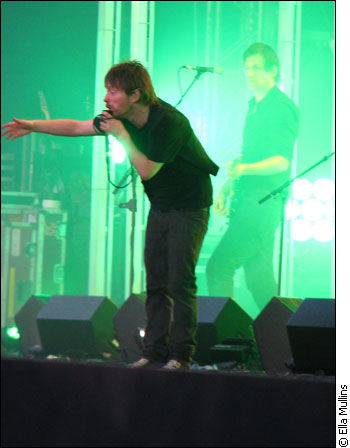
Frontman Thom Yorke performs on stage
Radiohead frontman Thom Yorke performs in Manchester. The band pioneered the concept of no-set-price for an album online.

“The music industry is really falling apart, and it’s initiatives like these that will help solidify buyer confidence, not only in the market and the bands but also the labels that are taking a chance and signing these bands,” he said.

In fact, it was High 4 Records that originally suggested the Crush Luther album’s no-set-price, according to Luther Mallory, the band’s lead singer.

For High 4 Records, profits weren’t part of the motive, Pfeiffer said. Just the opposite: The label did this to prove that they and the band aren’t in it for the money. The move worked, promotion-wise, and it gave back to the fans.

Not that the money is completely off the table. Said Mallory, “The advantages are banking a little bit, instead of nothing, off your album sales. You’re telling your fans, ‘I know you know how this works, but couldn’t you just throw us a nickel, so we can make a follow-up record?’”

Most people seemed fine with paying for the album. Most people paid $5, but one copy sold for $150, said Pfeiffer.

As for any disadvantages to “Pay what you want,” Mallory is uncertain. “It’s a decent, simple solution to people downloading your record for free. Some will bite and some won’t,” he said. “The way the industry is going, I’m not sure there are disadvantages.”

Today, an album’s release is more relevant than the album itself, said Al Masocco, a music marketer based out of Los Angeles.

“But I think especially for an established artist, taking what was once a high-value asset, like the release of a new CD, that same CD is now a promotional item. The CD is more about the buzz of the new album coming out than the sales. So ‘Pay what you want’ is an option that could turn into a separate wave in the future for them.”

So much music is being illegally downloaded today from pirate and bit-torrent sites that many observers and authorities are growing concerned over larger questions of copyright and intellectual property. Canada’s government is currently reviewing its copyright legislation: A proposed Copyright Reform Bill, Bill C-32, would make pirating more difficult; measures would include preventing “the manufacture, importation and sale of devices that can break digital locks” and placing an updated levy on MP3 players, according to the Canadian Heritage website.

‘The music industry is really falling apart, and initiatives like these will help solidify buyer confidence.’ – Darrin Pfeiffer

“I think until we solve the piracy issue, we’re not going to see a huge opportunity for artists of releasing their music in any way, whether it’s ‘Pay what you can’ or a more traditional model,” said Amy Terrill, a spokesperson for the Canadian Recording Industry Association. The idea that music has value is being lost with easy access to free downloads, she said.

Still, pirates ahoy

Even with Radiohead’s potentially free In Rainbows, 60 to 70 per cent of album downloads came from pirate sites anyway, said Terrill.

Luther would prefer people download from the band, even for free, if that’s the way they’re going to hear it.

“It seems now there’s a finite amount of music listeners who are willing to buy music, and that’s a small amount, and everyone else is going to download it if you want them to or not. They’re going to rip it off MySpace and somebody’s going to put it on Limewire, and it’s a horrible rip of the record. So you might as well give it to them for free,” he said.

The consumer no longer values the music, said Pfeiffer. So the industry is letting them have that choice with “Pay what you want” albums.

“[Consumers] need to care, because one day in the not-so-distant future there will be no labels. Until that day comes, it’s promotions like these that will help garner and keep fans,” said Pfeiffer.

Related links

www.myspace.com/crushluther

www.radiohead.com/deadairspace

www.saulwilliams.com

www.nin.com

Front page photo by Amelia Johnston

Ontario’s bold gambit for stardom

Flashing lights and sirens fill the screen. SWAT trucks pull up behind the FBI cars. Agents rush into position; they have surrounded the Federal Center Station in Washington D.C., and now we wait. This episode of Fringe has established the suspense it needs to hook in viewers.

The camera pans over to the station and suddenly the show’s illusion of reality shatters. That building is not the Federal Center Station; in fact, it is not even a metro station. It is the Vancouver Art Gallery.

With the help of a cameraman, a director sets up his shot on a Toronto street
Often seen in downtown Toronto: a film crew setting up a shot.

This type of scene is not uncommon to British Columbia (BC), which often benefits from runaway American projects. The province accounts for 60 per cent of all foreign film and television productions in Canada and follows Los Angeles and New York City as the third largest hub of foreign films in North America, according to the British Columbia Film website. Last year the BC Film Commission reported 14 American television shows in production. These shows spent almost $400 million dollars while shooting in BC.

But lately BC has a challenger: Ontario, which is seeking out its own chunk of foreign productions.

In June 2009, the Ontario government enlarged the Ontario Production Services Tax Credit (OPSTC), raising its tax credits for American productions from 25 per cent of eligible labour to 25 per cent of all Ontario production costs, according to the Ontario Media Development Corporation (OMDC).

These tax credits are issued by provincial governments to foreign or domestic film and television productions that fulfill certain qualifications when it comes to hiring crews and making other expenditures in the respective province. The eligible tax-credit spending is specific to production. (Meanwhile, whenever American crews film in Canada, many other, non-tax-credited dollars get spent—on lodging, food, gas and other necessities—that go fully into the local economy.)

‘The guys in BC have concluded that Ontario is actually losing money.’ – Steve Mitchell

Regarding BC tax credits: “For every BC individual that [the American projects] hire to work on a production, the provincial government will give a tax credit of a certain percentage, depending on what that person is doing and what type of production you’re filming,” says Robert Wong, vice-president of tax credits and development at BC Film.

In Ontario the credit system works almost the same way, except that the province now reimburses any foreign project one quarter of whatever it spends on production within the province; the credit is no longer specific to labour, as in BC. This means that for every dollar an American production spends in Ontario, 25 cents can be reclaimed.

The results of this enhanced tax-credit program were immediate. In that same year, 2009, foreign filmmakers started spending more money in Ontario, leading to a 114 per cent increase in foreign spending in the province.

For example, the OMDC recorded that for American television series alone, spending jumped 262 per cent in 2008–2009, from $16 million in 2008 to $58 million in 2009, despite the number of shot-in-Ontario productions climbing only from five to six. Furthermore, this boom appears to have followed through to the 2010 production year, says George McNeillie of the OMDC.

But this enhancement of tax credits is not necessarily a good thing for the Ontario industry, says Steve Mitchell, president of Vancouver Film Studios.

Too thin a profit margin?

When Ontario first announced its new tax credit program, there was some clamor within the BC film and television industry that Ontario was overtaking BC in competition. However, as Mitchell explains, it soon became evident in BC that increasing its tax credits to match Ontario’s would not have been the right decision for BC.

“At a certain point when you’re giving tax credits, you’re in a negative revenue situation,” Mitchell says. “The guys in BC have concluded that Ontario is actually losing money.”

The Vancouver Marine Building is used as the Daily Planet in WB's Smallville
Superman’s Daily Planet? In the U.S. TV series Smallville, the newspaper office’s exterior is really Vancouver’s Marine Building.

Imagine an American production shooting in Ontario and spending part of its budget on local producers, labour, film labs, etc.; the Americans would be eligible to get back 25 per cent of whatever they spent. If that production spends $50 million in Ontario, it would reclaim $12.5 million under the OPSTC, and Mitchell argues that it is just not worth it.

“We’re just not going to spend money to get these films; we’re going to at least try and recoup our costs,” Mitchell says.

But the OMDC argues that they are not losing money; instead, they have established a supportive and competitive program that, in 2009, contributed almost a billion dollars to the economy.

Both provinces agree on one thing, at least: Tax credits attract revenue to more than just the Ontario or BC film industries. Runaway film productions bring work to all sorts of local businesses; the filmmakers hire carpenters and drivers, stay in hotels, buy food, buy gas and much more. They give local economies a welcome boost. “We really look at it in BC as an industry that puts people into houses and enables them to pay their mortgages,” Mitchell says.

So to some extent, it makes sense for Ontario to stretch to offer competitive tax incentives to attract such business. The question is: to stretch how far?

Despite BC’s criticism of the Ontario program, in March 2010 BC apparently responded by increasing its tax credit from 25 per cent to 33 per cent of labour. The province also implemented an increase to its digital-animation or visual-effects bonus, moving it from 15 per cent to 17.5 per cent. This allows any eligible production that employs visual effects or animation companies from BC to reclaim 17.5 per cent of what is spent, in effect offering a good chance for increased business for BC’s many special-effects companies.

Still, BC’s 33 per cent tax credit is still far below Ontario’s aggregate, since it applies only to labour. Ontario credits apply to all production costs incurred within the province.

High hopes in Ontario

If Ontario’s bold tax-credit program is destined to put Ontario ahead of BC, that outcome is not yet obvious. Simply by turning on the TV, viewers can see that BC is still heavily favoured in regard to American filming. Shows like Fringe, Hellcats and Supernatural are all filmed in Metro Vancouver. Warner Bros.’s Smallville, now on its tenth season, has always been shot there.

Citing company policy, Warner Bros. TV was unable to comment on its business dealings in Canada. But BC’s Mitchell and Wong both point out that BC offers its American TV clients more than just savings.

“BC has some intrinsic, competitive elements that Ontario simply can’t compete with,”  Mitchell says. “Our geography is obviously very different; our climate is very different, which suits some shows better than others.”

Yet Ontario may have reason to hope, from such statistics as its aforementioned foreign-television-spending revenue increase of 262 per cent from 2008 to ’09. Although 2010 productivity reports are not available at this writing, the OMDC’s McNeillie, in an email, details some of 2010’s American-TV-series activity in Ontario:

Film crew sets up a scene in Toronto.
Hogtown plays host: cueing a scene in Toronto

“U.S. television production has been strong with a number of pilots, series and mini-series in production, including: USA Network’s Covert Affairs, the Cartoon Network’s Unnatural History, a re-make of Nikita from Warner Bros. Television; Steven Spielberg, DreamWorks [and] TNT’s new sci-fi series Fallen Skies [and] MTV’s Skins being produced by E1.”

While some in BC say that Ontario is too generous with its new tax-credit program and is essentially paying foreign productions to shoot in the province, McNeillie says that that is just not the case. These tax credits are an important part of Ontario’s toolkit to attract productions, he says.

It is all about offering TV and film producers the right mix of talented crews and actors, state-of-the art studios and infrastructure and, of course, financial incentives.

Front page photo courtesy of the City of Toronto

Stripping off our inhibitions through burlesque

The top button of her crisp, white blouse slides open right on cue. A sparkle of light bounces off the golden wings pinned to her shoulders. As she turns into the light, her hand slides down the front of her shirt, leaving a trail of flesh along the way. The blue matchbox hat slides forward on her head. She smiles.

“Ladies and gentlemen, would you please take your seats: It’s going to be a bumpy ride.”

For many, the idea of undressing in public is monstrous; the thought of stripping down in front of an audience would send most of us fleeing, clutching our sweaters closed. But for the members of Sexual Overtones, baring all onstage before 500 people at their latest show, The Big Top(less) Circus, was a thrilling success.

Sexual Overtones, or SO for short, is an Ottawa performance troupe that describes itself as a vaudevillian type variety show. Acts include singing-and-dancing and slapstick comedy, but the performers often lose their shirts along the way.

“It’s a lot about the humour,” says Cream Puff, “making people laugh to make sex acceptable, and to make people feel comfortable with different kinds of sex and sexualities.” Cream Puff (the troupe members, when interviewed, asked to be identified only by stage name) formed Sexual Overtones in 2008. After working with troupes like the Halifax Burlesque Society and Pink Velvet Burlesque, she felt Ottawa could well benefit from something similar.

Sexual Overtones is composed wholly of unpaid volunteers. Day jobs range from accountant, government employee, lawyer, and consultant to social-service worker—none are professional entertainers, says Puff. The group has around 30 members, of whom about a third are males. Ages range from early 20s to mid 40s.


Ottawa performance troupe Sexual Overtones.

Kinky and the Brain, The Dirty Thirties, The Muffin Tops and Aristotle O’Nasty (a burlesquing, gangster-rapping scholar) are just a few of the troupe’s committees, which are smaller groups within the whole. All the proceeds from their sold-out, two-hour-long Big Top(less) Circus in October were donated to St. Brigid’s Centre for Arts and Humanities and to Canadians for Choice. Their last two big shows have been held at St. Brigid’s, a deconsecrated church in Ottawa’s Byward Market.

“It’s an enormous space,” says Dirk Bag, another Sexual Overtones trouper. “People sit in pews and watch us perform on an altar.”

A flight attendant skit, in which members of the troupe read SO’s naughty interpretation of Porter Airlines’ safety manual to the tune of a 1960s porn score, was a huge hit a the recent show. The idea for an “in flight sexy demonstration” was sparked after Cream Puff watched Porter Airline flight attendants hand out coupons in downtown Ottawa.

Another memorable performance was an intricate dance. Two troupe members performed a five-minute, choreographed hip-hop routine while attached to one another by 15 feet of rope. Other skits might involve spills or cupcake-throwing fights, typically resulting in a swift pull at a pair of tear-away pants. “It’s funny because you can kind of see it coming and you know it’s going to be over exaggerated,” says Cream Puff.

“Mostly it’s just silly and we happen to take our clothes off,” says Puff. But not all of the skits end in nudity. While some performers end up in bottoms (and only bottoms), others are more comfortable in a bra or small tank top. It all depends on the performer and what they are comfortable in, says Puff.

‘You feel beautiful onstage, and confident.’ – Holly Harris

“There is a lot of gender bending as well. So some of the women in our troupe are queer and they don’t feel comfortable showing their breasts, so they’ll go down to a tank-top and wear a binder, which flattens down their chest. And there are guys in our troupe who are gay and sometimes they like to put pasties on [their nipples],” says Puff.

Their audiences tend to be just as varied as the performers and acts onstage. Males and females, from their twenties to their sixties, from different communities and classes, come and enjoy the shows, says Dirk Bag. Federal members of parliament and city politicians have been in the crowd, says Cougar, of the troupe’s Dirty Thirties committee.

The shows are about “making light of sexuality and encouraging the concept of it [sex] being fluid and fun and open and not something that we need to hide and shame ourselves from,” says Dirk Bag.

“Generally sex isn’t what polite society discusses,” says Heather Shipley, a Religion and Women Studies professor at the University of Ottawa who teaches a sexualities class. She says when something is made taboo, the way sex is, it makes us both anxious and curious. Satire and comedy are ways of breaking down the nervous feelings that surround our sexuality; they help us to feel comfortable, says Shipley.

Neo-burlesque

Comedy is not a new ingredient to the art of burlesque. Traditional burlesque from the mid 1800s through to the 1950s was a sultry, musical and comedic performance. Lydia Thompson’s British Blondes brought burlesque to North America from Britain in the 1860s; in costumes that were revealing for the time, the salacious group spoofed traditional theater. The burlesque sensation continued until the ’50s.

Currently, a revival, commonly referred to as neo-burlesque, has gained popularity in the U.S, Canada, Finland, Japan and France. Pioneers of the neo-burlesque movement, like Lili St. Cyr and Dita von Teese, have become household names. November 2010 saw the release of Steven Antin’s musical film Burlesque, starring Christina Aguilera and Cher. Although reviews were mixed, the film did mirror a current re-energizing of burlesque.

Also due onscreen, later in 2011, is Red Tremmel’s documentary Exotic World & the Burlesque Revival. The film examines what it claims was a driving force behind the neo-burlesque movement: a burlesque museum, formally located in California’s Mojave Desert and called Exotic World.

Today in cities across North America, a burlesque show can easily be worked into one’s weekend entertainment. Toronto, Montreal and Vancouver now host yearly international burlesque festivals. Even Ottawa has Sexual Overtones, plus a troupe called Capital Kink that offers burlesque dance lessons to a participatory audience; and there are The Sin Sisters.

‘Mostly it’s just silly and we happen to take our clothes off.’ – Cream Puff

The Sin Sisters encompass the kind of sparkly lingerie that most people associate with burlesque dancers (but that Sexual Overtones, for example, avoids). The Sisters’ whole style is reminiscent of traditional burlesque. Since forming, three years ago, this troupe has grown to 11 people, including two comedic emcees, two poi spinners (who perform by spinning fireballs in circular patterns) and a whole lot of pasties, fans and sexy underwear.

Holly Harris (Headmistress Holly Sin) started with the troupe as an announcer and manager. In a tale itself befitting a burlesque skit, Harris’s first time topless onstage was to fill in for a sick troupe member, last minute. “It was nerve-racking at first, but then I got comfortable,” says Harris. “You feel beautiful onstage, and confident.” For Harris the experience has been about embracing sexuality, regardless of one’s shape or size.

What the Sin Sisters’ costumes lack in coverage they make up for in elaborateness. The troupe members spend hours every week gluing sequins on bras and glitter on fans and pasties. Burlesque as an art form, says Harris, is about the tease: It isn’t so much what we’re showing but how we’re showing it.


The Sin Sisters at the Elmdale Tavern: from top left, Scare-ah Lynne Sin (Sarah Lynne), Maggie Sue Sin (Mandy Carroll), Faith McSin (Liz Pomeroy) and Headmistress Holly Sin (Holly Harrison).

“You can do a provocative number without actually taking your clothes off,” says Nick Peron (Christopher Bomb Sin). Peron, who has experience as a stand-up comedian, recently joined the troupe as an M.C. Despite the proliferation of sex in modern society, in a public setting we still tend to feel uncomfortable, says Peron. The Sin Sisters are attempting to break down these insecurities by sitting back and chuckling at them, he says.

Response has been strongly positive, according to the Sisters. Last February they held a show before a packed audience, says Harris. It was not the number of people in the audience that surprised her, but rather whom it comprised: middle aged couples.

The Sin Sisters’ success has encouraged them to continue to expand. They plan on adding more variety to their shows. Harris says she is currently looking for a magician and a juggler.

Meanwhile other Ottawa troupes, like Rockalily and the newly formed BrownCoats Burlesque, continue to revive the art form. Neo-burlesque has allowed Ottawa audiences to laugh their way to a comfortable expression of sexuality.

And no one seems to be buttoning up their shirt anytime soon.

The rebirth of Nature

The front of the Canadian Museum of Nature
The renovated Canadian Museum of Nature with its new glass addition, dubbed the Queen’s Lantern.

The Canadian Museum of Nature is unrecognizable. The scaffolding has been dismantled, revealing the Tudor-Gothic–style Victoria Memorial Building underneath; the construction vehicles and construction workers have departed; and a new glass enclosure housing a staircase, dubbed as the “Queen’s Lantern,” graces the front entrance, evoking the building’s early tower (which was removed in 1916 because unstable soil conditions couldn’t support its weight).

The dust has finally settled—literally—as the extensive six-year-long renovations were completed in 2010. And the timing couldn’t have been better.  The year 2010 marked the 100th anniversary of the national historic site and was pegged as the year for bio-diversity. May 22, 2010, the day the museum was unveiled for its grand re-opening, was International Bio-Diversity Day. And on June 30, Her Majesty Queen Elizabeth II and His Royal Highness the Duke of Edinburgh paid a royal visit.

‘It was a large-scale project; it took six years and was the whole building: infrastructure, heritage elements, and new exhibits. It affected every level of the museum.’ – Dan Smythe

“We made it!” says Dan Smythe, the senior media relations officer for the museum. “Looking back at the time, effort and resources it took: It’s finally done.”

Between the grand re-opening and Labour Day weekend, the museum received a record 300,000 visitors. That’s more than the number of visitors the museum saw pre-renovation—annually. Before the renovation, the average number of visitors was between 250,000 and 280,000 per year. By March 2011, the museum will see close to half a million visitors, says Marie Lasnier, director of community services.

Smythe and Lasnier both ascribe the sky-high numbers to the novelty of a re-modelled museum. The years of renovations have created a buzz of anticipation and visitors are excited to rediscover their favourite exhibits, updated and modernized, Smythe says. The renovations allowed for each gallery to be completely re-designed. Every exhibit had to be meticulously taken down. Then, the space was gutted, and re-built from the ground, up. Every gallery had to be re-done, and some galleries—like the RBC Blue Water Gallery—are brand new additions to the museum. The museum also boasts better visitor amenities, like a refurbished boutique and Nature Café.

Inside the main stairwell of the Canadian Museum of Nature
The renovation included restoration of heritage elements, like mosaic floors and wood banisters.

“The entire building is more flexible,” says Lasnier. “The new facility provides more space and opportunity than it did before.”

However, despite summer’s intoxicating numbers of visitors, Lasnier points out a trend that could have the museum looking at a ten per cent drop next year: She says that after major museums undergo massive renovations (think of the 2007 Michael Lee-Chin Crystal addition to Toronto’s Royal Ontario Museum) and the initial excitement has worn off, the visitor numbers tend to decline.

In an attempt to counteract this decline, or at least slow it down, the museum is coming up with specialty programming to spark more consistent interest. Group tours, monthly programming, and travelling exhibits are some of what the newly-renovated museum can now offer. The museum showed off its new user-friendly floor plan (and its Halloween spirit) this October with haunted tours put on by the Haunted Walk of Ottawa. Around 4,500 people took part in the tours, a number the pre-reno building never could have accommodated.

Lasnier adds that in the coming months, the museum will be able to offer limited-time, specialty activities. The haunted tours will resume next October; November will be meet-the-scientist month, when the museum shows off its research side by offering public meet-and-greets with its scientists; December and March are when school children have their vacations, so the museum will have more family-oriented activities; and in February, an adults-only Valentine activity will take place, educating visitors on the science of love and attraction.

Lasnier also gives some advance info on travelling exhibits that will arrive at the museum in the summertime: Next summer will be Extreme Mammals, an exhibit showcasing some strange mammals that roamed the earth after the dinosaurs became extinct. The following summer, visitors can expect a jaw-dropping whale exhibit from New Zealand. One significance of these travelling exhibits is that the museum could never have housed them before.

A young visitor reaches up to touch a life-like dinosaur.
Life-sized dinosaurs enchant, in the museum’s vivid displays.

“Travelling exhibits didn’t want to come to the museum before because it was dangerous for the specimens,” Lasnier says. What she’s talking about are the temperature and humidity control systems: The outdated building didn’t have sufficient climate control and couldn’t provide a safe environment for its precious artifacts. Pre-reno, the museum was limited to using display cases for items that needed special care. Some items in the museum’s collections were deemed too valuable or rare to be on public display altogether. Lasnier laments the damage done to one of the mammals on display whose fur literally got eaten by micro-organisms.

As a result, part of the museum’s renovation made a point of updating the electrical, hydro, heating and ventilation systems and reinforcing the building’s structure. Lasnier says the renovations have allowed the museum to offer richer exhibits. More than 1,500 items have been brought out of the storerooms and are now able to be put on display.  Smythe adds that half of the minerals in the Vale Earth Gallery hadn’t been seen by the public—in the remodelled gallery, there are more than 1,000 rocks and minerals on display. The Bird Gallery, which also received some additions, is now home to approximately 400 specimens.

Other projects included landscaping and the restoration of heritage elements, like stained glass windows, wood doors, and mosaic floors.

“It was a large-scale project; it took six years and it was the whole building: the infrastructure, heritage elements, and new exhibits. It affected every level of the museum,” Smythe says. “The challenge now is to deal with its popularity!”

Front page photo by Martin Lipman, Canadian Museum of Nature