Ontario’s wines toast better days ahead?

I never thought drinking on the job would be acceptable…until this occasion of the most-looked-forward-to drinking event in Ottawa. From the moment one enters Lansdowne Stadium, the notion that ours is the city that fun forgot becomes a distant and misinformed mockery of this very enthusiastic (and, at the moment, red-faced) crowd. Immediately approaching me are my 20-something-year-old friends, tongues as purple as the grapes I saw in Hartman’s for $3.29 a pound earlier today.

“OHMYGOD! Have you seen the guys in here?” they ask me, with more than just excitement adding to their drawl.

They were absolutely right. On this Friday night, quarter after six, the very crowded stadium field brims with sleek, male government workers in handsome suits (Government of Canada tags strategically half-hanging from their pockets). Groups of women, coddling their male colleagues, are in their winter best. All are dressed to impress at this year’s 25th annual Ottawa Wine and Food Show.


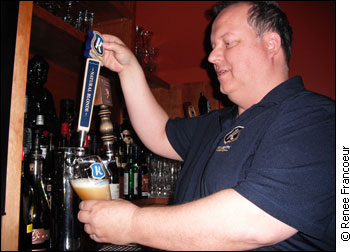
Bartender Tiffany Gagné at the booth of the Ottawa restaurant Steak. Only 10 percent of Steak’s wine list is Canadian.

For its first 22 years, the show was owned and operated by Halina and Robert Player, under the corporate banner Player Expositions.  The Players built the show with little support from Ottawa’s foodies—it was even suggested by one food writer, said Mr. Player in an interview years ago, that Ottawa “wasn’t ready for that kind of show.” Yet, not long after the show’s humble beginnings, it gained momentum, and has for many attracted more than 26,000 people annually. In 2008, Ottawa businesswoman Joan Culliton became sole owner of the show. Averaging over 200 exhibitors and featuring over 1,400 wines, spirits and beers, in addition to foods from across the world, the show claims to mirror Canada’s—specifically Ottawa’s—“vibrant culinary scene.”

I attempt to explore and get my tasting on, which I soon realize will not be easy for someone barely 5-feet-3-inches short. I shuffle through a towering herd all heading the same way as I, toward the ticket-sale booth. One sheet of 50 tickets costs $20, with each “sample” glass of wine, pint of beer or shot of vodka or Patrón (a luxury tequila) ranging between three and eight tickets (eight was unusual: vintage wine). Put into perspective, that’s a lot of booze for a little pocket-change. I notice the man in front of me proudly showcasing his cufflinks, shaped like wine bottles and purchased specifically for the occasion. From the way he’s bragging to the woman on his left arm, I guess that they’re on a return trip to the ticket booth.


The reporter (left), with a friend and fellow wine enthusiast, takes a breather amid an arduous evening of sampling.

The rows of booths are crowded with people busy with their hand-to-stem, nose-to-glass, sniff-swirl-sip routine. Servers hired by the Wine and Food Show run around tirelessly with large bins in an effort to clear the miniature wine glasses from the tables…and benches… and garbage-can lids… and floors…

Meanwhile, chefs from Le Cordon Bleu hurriedly prep their food, with the smell of garlic, cheese and fish harmonizing into one surprisingly tantalizing scent. The wine and food reps bustle (each with company dog tags hanging from his or her neck), trying to barter the coveted lobster poutine in exchange for glasses of Chardonnay.

And while the guests are drunk with happiness, the chefs thrilled to be cooking their best and the wine reps keen on hawking their products, a lonesome booth in a dark corner—near the inside of the truck-unloading bay, at the building’s far end—is being outshone (literally) by other, better lit booths.

Welcome to “Wine Country Ontario,” featuring a string of 20 Niagara wineries. Despite its chipper reps behind the counter, the booth is egregiously overshadowed by Wolfblass, LCBO and the like. How could this happen?

“Booths take bucks,” explains Ken Burton, President of the Ontario Wine Society. “You spend more, you have your choice of prime space.”

To me, the Ontario wine booth’s forlorn situation symbolizes Ontario’s wine problem generally: Across the world and especially in Canada, we’re underperforming; we’re under-appreciated. Ontario delivers some fine wines, but even Canadian consumers look elsewhere. I decide to ask why.

The LCBO: Friend or Foe to Ontario Wine?

Rod Phillips—wine author, Ottawa Citizen wine columnist and Carleton University professor of the History of Alcohol—co-chaired the show’s wine competition, having drawn up new protocols for 2010. He says that Ontario wineries have been internationally recognized for exactly one product: icewine. Yet it too remains on the shelves.

“It might be iconic,” says Phillips. “No one buys it.”


Ottawa wine pundit Rod Phillips
co-chaired the 2010 competition.

He says, “The problem with Ontario wine production is that Ontario has yet to find its niche: something other than icewine. They’re trying to grow everything, and people are just not tuned in enough.”

And it’s not just uninvolved consumers and a fuzzy focus on product that are to blame. Endemic problems in retailing also play a role, according to Phillips: “There aren’t many channels [in Ontario] for wine to be sold.”

On this economic question, I maintain that the Liquor Control Board of Ontario (LCBO) is a foe to the wine community. Due in part to its structural problems, or perhaps because it is a Crown corporation whose goal it is to generate profit for the government, it has reportedly posed difficulties to small wineries in putting their wines on its shelves, thus limiting the wineries’ sales outlets to restaurants and the wineries’ own stores. The reality is that for the LCBO, it is cheaper to purchase a mass-market wine from California than it is to stock a Riesling from the Niagara region. As our once Prime Minister Mulroney said to former American President Reagan, “You drink our beer, and we’ll drink your wine.”

Furthermore, Ontario wineries face legal impediments in getting their wine to the public, according to Shirley-Anne George, founder of the Alliance of Canadian Wine Consumers. That’s why since November 2010 George has spearheaded “Free My Grapes,” an Ottawa-based movement.


A bronze medal at the show went to Ontario’s Vineland Estate Chardonnay, available for sample for a meagre three tickets.

“Free My Grapes” is a group of concerned wine consumers who will challenge a Canadian law, the Importation of Intoxicating Liquors Act (last revisited in 1928), which prohibits the sale of wine directly from wineries to consumers across provincial borders. To put it into context, George explains, “I can bring home two bottles of wine from Argentina, but can go to jail for bringing home a bottle from British Columbia or Quebec.”

George says the group is working toward personal exemptions for individuals looking to buy wine cross-provincially. She says the dismissal of this archaic law would not only provide another avenue for sales, but “would encourage people to visit wineries within the country,” instead of travelling outside of Canada to wineries in California, for example.

Wine and Food Show owner and producer Joan Culliton wrote that she is pleased to announce that, for autumn 2011, “the Show will become the Ottawa Wine and Food Festival—an extended five full days of tasting and celebrating local, national and international wines, beers, spirits and cuisine.” Maybe by then, through continual efforts by united winos throughout Ontario, that lonesome corner booth—perched sadly in the corner like a forgotten party guest—will shine a little brighter. Cheers to hoping, for next year’s Ottawa Wine and Food Festival.

Related Links

“What you’ll be pouring in your glass in 2011”- Globe and Mail
Wines of Ontario

Free My Grapes

Body casting: feminism’s newest shape

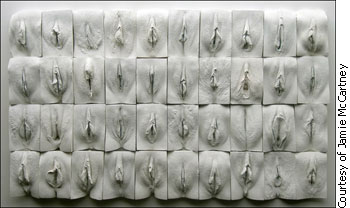
British sculptor Jamie McCartney has been approached by medical textbooks looking to use photographs of his artwork for sections about vaginas. He’s been told his “Great Wall of Vagina” is the best source in the world for showing what normal vulvas look like.

The Brighton-based McCartney created his “Wall” as a commentary on the phenomenon of women getting cosmetic surgery because they don’t like the look of their vaginas. The wall is made of plaster casts of women’s vaginas. McCartney has completed 360 casts and hopes to do 40 more before the piece debuts this year at London’s Hay Hill Gallery.

A wall made of plaster casts of women's vaginas.
One cast panel of Jamie McCartney’s “Great Wall of Vagina.”

Says McCartney: “My work is often a celebration of the female form, but at other times it is more of a celebration or even investigation of what it is to be female.”

He says he likes the immediacy and honesty of casting. “I capture people as they are, rather than creating my version of how they are.”

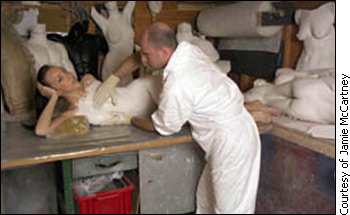
Casting allows the artist to experiment in a variety of ways. Some of McCartney’s casts are done of a subject’s entire body, while others, like those in the wall, are of a specific area or body part.

This accuracy is what makes body casting so popular today. It is even used in psychotherapy (often with an emphasis on full-body form, not just genitalia). By seeing themselves as they really are, women are able to overcome body-image issues, said Jamie Hurst, program coordinator at Hopewell Eating Disorders Centre in Ottawa.

Jamie McCartney covering a woman's body in plaster.McCartney covers a live subject in plaster for a full-body cast.

Body casting was used in Hopewell’s prevention program for girls aged 11 to 14. “We used the body casting with them as a means of helping them to recognize that all of us have different body shapes and sizes, and no one shape and size is any less beautiful than another,” Hurst said.

The artist behind the mould

McCartney began his body-casting business in 2006. He juggles many projects as an artist, photographer, sculptor and body caster, but admits his fine-art ambitions have taken somewhat of a backseat with the success of his casts.

While artists have found commercial success in casting, others pursue the vocation from a medical standpoint.

Keon was shocked at how beautiful her body was when she first saw a cast of herself.

Julie Keon, an Ottawa body caster, began as a doula and has a background in social work. She began casting pregnant women’s stomachs after a birthing client asked for help with an at-home casting kit she’d bought.

Keon says she thinks more women would benefit from the use of body casting in psychotherapy. Like most of her clients, Keon herself was shocked at how beautiful her body was when she first saw a cast of herself. She said she thinks every woman could benefit from that experience.

Changing outlooks

To inspire and empower more women to accept and love their bodies, Keon displayed her casts in March 2010 as part of the “Breaking the Mould” event held at Carleton University, organized by students for a women’s studies class focusing on activism. Then in July, Keon’s “Goddess Project” was displayed at Ottawa’s Stepping Stones Art Gallery. Both projects featured casts of women of all shapes and sizes who had been through various traumas or challenges, including sexual abuse, rape, mastectomies, eating disorders and physical disabilities. The casts were anonymous, but each was accompanied by a plaque detailing the subject’s story.

Coloured casts of torsos hanging on a wall.
Julie Keon’s “Goddess Project”: casts and stories from a variety of different women.

“I hope that women can look at their bodies differently, that they can celebrate their bodies and maybe celebrate things like that they’re healthy, that they can walk, that they’re strong,” said Keon.

“By getting casted, it really gave me a chance to see myself from the outside,” said Anna Bélanger, who had her cast done by Keon.

She said getting the chance to see her body as it really was completely changed the way she felt about herself, for the better.

Body casting is an effective tool in feminism because it doesn’t go deep into theoretical issues, said Patrizia Gentile, a professor of women’s and gender studies at Carleton University. It is engaging, easily understood and accessible for a wide audience. It powerfully puts forth a feminist message by “visually representing the diversity of women’s bodies in an immediate way,” she said.

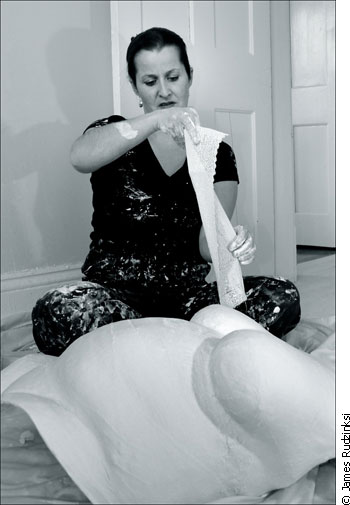
Julie Keon adding a plaster strip to a cast of a pregnant woman's torso.
Keon adds plaster to strengthen a cast before she paints it.

Gentile pointed out that women’s bodies have traditionally been thought of as weak and inferior, and to challenge these ideals by proudly and unapologetically displaying them delivers a crucial message about accepting the great diversity of the female form.

The women whose vaginas are included in the wall are a real representation of diversity. There is every race, sexual orientation and age – the youngest being 18 and the oldest 76.

There are also six transgendered individuals included: three male-to-female transsexuals who have undergone gender reassignment surgery, and three female-to-male transsexuals who were undergoing hormone therapy at the time they were cast.

McCartney says he feels the absence of a victim of female genital mutilation is a real gap in the wall. He is actively searching for such a woman to participate, but much to his disappointment, no one has yet come forward. He says he sees that as a missed opportunity for drawing attention to the “barbaric practice.”

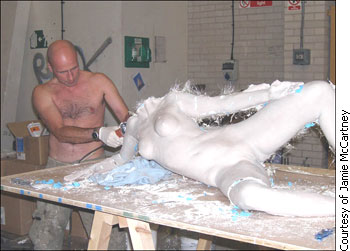
Jamie McCartney working on a plaster figure of a woman's body.
McCartney at work on a body cast: “I capture people as they are.”

The Great Wall of Vagina not only encourages the acceptance and celebration of each unique woman, said Gentile. It and similar projects serve to de-mystify the genitalia and challenge taboos about vaginas by displaying them outside a sexual context.

McCartney, who considers himself a feminist, said he’s very glad to have helped women think more positively about their bodies. “It is humbling,” he said. “It thrills me that I have done something right with my life. It is easy to change peoples’ lives for the worse, but to actually change them for the better on a grand scale is a miracle, it’s amazing.”

Related Links

Brighton Bodycasting

Ottawa Belly Casts

Adding some ‘story’ to history, the Bytown Museum goes modern

A small stone building beside the Ottawa canal locks
A hidden gem, the Bytown Museum stands beside the Ottawa locks.

The lights are on at the Bytown Museum along the Rideau locks on a cold winter day, but is anyone home?

Step into the warmly lit museum and, yes, it is now open for the winter season. Walk upstairs and there will be more than the traditional historical artifacts of old Ottawa; in the temporary galleries, an exhibit features local artists’ self-portraits—an unexpected departure from the museum’s usual city-history fare.

The Bytown Museum is making efforts to rejuvenate itself by taking a new approach that involves engaging the community. These efforts have been in the works for the last two years. Among the new measures, the museum is updating its website, staying open during the fall and winter season and, in a recent bold move, adding temporary exhibits reflecting modern-day Ottawa life.

“The museum will continue to remain a history museum. However, we’ve been able to shed the image of being a ‘dusty old museum’ and we are becoming a more relevant, community-focused museum,” says Mike Steinhauer, the Bytown Museum’s director.

Steinhauer’s decision here was the result of a year-long conversation with the board of directors and stakeholders. “It became apparent that we needed to broaden our audience and develop programming that is fresh and relevant,” he says.

Over the last year, the museum has been hosting more contemporary exhibits, such as “Many Guises: Contemporary Self-Portraits.” Six local artists have provided self-portraits paired with another photograph, to enhance the resultant narrative and character portrayal.

‘We’ve been able to shed the image of being a “dusty old museum” and are becoming more relevant, community-focused.’ – Mike Steinhauer

This temporary exhibit is being paired with a historical exhibit called “Likeness: Historic Photographs from the Bytown Museum Collection.” Combined, the two exhibits provide a more direct link to Ottawa’s past and present.

However, Steinhauer says, at first not everyone was keen on the new mandate of the museum. “Implementing change in any organization, regardless of how progressive it is, can be difficult. The Bytown Museum is Ottawa’s oldest community museum and thus certain people expected us to do certain things,” he says.

There were people who thought the idea of bringing contemporary exhibits to a traditional, historical museum would change the institution’s entire image and purpose. This has not been the case; instead, the contemporary exhibits have added depth and character to the permanent exhibits.

The new approach is being well received by the community, Steinhauer says. According to visitor statistics, local residents are once again coming to the museum; this has helped maintain strong visitor numbers over the last two years, despite an overall dip in Ottawa tourism.

Seeking a wider appeal

Increasingly, museums in North America are developing fresh ways to engage their audiences. Pairing contemporary exhibits with historical ones offers a new perspective on old artifacts. Also, it creates a more varied program, to appeal to a wider demographic and to encourage repeat visits.

Says Charles Akben-Marchand, heritage chair of the Centretown Citizens Community Association, “The Bytown Museum’s recent exhibits that show Ottawa’s recent and present history help to provide a tangible link that serves as a valuable starting point for people to reconnect with a lost past.”

Candid black and white of Mike Steinhauer, Director of the Bytown Museum
Kicking up dust: Mike Steinhauer, museum director since 2009.

Bruce Elliott, a Carleton history professor and volunteer historian at Pinhey’s Point Museum, agrees. “They certainly don’t need to apologize for including aspects of contemporary Ottawa in what they do, though I wouldn’t want the temporary galleries to be used always and only for that,” he says. He stresses the importance of having both historical and contemporary exhibits rotating through the temporary galleries, to create balance.

Elliott says the Nepean Museum had a similar idea of displaying the works of current Nepean residents. “It was part of that institution’s commitment to being ‘Your Nepean Museum,’ and I always thought it was a great idea,” he says.

Both the Bytown and Nepean museums are part of this greater wave to include contemporary aspects in exhibits, thereby offering a more complete context.

While museums’ efforts to engage communities are generally receiving a warm welcome across North America, Douglas Worts, a culture and sustainability specialist in Toronto, recommends looking a little deeper. “Museums assume whatever they do has a positive impact, but they never test it,” he says. He applies this notion to any new idea a museum may want to bring in, be it contemporary exhibits or interactive components, etc.

The best way to measure success, according to Worts, is to measure the strategic impacts. He says that to test the success of a museum’s impact, there are several levels to look at: individual, community, institutional and global. This includes evaluating whether the exhibit (a) provokes curiosity, (b) relates to issues facing the community and (c) sheds new light on the cultural issues of the day.

Measuring success

“Is the experience useful? Is there greater awareness on a given issue of the day?” Worts asks. These impacts are difficult to measure, but directors can use online and on-location surveys, individual interviews with guests, guestbooks, and other similar tools to gauge the impact at different levels.

Steinhauer says he measures success “by positive feedback from participants, visitors and the Board of Directors of the Bytown Museum. Attendance is also be an indicator of success.” The newer exhibits have caused an increase in visitor numbers at the museum, and Steinhauer says this is one of the main ways to prove they have been successful.

Worts says measuring success is more than that. “To me, a museum is a cultural organization that really needs to orient vibrancy and well-being within in the community,” he says. Measuring attendance numbers and positive feedback is only just the beginning, Worts says: The audience needs to take something away from the museum, something they’ve learned and can apply in a global context.

Worts reinforces, though, that the Bytown Museum seems to be taking the right steps. “It sounds like the director is heading in an interesting direction of community engagement.”

Inside the Bytown Museum - the historical artifacts fill the museum
Historical artifacts remain the Bytown’s key elements, despite the arrival of modern-themed exhibits.

Steinhauer acknowledges the importance of community engagement that Worts highlights, which is why he is excited that the museum’s new mandate has allowed him to further explore and develop community engagement.

“The museum is a place not just about the community, but a place for and by the community,” Steinhauer says.

Front page photo courtesy of Graham Iddon, Bytown Museum

Related Links

Bytown Museum

ince 2009, new director

Change a-brewing: craft beer discovers Ottawa

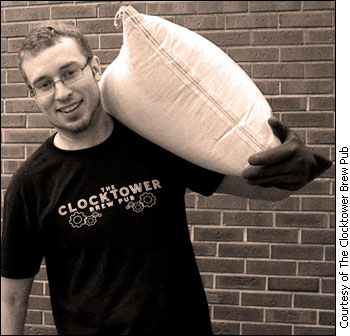
Patrick Fiori
Master brewer Patrick Fiori holds a bag of malt, a main grain ingredient in beer.

The air in here is thick with the chalky smell of barley and wheat, and it is cold—very cold. Welcome to a Saturday afternoon tour of Heritage and Scotch Irish Brewing Ltd., located in a small brick building just off Carling Avenue in Ottawa.

Owner Ron Moir steps around a few puddles on the warehouse floor and, stopping at a table beside large, cone-shaped, stainless steel storage tanks, takes a brown, stubby bottle of Stuart’s Natural Session Ale and pours a gracious amount into a small cup.

“This won’t taste like your typical Alex Keith’s pale,” he says, laughing, and begins to pass samples around.

The beer teases the taste buds, then lingers in the back of the mouth. It’s light—but nowhere near watery—and bitterer than those common swigs of Budweiser or Coors. There’s also this seductive dash of citrus crossed with smooth pine flavouring.

Heritage and Scotch Irish Brewing is the only microbrewery in Ottawa—“micro” meaning it produces fewer than 17,600 hectolitres of beer per year, according to Roger Tottman’s Traveller’s Guide to Great Beer. This arguably is what makes the company, and the 41 others in Ontario like it, special.

‘It’s us against the big guys.’     – brewer Patrick Fiori

“We produce our beer in smaller batches,” explains Moir. “And that’s why it’s called craft beer.” He adds, “Everyone defines craft beer differently but basically it’s beer with lots of flavour: It’s handcrafted. And the decisions around the brewing – bitterness, flavour, aroma – are all made directly in the brewery.”

Craft beer isn’t about making a huge profit, Moir explains; it’s about good, local ingredients and quality.

Quality not quantity

Ontario’s craft beer industry has grown steadily over the last few decades (writes international beer expert Stephen Beaumont in The Great Canadian Beer Guide) and especially in recent years. Craft beer sales rose 46.5 per cent in 2008–2009 at the Liquor Control Board of Ontario (LCBO), the government agency responsible for the sale and distribution of Ontario wine and spirits. Likewise, according to Ontario Craft Brewer (OCB), an organization representing over 25 small brewing operations, sales came to $170 million in 2009, while market share has more than doubled to roughly five per cent since 2002. Plus, OCB calculates new breweries are being created at the rate of about three per year, versus a loss of one per year.

Glass of Beau's beer
Steve Beauchesne of Beau’s All Natural Brewery with a glass of Night Marzen beer, Beau’s seasonal beer for fall.

Today 90 to 100 different brands of Ontario craft beer are offered by the LCBO, says Chris Layton, spokesperson for the agency. “It’s been a craft beer phenomenon over the last five or so years,” he says.

Others, like author Tottman, call it a renaissance, a growing rejection of the “corn syrupy” commercial beers that all taste the same and have dominated the market for too long.

Yet Ottawa’s citizens have been a bit slow to jump on this localized, artistic grain-train. While Heritage first opened in 2000 and the city boasts its own brew pub, Clocktower, it wasn’t until Beau’s All Natural Brewery started up in nearby Vankleek Hill in 2006 that micro-brewing got onto the Ottawa map. Now, within this past year, the capital region has become home to two new craft brews: HogsBack and Kichesippi.

In fact Kichesippi has done so well it is now in the process of taking over Heritage as the new operating corporation. However, it will retain all original staff and continue to produce the Heritage and Scotch Irish labels.

‘It’s local art you can’t taste anywhere else.’ – Kichesippi co-owner Paul Meek

For Ottawa the “best thing that could have happened was Beau’s,” says Patrick Fiori, the brew master at Clocktower Brew Pub on Bank Street. “They’ve stayed true to the ‘go local, go organic’ goal, but they knew how to market and reach people. They’ve challenged people to try other local craft beer.”

Fiori has been working for the past four years at the Bank Street Clocktower brewpub, where five of his brews are available. The same beer can also be found at the other Clocktower restaurants in Ottawa, as well as at the city’s Cornerstone and Steak restaurants.

“If you’d have asked me when I first started here if we’d be where we are today—with all this growth and demand—I’d have laughed at you,” he admits.

As for the threat of competition in the region over the craft beer market, Fiori says they don’t look at it that way. “That’d be pointless. We’re collaborative. It’s us against the big guys who still dominate the market,” he says. “Besides, we’re all making different beer. No two taste the same.”

Move over, wine and cheese

Across the city, on the edge of Chinatown, Zen Kitchen has had Beau’s on tap since the day the restaurant opened in June 2009. They added Kichesippi to the menu as soon as it was available last spring and carry two other local craft beers as well.

“We’re all about buying local, and that extends into our alcohol service,” says Dave Loan, Zen Kitchen’s owner and manager. “Personally, when I travel, I always ask what they have locally on tap. That’s part of experiencing that place.”

Last fall, the restaurant offered Oktoberfest-style meals with beer pairings. “People who tried it loved it, but it’s still a bit tougher of a sell compared to wine,” says Loan.

Dave Loan of the Zen Kitchen
Zen Kitchen’s Dave Loan pours a pint of Kichesippi, one of four local brews available at his restaurant.

Yet beer’s disadvantage to wine over food is changing, claims Colin Jack, a BC beer expert, educator and managing partner of the consulting company Just Here For the Beer, now in its ninth year. The company holds an annual Beer and Wine Festival in Vancouver to celebrate both beverages with food.

“People are just blown away when you show them that craft beer actually goes better with cheese or chocolate because of its different degrees of bitterness. It can also be very palate cleansing, which a lot of people don’t know,” says Jack.

For the face and brains behind Kichesippi, owner Paul Meek, craft brewing is simple: It’s local art you can’t taste anywhere else.

Kichesippi’s name pays homage to the Algonquin language and means “Great River.” It refers to the Ottawa River and tells a story of local history, explains Meek.

“I want one day for people to say, ‘Hey, I’m going to Ottawa, what should I do?’ And the reply will be, ‘Go to the canal; see the Parliament Buildings; have a beavertail and a Kichesippi beer.’”

Related Links

Ontario Craft Brewers

Kichesippi Beer

Hogsback Brewing

Cover image courtesy of Kichesippi Beer Co.

CBC scores, with Battle of the Blades

The TV screen shows the lights lower in the Maple Leaf Gardens.

Two male skaters dressed in tuxes emerge onto the ice. They skate circles around each other in front of a cheering crowd. The camera cuts to a close-up of the performers’ feet as they stop in unison — one is wearing hockey skates, the other, figure skates. Hosts Ron MacLean and Kurt Browning know how to get the crowd going.


Battle of the Blades pairs retired NHL greats with sweetheart championship figure skaters (here, Marie-France Dubreuil and Stéphane Richer), to create a truly Canadian reality show.

And so it begins.

Battle of the Blades, Canada’s latest attempt at reality-show success, takes hockey tough guys, pairs them with figure skating sweethearts and has them churn out weekly ice dance routines on live television.

The eight couples are judged after each Sunday night performance show using traditional figure-skating scoring by former skating champions and choreographers — with a little help from legendary Canadians like Lanny McDonald and Don Cherry. Viewers cast votes for their favourite couples, and on Monday nights one pair is eliminated from the show.

The simplicity of the concept is almost laughable.

There’s no way people will watch this, right? Imagine hockey fans calling the guys over for a game night that involves pizza, beer and Claude Lemieux in tight pants. Or lifelong figure skating devotees envying the grace and style of an aging hockey player’s death spiral.

Well, judging by the ratings, it isn’t that unrealistic. An average of 1.5 million viewers tune in to the show weekly. So what is it about this show that has Canucks glued to their television screens week after week?

It’s all in our image

The show is quintessentially Canadian, and we can’t get enough.

“It fits with the image of Canada which is all about hockey, figure skating, Tim Hortons, kids skating on a frozen pond in the winter, Ron MacLean’s terrible puns, and Stephen Harper wearing a sweater,” says John Doyle, television critic for the Globe and Mail.

The show has nation-wide appeal because it hits on elements of Canadian culture that everyone can identify with, he says.

Millions of Canadians have connections to hockey and figure skating in one way or another. And in a star system that has more sports figures than actors, the mass appeal is obvious.

“Before it premiered, I said I’d eat my skates if Canadians didn’t eat up a hockey and figure skating competition reality show,” says Diane Wild, contributor to the blog TV Eh?, an information portal for Canadian television shows.

Wild describes Battle of the Blades as being the perfect fit of audience and content. There is just something fun about seeing the worlds of hockey and figure skating collide, she says.


Host Ron MacLean prepares to eliminate one pair on the Blades finale. Salé and Simpson (in black) eventually came out on top.

The Canadiana concept certainly draws in the audiences, but to keep them there, the show needs to entertain, says Denis McGrath, a television writer who has written episodes for Canadian shows like The Border and Rent-A-Goalie. He says Canadian television is often guilty of preaching to its audience.

“You mix in the familiar reality competition format which we’re all used to by now, and figure skating. And then you add the surprising — how will these hockey players and figure skaters mix and work together?” he says.

This combination is undeniably entertaining. You see retired tough guys wearing flashy costumes, Continue reading “CBC scores, with Battle of the Blades”

Turning Japanese: Ottawa’s karaoke fever

Draped in blue velvet, China Doll clutches the microphone with three fingers and the natural grace of a woman. Watching those hips gyrate to the beat, the audience almost forgets about his five o’clock shadow. His ring finger is appropriately sporting a fake diamond ring the size of a golf ball and, like a true diva, he flutters it through the air as he hits the high notes.

“Love, love will keep us together. Think of me baby whenever” — China Doll belts out as he prances around the room — “some sweet talking whore comes along, singing her song.” The audience giggles wildly as he ad-libs “whore” for “girl,” and erupts again when he assures the woman in the front row that he isn’t talking about her. It’s a version of the classic Captain and Tennille song that you’ll never hear on the radio, but one you might catch at Ottawa’s Shanghai restaurant on a Saturday night.


China Doll sparkles on Saturday nights at the Shanghai.

China Doll, known offstage as Edward Kwan, is the magnetic force that brings vocals-craving crowds to the little restaurant on Somerset Street. The family-owned business has been a community hot spot since the 1970s but has recently gained attention for wild karaoke nights hosted by Kwan’s alter ego. The image of his face is spray-painted on the side of the building, and inside you’ll either find him cooking egg rolls in the kitchen or singing in drag.

Newcomers leave vowing to return next week and regulars wonder why he doesn’t ad-lib “karaoke” for “love” instead. Love doesn’t always keep people together, nor does it keep restaurants in business, but karaoke might.

The Japanese tradition of karaoke has been popular in Western culture since the 1980s, but it’s no longer reserved for gloomy watering holes. In Canada and elsewhere, mainstream bars are now using karaoke to battle slow weeknights and economic slumps.

And apparently it’s working; according to the Performing Right Society, karoke revenues increased by 10 percent during the thick of the 2008-2009 recession.

In Ottawa, karaoke bars are packed from Monday to Sunday, with the Shanghai exceeding its 70 seat capacity almost every Saturday night. If you plan on showing up after 10 p.m., be prepared to stand in the doorway to catch a glimpse of the action. In typical karaoke fashion, little white pieces of paper are delivered to the DJ booth, and singers are called up to try their luck in front of a glowing screen. Some performances seem overly practised, while others require vocal assistance from the audience.

‘The truth is, karaoke is not about being good.’ – karaoke impresario Edward Kwan

As Kwan throws in commentary, he proves to be his own bizarre version of Simon Cowell. After a man in a suit performs a technically perfect performance of Boston’s “More Than a Feeling,” he rolls his eyes.

“The bad singers are more entertaining,” he says quietly as he covers his microphone. “We have Canadian Idol rejects that come in here and think they’re really good. The truth is, karaoke is not about being good.”

Kwan is wearing a curly black wig, white feather boa and pink framed glasses. He developed his feminine persona after volunteering to throw on a wig and sing at a private karaoke party. Ever since, the restaurant’s karaoke nights and China Doll’s outlandish outfits have been a celebrated attraction.

“It’s a total bonding experience,” says Kwan as he walks to the front of the restaurant. “Let me get that for you, honey,” he croons as he opens the door for a woman, who enters grinning uneasily. Kwan puckers his silver tinted lips and adjusts his wig. “Some people come in here looking so shocked. I just tell them to shut their jaw. When you step in here, you’re not in Ottawa anymore. You have to expect the unexpected.”


Performers at the Shanghai: free to do badly or well.

The Duet

At Carleton University, karaoke has turned a typically low-key graduate student bar and a slow Tuesday night into a midweek diversion.

“When we first started coming here, Mike’s Place was dead on a Tuesday. Through word of mouth, it went from five people to this,” says Carleton alumnus Justin Samlal as he gestures around the room. Tables are filled with people hunched over song binders and sipping beer, trying to gain some liquid courage to perform.

People can sing sometimes poorly, often ridiculously, with no social consequence.

Host Kristin Marand sits behind the equipment, watching the action. Asked about karaoke’s appeal, she replies with a shrug. “It’s the next level of singing in the shower. People jump at the chance to have an audience and let loose. It’s all about having an outlet. You can be awful and it doesn’t matter, it’s karaoke!”

In a world where cheers will follow just about any performance, people can sing sometimes poorly, often ridiculously, with no social consequence. This fun, supportive atmosphere is what keeps people coming back.

Samlal and friend Jacob Campbell have been coming to Mike’s Place karaoke every Tuesday for four years.

“I used to purposely avoid scheduling class on Wednesday mornings, and now I purposely avoid scheduling work meetings that day,” says Campbell.


Sara Edwards embraces the moment in a heartfelt performance.

They perform as a duo, and will begin tonight with a choreographed repertoire of Bloodhound Gang’s “The Bad Touch”. As they get up for their turn, about ten people follow suit; everyone seems to know the hip-thrusting dance by heart. Their university days may be over, but karaoke keeps the bond strong.

The Soloist

For those seeking a romantic partner, the spotlight can be the perfect place to meet someone. Danni Plume has introduced karaoke to more than a dozen regular venues in Ottawa with her and her husband’s traveling karaoke show, Dog and Pony Sound. From the Royal Oak to the Lookout, Plume attributes busy karaoke nights to what she calls “the lonely hearts club” factor.

“Typically the people who come out here are looking for something. At gay bars, it’s very cute. The boys get up and basically market themselves to the room,” she says. “When they’re finished singing, there’s usually someone waiting to buy them a drink.”

Plume says she has combined her love of karaoke with a psychology degree to bring karaoke therapy to the capital. Karaoke can help people overcome fears of public speaking, especially in a relaxed bar environment with audience and host encouragement, she says.

“I was hooked after my first song. I enjoyed the exhilaration of stepping out of my shell. I enjoyed challenging myself. I enjoyed the camaraderie. Everyone supports each other.”

Karaoke’s popularity is a product of the people: both the performers and the audience, the fuel and the fire. Outside of lecture halls and cubical walls, karaoke offers a judgment-free atmosphere where anything goes. One man got so comfortable at the Shanghai one Saturday night, he took off all his clothes during his solo. We can only hope that that doesn’t mark the opening of a new Chippendales.  But racy nights like those are getting Ottawans to strip off their apprehensions and shine.


Amy O’Neal and friends at the Speak and Sing

Who wants 15 seconds of fame when you can have three and a half minutes? You may not know the words, you may have forgotten the tune, but if you can pretend, you can karaoke.


Related Links

Society of Composers, Authors and Music Publishers of Canada

Performing Right Society for Music


The healthy balance at Ottawa’s artist-run galleries

Visitors to SAW Gallery in downtown Ottawa won’t be greeted by a front-desk host or a tour guide in uniform.

Instead, they’ll be confronted by a naked goddess, 12 feet tall, made of felt and plush, complete with emphatic pubic hair. She’s standing on a latch-hook rug, and her head almost disappears into the gallery’s exposed ceiling. She looks like the idol in some crazy version of an ancient Greek temple.

Apparently, this isn’t a traditional art gallery.

SAW is only one of two artist-run galleries in Ottawa, along with Gallery 101 at Bank Street near Somerset. Artist-run centres, which have been operating in Canada since the 1970s, have by definition a board of directors containing a majority of artists. According to Daniel Roy, Director of the Artist-Run Centres and Collectives Conference of Canada, the spirit of the artist-run centre runs far deeper than that.

What’s important, he says, is “the way these places work and what they do with the services they provide to artists.” What they provide is freedom.

“Artists working in an artist-run-centre context have much more freedom to do what they want to do than those who are working at a bigger institution,” he says.


Guardian spirit: the goddess at SAW Gallery on Nicholas Street.

Unlike commercial and public galleries, artist-run spaces do not depend on selling exhibited works or tickets to make a profit. Instead, they run as not-for-profit institutions, relying on operational and project grants, memberships and fundraising.

And it’s all controlled by artists.

Money matters

“I’m shocked when I hear this misconception that artists don’t know how to manage money,” says Roy. He says that artist-run centres are proof positive that “artists are the best to manage money because they have so little that they have to work with what they have.”

Pat Durr has been creating art in Ottawa for over 30 years, and says that she too has encountered the notion that artists are bad at business.

“We’re not a bunch of artsy-fartsy, inept people just dancing around and looking for inspiration,” she says. “Any artist that has to stay alive and functioning over any period of time has got to learn to be a decent businessperson.”

Durr says that artist-run centres can be seen as one solution to one of the biggest problems facing Ottawa-area artists — a lack of exhibition space.

“If you can’t find places to start exhibiting, then it’s very hard to find a clientele who can support you,” she says. She says that artist-run centres provide a different service than other galleries “because the people running artist-run centres are artists, and they understand the issues and the problems we face.”

Because artists are in control of how the art is presented, says Stefan St-Laurent, curator at SAW Gallery, they can identify with the exhibiting artists and present them as well as possible.

“Public galleries have a lot of pressure to perform, sell tickets and try to organize blockbuster exhibitions,” he says. “Instead, we really want to show the artist today without any censorship whatsoever.”

‘We’re not a bunch of artsy-fartsy, inept people. Any artist that has to stay alive has got to learn to be a decent businessperson.’
— artist Pat Durr

St-Laurent says that his curatorial experience would be completely different if he was at another sort of gallery, and he wouldn’t have it any other way.

“If I would be working at a public art gallery, I would probably encounter a lot of obstacles,” he says. “I’ve never been told I can’t do something because it’s contentious or potentially controversial.”

St-Laurent also says he has a love for the off-beat, which often goes ignored in traditional galleries. For instance, in 2003 St-Laurent curated an exhibition called Scatalogue, featuring all things fecal, and told the Canadian Press that he was excited to break art’s “last remaining taboo.”

Granting and raving

The artistic freedom of artist-run centres has allowed St-Laurent to bring shows like Scatalogue to SAW, but it comes at a price. Artist-run centres rely on funding from federal, provincial and municipal organizations like the Canada Council — curators’ and administrators’ estimates range from 20 to 75 per cent of operating costs — and they need to be accountable. Scatalogue, for instance, was called a waste of taxpayers’ money by a Canadian Alliance MP when it premiered in 2003.

Leanne L’Hirondelle, the director and curator at Gallery 101, says that she always remembers that she is “beholden to [her] funders.”

Even so, L’Hirondelle has brought cutting-edge shows to Gallery 101. Recently, she exhibited works by First Nations artist Roger Crait, featuring brightly coloured metropolitan landscapes literally exploding — a highly controversial view of the First Nations experience.


Shopping for art at a SAW fundraiser.

Gordon Hatt, who runs the Contemporary Art Forum in Kitchener, says he also keeps his money in mind. “Each funder has a different point of view and different interests,” he says. Even so, the vast majority of provincial and federal grants are peer reviewed — the organization’s eligibility for funding is determined by other arts administrators — and Hatt says he knows he is in good hands.

“If we think [a show] is really good, then we’re pretty sure that our colleagues at other organizations think it’s a good thing, too,” he says. “Then we know that we’ve got our act together and will be reasonably well supported by the peer-reviewed councils.”

Both SAW and Gallery 101 supplement their government funding with other initiatives. They host fundraisers and sell memberships, and “have things that make me really tired, like we rent out our space to groups and events,” says L’Hirondelle. “It makes for a lot of long days sometimes, but it helps.”

Present tense

These fundraising efforts might help, say both St-Laurent and L’Hirondelle, but they’re just not enough.

The question comes down to funding. Gallery 101 can’t fix Ottawa’s lack of exhibition space on its own, says L’Hirondelle, because it faces the same pressures.

“I don’t think we can totally fix all of the problems because we’re limited by the same things that are limiting the artists,” she says. “If you look at how many submissions we get per year and how much space we actually have, your chances as an artist of getting art in an artist-run centre are pretty small.” She estimates that fewer than 10 per cent of the submissions received end up in a gallery.


Gallery 101’s minimalist space on Bank Street, downtown.

Like the artists themselves, Ottawa’s artist-run centres are suffering from a lack of exhibition space. SAW has been in Ottawa for over 35 years, and Gallery 101 recently turned 30, but their spaces seem to be getting smaller and smaller, says L’Hirondelle. SAW is located in what St-Laurent calls “a glorified basement with exposed ceilings,” under the Mackenzie King Bridge, and Gallery 101 is in a loft-apartment-sized space on Bank Street.

Even so, these galleries play a vital role in the Ottawa’s arts community. Peter Honeywell, executive director of the Council for the Arts in Ottawa, says that artist-run centres provide a youthful glimpse into Ottawa’s art scene.

“The fact that those galleries have been able to stay for 30 or 40 years shows that they’re obviously finding a clientele,” he says. “It’s fantastic that we’re starting to see a younger market exploring what’s available through their own artists in their own community.”

Artist-run centres, says Honeywell, are constantly “balancing the needs of the artist…their artistic goals…and that they have the income to make the space work.”

According to Roy, it’s this sense of balance that ensures that artist-run centres are an “important complement to the visual arts in Canada.”

“It’s all part of a delicate ecosystem,” he says. “We all have a spot in this ecosystem and every spot is important, [but] artists are in the best place to know what is good for them.”

Related Links:

Gallery 101

SAW Gallery

To make your film, just wager all you own

There are those who might think Will Inrig’s struggle to get his latest project off the ground has to do with his age. He is, after all, the youngest filmmaker to ever have a feature project green-lighted by the National Film Board.

To judge Inrig on his youth alone would be to do him a disservice. The Ottawa-based 18 year old is hardly inexperienced in his craft; he has achieved more already than many will in their lifetimes. He directed his first feature-length documentary at 15 and was only 17 when he took home the top prize for high-school animation at the 2008 Ottawa International Animation Festival.


Inrig’s stop-motion film, The Depose of Bolskivoi Hovhannes, won a top prize at the 2008 Ottawa International Animation festival.

Inrig now finds himself facing his first professional roadblock. Production of his latest documentary feature — The Fantastic Ballet of the Mind and its Master, about the adult autistic mind and a little-studied phenomenon called “autistic fantasy” — has ground to a halt.

The troubles plaguing the production of the documentary are not the fault of its director. Rather, they are the result of a financially unstable cultural environment in Canada, one that’s hesitant to take a chance on emerging directorial talent. Those who are making movies are often doing so at great financial risk.

A passion deferred

The Fantastic Ballet of the Mind and its Master is a highly personal project for Inrig; his younger brother Ben is autistic.

It’s Ben who is featured in the doc’s opening scene. He stands up to his shoulders in the rushing waves of Lake Ontario at Sandbanks Provincial Park at sunset, his arms outstretched and his face rapturous, eyes fixed on something the audience can’t see.

“You look at his face and you realize that he’s not here,” Inrig said, voice cracking with emotion. “He’s somewhere else. But you look into his eyes and it’s just divine ecstasy. And there’s something quite beautiful in that, and there’s also something quite tragic. And that’s what I have to make a movie about.”


Inrig filming the opening scene of The Fantastic Ballet of the Mind and its Master at Sandbanks Provincial Park.

After receiving enough financial help from the NFB (largely in the form of access to post-production facilities) to produce a demo reel for the film, Inrig has found himself with neither the funds nor facilities needed to continue filming.

A national problem

Adam Symansky, an Oscar-winning producer with the Board and Inrig’s mentor, said the NFB has done everything it can to start Inrig off financially, but the next step is his to take.

“If we can help Will, it would be the sort of thing that the Board should be doing,” he said. “Whether we’ll be able to or not is still up for discussion.”

‘The project is excellent, the rest is going to come. I’ve lived my whole life with people with mental disabilities. What I’m quite positive I can do is bring people into that world; I can show them the soul of these autistics, their gentleness, nobility, dignity.’ — Will Inrig

For the moment, Symansky said, the Board can afford no more investment until Inrig starts on-location filming at an institution for autistic adults. This, however, would require more capital, leaving Inrig stuck in pre-production limbo.

The basic problem is that Canada’s national audio-visual producer has taken a series of financial hits in the past two decades. In 1996 the Board suffered a 32% cut to its operating budget, leading to job cuts and the permanent closure of one of its studios, dedicated to production by female filmmakers; since the early 2000s the Board has experienced a series of smaller budget cuts; today only one of its two Montreal headquarter buildings is in use.

According to the Board’s 2008–2009 to 2012–2013 mandate, “the constant erosion of the organization’s […] power results in a constant reduction of its capacity to deliver value to Canadians.”

The NFB isn’t the only Canadian cultural institution strapped for cash. Between 2006 and 2008 the Conservative government cut $45 million of arts and culture funding, an issue that figured prominently in the country’s 2008 election.

Inrig has approached virtually every major broadcaster and distributor in the country for capital, but the fact is that his project is risky.

Even if he does succeed in making Ballet the way he wants to, it’s obviously not a film destined to break box office records. During this time of economic duress, risky investment doesn’t seem to be in the cards. The response from potential investors has been always the same.

“Ballet looks like a unique and very ambitious film,” said distributor Kino International in a letter to Inrig. “We are interested in following the progress of your production and would like to see it upon completion.”

“We feel that Will’s film [. . .] will touch a wide audience of filmgoers who are looking for something compelling, and different,” documentary distributor Zeitgeist Films echoed. “We intend to view the film when it is finished and will strongly consider its potential for theatrical distribution at that time.”

Apart from small donations here and there — a corporate sponsorship from TELUS, a grant from the Ontario Arts Council and personal donations from Inrig’s high-school principal and from Global TV anchor Kevin Newman — no one seems willing to take the plunge and invest fully in the making of Inrig’s film.

So what does it take for an emerging filmmaker to make a movie in Canada these days? If Inrig, with all his potential, has stood for so long at a production standstill, what hope is there in Canada for other new filmmakers?

A risky solution

Two thousand and nine was Xavier Dolan’s year. The 20-year-old Quebecois actor aced first the Cannes Film Festival, where he took away a prize for outstanding new director, and then the Toronto International Film Festival, where his directorial debut, J’ai tué ma mère (“I killed my mother”), was well received by the public. In addition, the film was picked up by domestic distributor K Films Amérique and will be distributed theatrically and on DVD in the United States by Here Films in 2010.

The similarities between Dolan’s and Inrig’s films and between the filmmakers themselves are numerous. Like Inrig, Dolan drew on highly personal subject matter for inspiration. J’ai tué ma mère, which Dolan also wrote and starred in, is an autobiographical examination of a gay teenager’s rocky relationship with his infuriatingly kitschy mother.


A scene from director Xavier Dolan’s acclaimed J’ai tué ma mère. Dolan put his life savings on the line to make the film.

“I wrote the screenplay to evacuate things, with mostly a cathartic intention,” he explained. “But then a friend read the project and told me that it should be a movie, rather than a little diary for myself.”

Like Inrig, Dolan has an intimate understanding of Canada’s entertainment industry, having acted throughout his childhood in Québécois films and television programs. Dolan too approached many potential investors with his film’s script, which he wrote when he was 17.

After submitting the project to the “usual funding agencies” and being rejected by all, Dolan took matters into his own hands. He was lucky enough to have saved over $100,000 from his acting career, and used those savings to bring his script to life. It was a huge risk, one with no guaranteed reward.

“The distributor and the producer associated with the project just backed out,” Dolan explained. “They had all the documents and papers ready, but it didn’t work out and they couldn’t do it with their own money because we just don’t have producers or directors putting their house on mortgage to save movies. But I had the urgency to do the movie. I paid for the movie myself. That was the base, all I had to start the movie.”

‘I paid for the movie myself. That was the base, all I had to start the movie.’ — filmmaker Xavier Dolan

Eventually, once production of the film was underway, Dolan resubmitted a proposal to Telefilm Canada, and the agency came on board to carry the film through to completion. Without their financial aid, it’s doubtful the film would have been completed, but it took Dolan accepting the initial risk to coax the cultural agency to step forward.

The cultural cost?

According to Roch Brunette, manager of the Ottawa-Gatineau Film and Television Development Corporation, aspiring filmmakers like Dolan and Inrig can’t rely on traditional organizations to make movies anymore. Independent filmmaking has never been an easy career choice, he explained, but now the artists who succeed will be those willing to risk everything to have their voice heard.

“There is money in this business regardless of what people are saying,” he insisted. “Broadcasters are putting a lot of projects on hold because they’re waiting on God knows what, but in the meantime directors like Will have to go forward with their projects.”

“Going forward” with no guarantees comes with the possibility of failure. But there is greater risk here than just to individual artists. What of the cultural cost?

The NFB has been publicly and federally criticized for being out of touch with what modern Canadian audiences want and are willing to pay to see. It’s not unaware of these criticisms and addresses them in its mandate, as well.

The NFB’s vision for the next three years is “[t]o ensure that [it] remains a vibrant cultural institution, necessary, relevant and vital.” The mandate is littered with words like “creative,” “emerging talent” and “challenging subject matter.”

Inrig and his documentary seem to be a manifestation of the sort of production even the NFB knows it needs, to survive cuts and losses; but he remains stuck in a financial quagmire. There is the very real possibility that his passion for his subject matter will never be put to film. And, had Dolan been unwilling to put his life’s savings on the line, it’s possible that his vision would have been ignored by Canada’s cultural funding agencies. How can the Canadian film industry hope to compete with the cinematic giant that is Hollywood if new cinematic voices are being silenced before they’re ever heard?

Running on a latte and a prayer

Inrig doesn’t have savings like Dolan’s to fall back on. He can’t afford that sort of risk. All that remains is his passion for Ballet and his belief that it should be made.

“The project is excellent, the rest is going to come,” he said confidently. “I’ve lived my whole life with people with mental disabilities. What I’m quite positive I can do is bring people into that world; I can show them the soul of these autistics, and their gentleness and their nobility, their dignity. These are some of the most dignified people I’ve ever met.”

The question then becomes not how an emerging filmmaker can hope to make a movie in Canada in the current economic climate, but rather, who has the drive to?

Related Links

National Film Board’s official website

Video of Will Inrig’s The Depose of Bolskivoi Hovhannes

Official trailer for Xavier Dolan’s J’ai tué ma mère

Urban gorillas and the parkour craze

James Bond attempted it. The Office mocked it. And now, a niche group of mostly teenagers is keeping fit by doing what these fictional characters can’t: vaulting over walls, cat-crawling up railings and leaping from 10-foot drops. This physical movement is called parkour, and its traceurs, or practitioners, combine athletic discipline with animal instinct to negotiate a path around everyday city structures.


Vaulting a school picnic table in Toronto’s Beaches neighbourhood.

For them, the urban jungle becomes a playground littered with obstacles, and the goal is simple: to move forward as efficiently as possible. Running at a wall to leap it, a traceur jumps, bounds off the wall with one foot and, in keeping with the upward momentum, uses upper-body strength to make the final up-and-over push.

It’s harder than it looks. Casino Royale (2006) featured Daniel Craig’s Bond and his faltering parkour skills as he strove against an antagonist’s smooth manoeuvres; Bond finally resorted to blunt-force tactics such as powering through a still-wet plaster wall instead of swinging through a gap above it. And the well-received TV show The Office parodied the trend in last season’s premiere episode; Michael Scott, Andy, and Dwight amused audiences by somersaulting over couches, trampling across desks and falling into refrigerator boxes. YouTube, as well, has hundreds of thousands of streaming videos made by enthusiasts.

Parkour, then, is the latest craze in popular culture to hit the movies, televison and Internet. Its pioneers, widely credited to be David Belle and Sebastian Foucan, derived the name from parcours du combatant, a phrase that refers to the obstacle courses negotiated by the French military in war-torn Europe. Belle’s father was a soldier, and both founders were teenagers in the 1980s when they began experimenting in the outskirts of Paris.

Parkour has since exploded into the mainstream; MTV launched its “Ultimate Parkour Challenge” last fall where athletes battled for a $10, 000 cash prize. Ottawa has not been left off the map, and Patrick Bériault is here to help the pk scene grow.

Beginnings

Bériault initiated a parkour group that meets twice a week, on Wednesdays and Saturdays. As a health promoter for physical activity at the Somerset West Community Health Centre (SWCHC), he says he wanted to engage youth with a cutting-edge sport. To capture attention and attract participants, he bills the program as an extreme activity.

“My legs are aching the next day whenever I’m done, but it’s not extreme in the sense that we’re leaping across buildings and running among cars,” says Bériault.

The program, now in its second year, focuses on conditioning and teaching the essential body movements. With a background in kinesiology, Bériault leads sessions to strengthen muscles and quicken agility. Fast footwork and the ability to tumble can help prevent injury, he says, because the kids will be able to recover if a slip or a mishap occurs.


Patrick Bériault explains proper front-roll technique at a Gatineau training session.

“Parkour is as dangerous as you want it to be,” says Dan Iaboni, the whizz kid behind both the popular go-to website, pkTO.ca, and the unique indoor training centre known as the Monkey Vault in Toronto. “If you want to be perfectly safe, you can do parkour perfectly safe, because 99 per cent of the stuff is on the ground and the biggest problem you’re ever going to get is maybe a banged-up knee, bruises on your arm or a little cut or scratch.”

Sprained ankles are the most common injury in parkour (but even so are rare). Traceurs must understand their limits, Iaboni explains. Newcomers cannot simply go out, pretend they are Superman and copy a YouTube video.

Moving within the law

Perhaps due to the occasional reckless kid, parkour suffers ill repute among authorities. Security guards and law-enforcement officers are sometimes less than thrilled with the public activity.

‘We’re not doing anything wrong. It’s not illegal to jump down a set of stairs instead of walking them.’ – parkour organizer Dan Iaboni

“Especially in the financial district, security guards are always trying to kick us out left and right. People complain inside, and they don’t want us on the property,” says Iaboni. In that case, he explains, traceurs will leave and move to the next building.

Seventeen-year-old Juan Diego practised parkour in Ottawa for several months and sees disapproval as an overreaction. He says, in Canada especially, authorities should pause long enough to confirm the need for any interference.

“In Colombia, if they see you climbing something, they immediately think you stole something.  So they call the police,” says Diego.

The key is to ask permission before using the property, says Ottawa police spokesman Const. J.P. Vincelette. If traceurs fail to do so or choose to disregard the owner, they could be charged with trespassing. To date, Ottawa police do not have parkour flagged as a problem.

Says Iaboni, “We don’t have skateboards. We’re not marking stuff up. We don’t have spray paint in our hands. We’re not doing anything wrong. It’s not really illegal to jump down a set of stairs instead of walking them.”

Gaining momentum

The SWCHC group, comprised of 8 to 10 members during the summer peak season, often trains at Place du Portage in Gatineau and in downtown Ottawa — two hotspots for traceurs, because both locations provide creative possibilities. Intricate architecture, cement structures, benches and railings are all ideal to stimulate expression. These weekly meet-ups are as formal as parkour gets in Ottawa. The nation’s capital has yet to see the level of organization and enthusiasm that is visible in Toronto.

Toronto’s Monkey Vault, for instance, opened its doors in 2008 and continues to thrive as a community project. There are about 15 people who train every day and about 150 to 200 others who visit each month. It’s the only gym of its kind in Canada, designed with parkour specifically in mind.

Iaboni’s website, similarly, is a hub for enthusiasts to connect and to organize meets. More than 700 people visit the site at least three times a month, and Iaboni estimates 300 check it every day.

Iaboni says the city of Toronto sees about 60 different meet-ups in the summer. Popular places to train include the financial district, the University of Toronto, the city hall area and the downtown park Cloud Gardens.


No obstacle is too big for traceur Max Lee Fox Stussi at Toronto’s Malvern Collegiate Institute.

At a training session, it’s not uncommon to drill a jump until the timing, body position and landing are perfected. If a structure becomes familiar to the point that its ins and outs are known by heart, the movement becomes instinctive.

Iaboni likens this second nature to someone who starts dancing when music is turned on. “They do whatever they feel like inside, and that’s what we do, too. We’re outside, we see a bunch of stuff and your body takes over.”

The leap to the future

In light of Canada’s good showing at Vancouver’s Olympics, could parkour have a future in international sport? Iaboni insists parkour is not about competition, despite the excitement over MTV’s Ultimate Parkour Challenge in the U.S. The culture in Canada is more oriented to building camaraderie and helping one another. Training in big groups, especially, provides the chance to exchange knowledge, ask questions and fine-tune skills.

“I’d like to see as many as possible doing it. Everyone used to do this stuff as a kid and everyone sort of grows out of it. I don’t believe people should grow out of it. Everyone should be moving and running around,” says Iaboni.

Related Links

The Monkey Vault

pkTO website

Ottawa dance gets fresh

Ottawa is full of vibrant dance schools, but the city is more known for technical training than innovation.

It used to be that every little girl in dance dreamed of being a ballerina, with a pink tutu and pink point shoes. But recently, television changed the game.

The dream, inspired by popular shows like So You Think You Can Dance, has evolved to include new styles, new aspirations and a new knowledge of dance.


Not strictly ballroom: Capital City Dance teachers’ various styles.

Ottawa’s  dance education community is playing catch-up. Along with various schools looking at providing new courses, a whole new school has just arrived in town that promises to deliver more of what television audiences — including Ottawa students and parents — are looking for.

A new school

Capital City Dance opened in Westgate mall last September. At the helm of this new endeavour are Gabriel Wolinksy and Michael Falcucci. Their aim is to bring “the best of everything to Ottawa.”

“We are a new studio, and dance has changed so much in the last five years; it’s been very commercial, styles have changed, and we’ve been a part of that,” says Falcucci.

Both Falcucci and Wolinsky trained at Greta Leeming Studio of Dance, and left Ottawa to pursue careers as professional dancers. Since then, they have kept busy with shows like Cats, We Will Rock You, Oliver and Hello Dolly, and they danced together in the national Broadway tour of Dirty Rotten Scoundrels. They have experienced what bigger cities like Toronto offer in terms of classes, workshops and styles, and they are bringing that to Ottawa.

“We are a new studio, and dance has changed so much in the last five years, and we’ve been a part of that.” — Michael Falcucci, Capital City Dance school

“I feel like [Ottawa is] known as having good technical dancers out there. I want people to realize that Ottawa also has creative people, people that can really step outside the box and can make a difference in dance in general,” says Falcucci. “I think people here have the ability to do so. We are just wanting to give them the tools to realize that.”

New styles — like contemporary, zumba, ballroom and step dancing — aren’t the only tools that Capital City Dance provides. It also has a stronger focus on workshops, which bring dance professionals from other cities to Ottawa.

“Bringing people who have worked with Michael Jackson and amazing choreographers from all over the world to Ottawa is just giving a dancer another tool, an extra edge,” says Wolinsky.

For the first time in Ottawa, that “edge” is in demand.

The television effect

“So You Think You Can Dance has been huge for dance in general just because it is putting it on a main stage and exposing dance in a way that it never really has been before,” says Brianna Rowan, who has been dancing at the Canadian School of Dance for the past 18 years.

Tami-Lynn Caloia, co-director of Greta Leeming Studio of Dance, agrees. She has been teaching in Ottawa for 24 years and says that popularity of dance has risen and parents are more aware than ever of what makes a good dancer.

“They want to make sure that their kids are getting what they should be getting, whereas before I think parents kind of just dropped their kids at the door,” she says.


A Capital City Dance chalkboard shows the school’s range.

Greta Leeming, too, is looking at implementing new styles in its curriculum. The school did workshops of new styles in its summer program, says Caloia. Latin dance, ballroom and disco all proved to be popular with students.

“You have to keep current,” she says. “For me, I have to watch all those shows, go to conventions and learn from my graduates that have left and come back.”

Caloia says that while the new styles are getting more popular, it is still essential to be true to basic training and to proper teaching, as well.

It’s hard for dancers in Ottawa, adds Caloia, because in order to pursue a professional dance career after high school, you have to move to Toronto.

But for those who are learning in the capital city, Ottawa is developing more options.

In the past year, Rowan’s younger sister, Mallory, who trains at the Canadian School of Dance, has embraced those new opportunities. She has joined hiphop troupes Future Shock and dTALE, participates in workshops at other studios and takes classes at Capital City Dance.

Mallory Rowan says that it’s not just the teachers but the students who have to make the effort to branch out.

“In Ottawa, a lot of people tend to complain that there are not enough classes they can take.  But the thing is when people are with a studio or with a crew, sometimes they don’t branch out and then they don’t realize that there are classes like this.”

New styles, new options

With dance being as popular as it is, there is a unique opportunity for Ottawa dance students to grow.

“Everybody, no matter who they are, brings something different with respect to choreography, how they train you,” says Caloia. “I think for a dancer, you just soak it in and you can apply that to your regular dancing. I think the exposure to different things makes you better.”

That open attitude is exactly what Ottawa needs, and what Capital City Dance hopes to thrive on. Wolinsky explains that “you can’t always stay in the box: if you stay in the box you are only going to grow as big as a box. So you have to step out of that and you have to learn new things.”


Related Links

Capital City Dance Website

Greta Leeming Studio of Dance Website

Canadian television’s coming of age

Remember several years ago when you would tune-in to CBC or CTV for the latest homegrown drama series? Shows like Road to Avonlea and Cold Squad seemed cheap and corny compared to shows on American networks.

“A few years ago Canadian dramas were said to have a ‘look,’” says Denis McGrath, council member of the Writers Guild of Canada.

He describes it as a look that featured flat lighting and static shooting, and that reeked of a low budget. In addition, the writing and editing were bad and the subject matter was dull, lacking the conflict we are used to seeing in American dramas.

Those days are quickly fading into the past, as Canada’s television industry continues to evolve. More than ever, the lines between Canadian and American drama series are blurring. Rather than recognizing a Canadian show by its low-budget appearance, viewers are recognizing it for the Tim Hortons cup in the lead character’s hand.


Flashpoint, with its many fans on both sides of the 49th, proves that Canadian dramas can have all the appeal of U.S. ones.

“I remember the days when ‘Oh my god, this is so bad it must be Canadian’ was what people said,” says Valerie Creighton, President and CEO of the Canadian Television Fund. “And I think we are way past that.”

Canadian television is getting better, and more and more Canadians are choosing to watch programs made and set in their home and native land.

Flashpoint, CTV’s police drama based on the Toronto Police Emergency Task Force, set a ratings record earlier this season with 1.8 million viewers tuning in. Compare that to big-budget American programs like Grey’s Anatomy, which also airs on CTV and averages about 3 million Canadian viewers per episode: Flashpoint looks like a competitor. And it is not the only Canadian-made program to be generating buzz.

“If you look today at shows like Flashpoint which are often being talked about — Being Erica, Durham County — they have critical acclaim from the U.S.; they’re sold around the world,” says Creighton.

She says audience ratings are paramount, as obviously nobody wants to make a television show that goes unwatched. However, critical acclaim and award nominations are also important indicators of strong, creative programming.

Twenty-year-old Queen’s University student Lauren Tight is an avid TV viewer. She says she watches a lot of American programs, like Gossip Girl and Grey’s Anatomy, but also is a fan of several Canadian shows, including the Rick Mercer Report, Flashpoint and Being Erica.

“I used to not watch Canadian TV — it was awful,” she claims.

‘I remember the days of ‘Oh my god, this is so bad it must be Canadian.’ I think we are way past that.’ — Valerie Creighton, Canadian Television Fund.

More recently, however, Tight has noticed a change in the programming being developed in Canada. She says the storylines, scripts and acting have improved.

“You can tell it’s not as cheap as it used to seem,” she says.

And that is a big part of the change. Creighton says the Canadian Television Fund increased its production budgets for English drama series by 48 per cent last year as compared to six years ago. She says this difference is reflected in the quality of programming being made now, and that Canadian TV obviously will benefit from further investment.

“Like any industry — you could look to oil and gas or agriculture — if you spend some time and money investing in the sector, supporting people who do the work, eventually you end up with a really good consumer product,” she explains.

Let’s do it our way

Thanks to increased funding, Canada’s television industry is starting to find its stride; but money isn’t everything. Creative talent — writers, directors, actors — is what really makes or breaks a show. And taking new paths, instead of following the pack, might be the formula for creating great, successful Canadian television programs.

“The important thing about Flashpoint is that it’s not trying to copy something that’s already on a U.S. network,” says Alex Strachan, national TV critic for Canwest News Service.

This judgment is proven out by a viewing of any Flashpoint episode: the show is not trying to be anything but itself. It has its own compelling characters and storylines — not obviously drawn from U.S. models — and, rather than emphasizing the Canadian backdrop, it simply uses it.

McGrath has similar thoughts. “Rather than trying to do a pale photocopy of a U.S. cop show, how about a show like Slings and Arrows? When the New York Times saw that, they raved because nobody had ever done a show like that in the States.”

Unlike Flashpoint, which has seen mainstream success, Slings and Arrows found its niche on pay-TV channels like Movie Central and The Movie Network. The show, loosely based on the behind-the-scenes action at Canada’s Stratford Shakespeare Festival, lasted for three seasons from 2003 to 2006. With a team that included comedy writer Mark McKinney (The Kids in the Hall, Saturday Night Live) and actor Paul Gross (Men With Brooms, Passchendaele), the show garnered praise from critics on both sides of the border.


Erin Karpluk in CBC’s hit Being Erica. CBC’s short season format (13 episodes) helps its shows to concentrate on better scripts.

Strachan describes Slings and Arrows as a “boutique show.” It had a small but loyal following , and that’s why it worked on pay-TV. He says other Canadian television shows, such as Durham County, a dark show about the secrets of suburbia, can benefit from this model.

“Durham County was never going to be a mainstream hit, which is why it can survive and do its job on The Movie Network,” he says.

He says CBC tends to operate like a pay-TV channel when it comes to scheduling and marketing their programs. Instead of 22 episodes per season, there are only 13. Perhaps that’s why Being Erica has been successful. According to Strachan the future of good Canadian television drama is this model, especially if homegrown programs want to remain competitive in a market dominated by American shows.

Canadian but not self-consciously so

It is clear there has been a shift in Canadian productions. Creighton says in the earlier days the focus was too much on being “Canadian” rather than on being entertaining. It’s likely that Canadian-content regulations are to blame for this.

“I would rather see one ambitious, heartfelt drama like The Line or Durham County than two hundred shitty reality shows with some kind of Canadian angle,” says Strachan. Unfortunately, he adds, the CRTC`s regulations are more about the amount of Canadian content produced rather than the quality of the content itself.

McGrath says the way to good television is to make the show the most important thing, and put political and cultural concerns aside. He says when this happens, writers and directors can concentrate on telling fun, entertaining stories.


More and more Canadians now choose to watch homegrown fare, such as Flashpoint and Hockey Night in Canada.

Sometimes, however, the Canadian angle is what Canadian viewers find appealing. For example, Tight says she likes Rick Mercer’s humour because it’s about Canada and being Canadian.

“I like Being Erica for similar reasons, but at the same time, it’s entertaining — I wouldn’t watch it if it weren’t,” she explains. “But because it’s Canadian, I like it more.”

Of course, there are still some people out there who won’t give a Canadian drama series the time of day because they assume it’s terrible. McGrath says that attitude is outdated — as well as typifying some Canadians’ tendency toward self-loathing.

“All the stuff about Canadian TV ‘sucking’ got said about Canadian music in the 1960s,” he explains. “Today, if you said something like ‘All Canadian music sucks,’ most people would rightly call you out with a dozen or twenty examples that show how ridiculous a blanket statement that is.”

However, according to Creighton, when there are a couple million people watching a program like Flashpoint, it’s clear that many Canadians are starting to see the value of our homegrown programming.

“Even when something we do is great, it takes someone else — not us — telling us it’s great before we’ll believe it,” says McGrath. “This is kind of sad. The good news is that we’re slowly trying to change that perception. And we’re winning.”

Weekly viewership figures for the top 30 programs, both reality and scripted, currently aired in Canada.  Canadian-made shows appear in red.


Related Links

Top Program Reports

Canadian Television Fund

CRTC


Record labels, who needs ’em? Young musicians market online

Sign up. Log in. Entering the world of MySpace is overwhelming at first. Everyone wants you to add her or him as a friend. Everyone wants to see who you are and why you are there. Then, there it is — the brilliance behind these social networking websites — flashing from different sides of the screen. “Are you a musician? Click here.” “Record, upload and share videos? Click here.” New artists quickly realize that the tools to broadcast and promote themselves are a click away.


Emerging artists are using online utilities to do what record execs used to: launch a career.

This trend of online music promotion invites the question — what happened to young artists wanting desperately the attention of a major record label? It seems nowadays all it takes is an online-savvy musician to set up a MySpace, Facebook, Twitter or YouTube account to reach a fan base. It seems the idea of the man in the suit sitting in the back of a smoky local bar, waiting to sign the unknown artist, is something of the past.

“It’s extreme at this point in time,” says Jason Feinberg, founder of On Target Media Group (OTMG), a digital music-marketing firm. “Most record labels are starting to realize they are no longer in the business of breaking music.”

Feinberg — whose company has a shiny list of campaigns that include Steve Vai, Van Morrison and Ringo Starr — helps already established musicians reach out to their fan base through online and digital engagement. He admits he would be reluctant to take money from a new artist, when artists can do the initial campaigning themselves online.

“The artist is in control now,” says Feinberg. “They can have a homepage, get on the core social networks and maintain a stream of content to their fans. They have the ability to share.”

Meredith Luce, an independent local musician who has been playing in Ottawa for almost six years, says she has remained unsigned because labels are generally “cliquey” and fixed on branding an artist’s identity. As an alternative, Luce is active in promoting herself online. Not only does she have live footage, photos and music downloads posted on her MySpace and Facebook pages, but she also sells hard copies of her recordings through a digital distributor, CD Baby, the largest online distributor of independent music.

The Oregon-based CD Baby allows any musician above the age of 13 to join their database, and it all starts with what seems to be the most popular step towards early artist success — signing up as an online member.

Once the artist is a member, the online warehouse creates a page for the artist on its website, digitizes the artist’s music and album information, and makes the music available to the masses worldwide. The distributor proceeds to ship music to fans, as well as to other online music databases like iTunes and Rhapsody.

‘Now, record labels come into the picture later. If they see someone already has a really good online fan base, they’ll pick you up.’ — musician Meredith Luce

For one physical CD or vinyl sale, the website asks the musician for a $35 sign-up fee and then a $4 portion per album sale. CD Baby has over 1.6 million customers and pays over $111 million in royalties to artists yearly.

“It’s a huge network out there,” says Luce. “I get people from across the world stumbling upon and buying my two albums.”

So does this mean that emerging artists don’t need record labels anymore? Not exactly, says Luce.

“Now, it seems record labels come into the picture later. If they see someone who already has a really good online fan base and has put in the time and money to sell themselves, they’ll pick you up.”

Feinberg corroborates this point, saying that it is rare to have a new band catapult to success by signing a contract with a record label. He states that for a label, it no longer makes sense — from an investment and revenue standpoint — to take an unknown band and move them up the ranks.

“Once the band already has that consistent fan base and has sold music, a major record label can obviously turn up the heat very quickly for them,” says Feinberg.

Tony Sutherland, coordinator and professor at the school of music business management at Durham College in Oshawa, says that to have an unknown act become a runaway success completely on their own is rare, but many contemporary artists are following the online-then-label model. Vampire Weekend, Lights and Jamie Robinson are all examples of artists who did the digital work themselves and then were taken to the next level by the major label.


Meredith Luce has never been signed to a label; instead, she markets herself online.

“Success breeds success,” says Sutherland. “The industry will help to build a successful regional act to a national and an international force.”

According to Feinberg, the changing face of the industry is not settling well with record label executives. The major labels are hesitating to begin the significant shift from the traditional business model to one that is rooted in online talent discovery, networking and sales. In order for the major labels to re-enter the start-up scene and profit off unknown talent again, they need to integrate large online elements into their business models — because that is where the money is.

If the shift from traditional to digital does not happen soon, the labels could crash and burn, says Feinberg.

“The people at the top might have an idea in the back of their heads of what they need to do,” says Feinberg. “But as they sit there with their multimillion-dollar salaries, it seems they can’t help but reminisce about the good old days — they don’t want to let it go.”

Save the boobs: breast cancer awareness, made cool

Picture a beautiful young woman in a bikini, walking confidently into a pool scene, surrounded by gawking men and women, all staring at her breasts. It may sound like a beer commercial: but not this time. Instead of trying to sell a product, a recent viral video was selling a message — to save the boobs.

The video features Aliya-Jasmine Sovani, host and segment producer of MTV News Canada, with the camera tight on her bouncing breasts. The message appears onscreen: “You know you like them…now it’s time to save the boobs.” The video ends with a statistic, that breast cancer is the leading cause of cancer death in young women, ages 20 to 49.


Attention getting: Aliya-Jasmine Sovani in the hit cancer-awareness viral video Save the Boobs.

Sovani says people like breasts and are used to seeing them in advertising, but there’s a huge disconnect between those breasts and the breasts affected by cancer.

“This video was really just supposed to shock you into realizing that the breasts in breast cancer are the same ones that you appreciate or you look at or you have,” she says.

The Save the Boobs video was a viral hit, spreading quickly across the Internet. Sovani, who came up with the idea and wrote it, says she wanted it to be fun and sexy, something that people would open on their computers and watch. And people certainly did.

The video was viewed online hundreds of thousands of times and was picked up by the news media. In the end, it reached many people who weren’t on the Internet.

“This thing was all over the place,” says Tom Megginson, a creative director at Acart Communications in Ottawa. According to Megginson, viral marketing is about being bold and breaking boundaries, which this video achieved in order to reach young viewers.

The video was a promotional tool to sell tickets to a Toronto breast cancer fundraiser called the Boobyball, which Sovani co-chaired this year. It was sensationally effective, helping to sell out all 1,100 tickets.

The video is an example of the creative tools now being used to direct young people’s attention to the breast cancer cause. The idea is to raise young women’s awareness that breast cancer can affect them, too, says Sovani.

Appealing to a younger crowd

People today in the breast cancer awareness field are trying to appeal to younger audiences through three strategies: viral marketing (whereby a marketing message passes from user to user via Internet and social media), charity events aimed at people in their 20s and 30s and other programs aimed at young women affected by or concerned about breast cancer.

It’s important that young women be aware of breast-health messages, because while most women who get breast cancer are older, 23 per cent of all cases are women under 50.

It is the most common cancer to affect women, says Marisa Weiss, a breast oncologist and breast-health author.

Therefore it’s important that women do all they can to reduce their risk of getting it, says Weiss. If they do get it, it’s important they find out this fact as early as possible, she adds.

Twenty-three per cent of all breast cancer cases are women under 50.

“Young women have the greatest opportunity to prevent breast cancer if they start breast-health practices at a young age,” says Weiss. “So there’s a great opportunity to reduce the devastation of this disease.”

Weiss says this means young women should not smoke and should stick to a healthy weight, limit their alcohol intake, exercise three to four hours a week and avoid hormones in their food.

Also, young women can self-examine their breasts on a regular basis, looking for lumps or other abnormalities, and notify their doctors of any changes, says Weiss. By starting this at a younger age, women will develop a better sense of what’s normal and what’s not.

Partying with a purpose

It’s important that such breast-health messages get through to young women. Hence the need for events like the Boobyball, which get younger people involved and raise consciousness among younger women.

Thanks partly to the attention-grabbing Save the Boobs video, 2009’s Boobyball was a huge success.  The sold-out, cruise-themed event raised $160,000 from ticket sales, an online auction, on-site fundraising, event sponsorship and private donations.


Hosts Ashleigh Dempster and Amanda Blakley at the 2009 Boobyball.

The Boobyball was started in 2002 by a group of young men and women in Toronto, to help raise the spirits of their friend Sarah O’Regan, who was diagnosed with breast cancer at age 23.

Amanda Blakley and Ashleigh Dempster were part of that founding group. In 2006, Blakley and Dempster co-founded a culture club called The Society, which has presented the Boobyball since then.

Dempster says the Boobyball is anything but a stodgy fundraiser.

“It’s wild and fun, and it’s crazy, and there’s no sit-down dinner,” she says. It’s attractive to young people, adds Blakley.

Sovani agrees. “[The Boobyball] is getting a bunch of young people involved by doing what young people do anyways – which is party,” says Sovani. “So it was like partying for breast cancer, and raising money in that way.”

The event raises money for Rethink Breast Cancer, a Toronto-based organization that tries to reach younger women in creative ways, promoting breast-health awareness with a variety of educational and support programs. The organization hosts edgy events and designs materials aimed at a younger demographic.

One of Rethink Breast Cancer’s jobs is to administer a program called the Booby Innovation Grant, to fund new projects spearheaded by breast cancer survivors. The program gives survivors an opportunity to submit proposals for innovative tools they think will help improve life quality for other newly diagnosed women going through treatment. The grant will then fund one or more of these projects.

This B.I.G. is the program to which 60 per cent of the Boobyball’s net funds will go. The rest will go towards Rethink Breast Cancer’s existing programs, research and support services.

M.J. DeCoteau, executive director of Rethink Breast Cancer, helped found it in 2001 upon realizing that breast cancer information wasn’t reaching young women. After her mom died from breast cancer, DeCoteau, then 22, began researching her own risk, but says the information she found wasn’t much designed to motivate someone her age.

DeCoteau says there is a lot of information out there, but it isn’t very inviting to young women because it’s either too medical or intimidating, or it simply has an older face on the brochure, which naturally suggests that cancer is something women don’t have to think about until they are older.

She says Rethink Breast Cancer was an easy concept to sell.

The idea has hit a nerve in Canada. DeCoteau says people have really responded, whether to being shown that breast cancer materials don’t have to be designed for a 65-year-old, or to being invited to events that are fun and upbeat, have cool music and otherwise appeal to young people.

Rethink Breast Cancer’s events have become popular, drawing in hundreds of young women and men. The annual Rethink Breast Cancer Romp in Toronto attracts over 600 people.


Breast cancer survivor Sarah O’Regan, left, speaks at the Boobyball, which was founded in her honour.

DeCoteau says it’s important to reach younger women because, although they belong to a smaller cancer demographic, they too can have lives shaken by the disease.  Many young women are just starting careers or have small children, she says. A breast cancer diagnosis can easily bring severe consequences to the family.

Side effects of treatment can include fertility issues or early menopause, she says. And with young women, these changes would happen at an early life stage.

While other breast cancer organizations agree, they don’t focus exclusively on young women.  For example, the Canadian Breast Cancer Foundation tries to reach everyone, as breast cancer can strike people of any age, says Naomi Rose, director of marketing and communications for the CBCF Ontario region.

But that’s what makes Rethink Breast Cancer different. It has created a way specifically for young people to get involved, DeCoteau says.

Any buzz is good buzz

DeCoteau says that through viral marketing and new media, she hopes to continue reaching more young people where they are, which is online. And the Save the Boobs video proved that. Social media and YouTube brought it to a whole new level, opening it up to an international audience, says DeCoteau.

Meanwhile, the video continues its life online, racking up plenty of views and comment.

httpv://www.youtube.com/watch?v=CQI1tzkwpkI

Megginson says it definitely invites criticism by presenting the overtly sexualized image of breasts, which is sure to offend some viewers.

Meredith Gould, a health communications blogger and sociologist, is one such. She says she found the video stupid and offensive. Also, she says, if they were trying to appeal to a younger demographic, the text should have been edgy and punchy to match the images; but the text was boring and flat.

But despite these criticisms, the video has at least sparked discussion, which Sovani says is a good thing.

“Everyone kind of came to the conclusion that at least it got people talking, which, at the end of the day, is really positive,” she says.