CBC scores, with Battle of the Blades

The TV screen shows the lights lower in the Maple Leaf Gardens.

Two male skaters dressed in tuxes emerge onto the ice. They skate circles around each other in front of a cheering crowd. The camera cuts to a close-up of the performers’ feet as they stop in unison — one is wearing hockey skates, the other, figure skates. Hosts Ron MacLean and Kurt Browning know how to get the crowd going.


Battle of the Blades pairs retired NHL greats with sweetheart championship figure skaters (here, Marie-France Dubreuil and Stéphane Richer), to create a truly Canadian reality show.

And so it begins.

Battle of the Blades, Canada’s latest attempt at reality-show success, takes hockey tough guys, pairs them with figure skating sweethearts and has them churn out weekly ice dance routines on live television.

The eight couples are judged after each Sunday night performance show using traditional figure-skating scoring by former skating champions and choreographers — with a little help from legendary Canadians like Lanny McDonald and Don Cherry. Viewers cast votes for their favourite couples, and on Monday nights one pair is eliminated from the show.

The simplicity of the concept is almost laughable.

There’s no way people will watch this, right? Imagine hockey fans calling the guys over for a game night that involves pizza, beer and Claude Lemieux in tight pants. Or lifelong figure skating devotees envying the grace and style of an aging hockey player’s death spiral.

Well, judging by the ratings, it isn’t that unrealistic. An average of 1.5 million viewers tune in to the show weekly. So what is it about this show that has Canucks glued to their television screens week after week?

It’s all in our image

The show is quintessentially Canadian, and we can’t get enough.

“It fits with the image of Canada which is all about hockey, figure skating, Tim Hortons, kids skating on a frozen pond in the winter, Ron MacLean’s terrible puns, and Stephen Harper wearing a sweater,” says John Doyle, television critic for the Globe and Mail.

The show has nation-wide appeal because it hits on elements of Canadian culture that everyone can identify with, he says.

Millions of Canadians have connections to hockey and figure skating in one way or another. And in a star system that has more sports figures than actors, the mass appeal is obvious.

“Before it premiered, I said I’d eat my skates if Canadians didn’t eat up a hockey and figure skating competition reality show,” says Diane Wild, contributor to the blog TV Eh?, an information portal for Canadian television shows.

Wild describes Battle of the Blades as being the perfect fit of audience and content. There is just something fun about seeing the worlds of hockey and figure skating collide, she says.


Host Ron MacLean prepares to eliminate one pair on the Blades finale. Salé and Simpson (in black) eventually came out on top.

The Canadiana concept certainly draws in the audiences, but to keep them there, the show needs to entertain, says Denis McGrath, a television writer who has written episodes for Canadian shows like The Border and Rent-A-Goalie. He says Canadian television is often guilty of preaching to its audience.

“You mix in the familiar reality competition format which we’re all used to by now, and figure skating. And then you add the surprising — how will these hockey players and figure skaters mix and work together?” he says.

This combination is undeniably entertaining. You see retired tough guys wearing flashy costumes, Continue reading “CBC scores, with Battle of the Blades”

Ottawa dance gets fresh

Ottawa is full of vibrant dance schools, but the city is more known for technical training than innovation.

It used to be that every little girl in dance dreamed of being a ballerina, with a pink tutu and pink point shoes. But recently, television changed the game.

The dream, inspired by popular shows like So You Think You Can Dance, has evolved to include new styles, new aspirations and a new knowledge of dance.


Not strictly ballroom: Capital City Dance teachers’ various styles.

Ottawa’s  dance education community is playing catch-up. Along with various schools looking at providing new courses, a whole new school has just arrived in town that promises to deliver more of what television audiences — including Ottawa students and parents — are looking for.

A new school

Capital City Dance opened in Westgate mall last September. At the helm of this new endeavour are Gabriel Wolinksy and Michael Falcucci. Their aim is to bring “the best of everything to Ottawa.”

“We are a new studio, and dance has changed so much in the last five years; it’s been very commercial, styles have changed, and we’ve been a part of that,” says Falcucci.

Both Falcucci and Wolinsky trained at Greta Leeming Studio of Dance, and left Ottawa to pursue careers as professional dancers. Since then, they have kept busy with shows like Cats, We Will Rock You, Oliver and Hello Dolly, and they danced together in the national Broadway tour of Dirty Rotten Scoundrels. They have experienced what bigger cities like Toronto offer in terms of classes, workshops and styles, and they are bringing that to Ottawa.

“We are a new studio, and dance has changed so much in the last five years, and we’ve been a part of that.” — Michael Falcucci, Capital City Dance school

“I feel like [Ottawa is] known as having good technical dancers out there. I want people to realize that Ottawa also has creative people, people that can really step outside the box and can make a difference in dance in general,” says Falcucci. “I think people here have the ability to do so. We are just wanting to give them the tools to realize that.”

New styles — like contemporary, zumba, ballroom and step dancing — aren’t the only tools that Capital City Dance provides. It also has a stronger focus on workshops, which bring dance professionals from other cities to Ottawa.

“Bringing people who have worked with Michael Jackson and amazing choreographers from all over the world to Ottawa is just giving a dancer another tool, an extra edge,” says Wolinsky.

For the first time in Ottawa, that “edge” is in demand.

The television effect

“So You Think You Can Dance has been huge for dance in general just because it is putting it on a main stage and exposing dance in a way that it never really has been before,” says Brianna Rowan, who has been dancing at the Canadian School of Dance for the past 18 years.

Tami-Lynn Caloia, co-director of Greta Leeming Studio of Dance, agrees. She has been teaching in Ottawa for 24 years and says that popularity of dance has risen and parents are more aware than ever of what makes a good dancer.

“They want to make sure that their kids are getting what they should be getting, whereas before I think parents kind of just dropped their kids at the door,” she says.


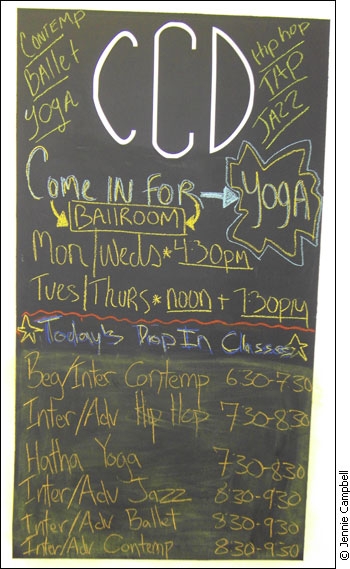
A Capital City Dance chalkboard shows the school’s range.

Greta Leeming, too, is looking at implementing new styles in its curriculum. The school did workshops of new styles in its summer program, says Caloia. Latin dance, ballroom and disco all proved to be popular with students.

“You have to keep current,” she says. “For me, I have to watch all those shows, go to conventions and learn from my graduates that have left and come back.”

Caloia says that while the new styles are getting more popular, it is still essential to be true to basic training and to proper teaching, as well.

It’s hard for dancers in Ottawa, adds Caloia, because in order to pursue a professional dance career after high school, you have to move to Toronto.

But for those who are learning in the capital city, Ottawa is developing more options.

In the past year, Rowan’s younger sister, Mallory, who trains at the Canadian School of Dance, has embraced those new opportunities. She has joined hiphop troupes Future Shock and dTALE, participates in workshops at other studios and takes classes at Capital City Dance.

Mallory Rowan says that it’s not just the teachers but the students who have to make the effort to branch out.

“In Ottawa, a lot of people tend to complain that there are not enough classes they can take.  But the thing is when people are with a studio or with a crew, sometimes they don’t branch out and then they don’t realize that there are classes like this.”

New styles, new options

With dance being as popular as it is, there is a unique opportunity for Ottawa dance students to grow.

“Everybody, no matter who they are, brings something different with respect to choreography, how they train you,” says Caloia. “I think for a dancer, you just soak it in and you can apply that to your regular dancing. I think the exposure to different things makes you better.”

That open attitude is exactly what Ottawa needs, and what Capital City Dance hopes to thrive on. Wolinsky explains that “you can’t always stay in the box: if you stay in the box you are only going to grow as big as a box. So you have to step out of that and you have to learn new things.”


Related Links

Capital City Dance Website

Greta Leeming Studio of Dance Website

Dying for a tan? Teens and tanning in Ottawa

It was just supposed to be the one time. She never imagined she’d get hooked, but soon she needed a fix three, even four times a week.

At 15 (Lindsay Fagan says), she became, like many of her peers, a tanning addict.

“It was one of those feel-good things, and people noticed. I got compliments,” explains Fagan, now 21. “I was definitely a regular tanner. I’d almost say borderline obsessed.”

Fagan is one of many Canadians to have fallen in love with indoor tanning as a teen. In 2006, a survey by the Canadian Cancer Society found 27 per cent of females age 16 to 24 used tanning equipment, compared to 15 per cent of those age 25 to 44.


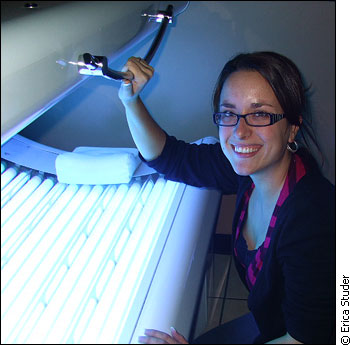
Beauty and the beast: at an Ottawa tanning salon.

Now a Carleton University student and a more moderate tanner, Fagan admits that, back in high school, fitting in was a huge motivation for constant visits to the salon.

“Everyone was doing it. They were all getting really nice tans, and it was really attractive,” she explains. “I remember thinking, ‘Oh my God, like I really want to do it.’”

Risky business

Fagan says she tanned excessively, spending hundreds of dollars, not an easy feat for a teenager earning minimum wage.

Did she ever worry about the risks?

“Not at all,” she says. “It didn’t even cross my mind. I didn’t care. It was all about in the moment.”

Darcy MacLennan, owner of a popular Ottawa tanning salon, says she sees many teens hoping to achieve the look they admire on celebrities and their peers without being aware of the risks.

“Some teens, when they’re 15, don’t make the best judgment calls when it comes to their bodies and themselves,” she observes.

The risks are proven, but today’s teens seem willing to take their chances in order to achieve that perfect golden glow.

‘It’s like drinking. People are going to find a way to do it whether it’s against the law or not’ — Lindsay Fagan

According to the Canadian Dermatology Association, Canadians born in the 1990s are two-to-three times more likely to get skin cancer in their lifetime, compared with those born in the 1960s.

This summer, the World Health Organization labeled tanning beds as a definite cause of cancer in humans, upgraded to the same risk-level as tobacco and mustard gas.

The younger you are when you first tan or burn, the greater the risk. According to the report, tanners are 75 per cent more likely to develop skin cancer later in life if they start before age 30.

Despite such risks, MacLennan says tanning in a salon is the safest route for determined teen tanners.

“Kids, if they can’t tan indoors before the summer or before going on a trip, they go out in the sun and put on their baby oil and then they give themselves first, second, third degree burns,” she says.


Tanning lotion and protective eyewear are two safety measures many tanning salons mandate for their clients.

She says that salons with proper standards offer a safer, supervised tanning experience to those teens determined to tan, no matter what.

Legislating safety?

Parents play a key role in determining the fate of teen tanners. Fifteen is the minimum age for tanning in MacLennan’s salon, and parents must sign a waiver, giving them the final say.

But some feel that stronger measures are needed to advocate for the health and safety of Ottawa’s teenagers. In July 2009, following the Canadian Dermatology Association’s report about the risks of teen tanning, one city councillor proposed making it illegal for tanning salons to serve clients below age 18.

Alex Cullen, Bay Ward councillor, says while education is important, legislation is needed to regulate an activity that can have far-reaching consequences.

“We do want to use education. It informs people. But it’s not just a question of ‘Well, ok, I’m informed now, so I’m going to take an informed risk.’ We’re not only dealing with an impact of people’s health, but the cost to us as taxpayers dealing with those symptoms,” he explains. “It’s in the public interest to eliminate these very preventable risks to a very common form of cancer.”

In October, city council decided to scrap the ban, passing off the decision to the province, where similar legislation is under consideration. Cullen says he is disappointed by the decision but hopes there is room for change in the future.

Where there’s a will…

MacLennan says she feels that a ban would not deter teen tanners because it wouldn’t deal with the root cause. Teenagers will still crave the sun-kissed look and may turn to extreme, unsupervised tanning practices to get it.


Inviting though it seems, harsh tropical sunshine can often cause burns for unsupervised tanners, on vacation.

Citing her own experience, Fagan agrees that teens determined to tan would not be put off by a city-wide ban.

“I think it’s like drinking. People are going to find a way to do it whether it’s against the law or not,” she says. “We crossed the border to Hull when we were too young to drink here. There are places in Quebec that have tanning salons, too.”

She says that teens are motivated because tanning makes you feel good and is a convenient way to boost self-esteem and be “cool.”

“It’s a quick fix. You can’t go out and get liposuction, but you know you can go tanning and get that nice tanned look and feel better about yourself.”


Related links

The Canadian Cancer Society’s position on youth and artificial tanning

The World Health Organization’s 2009 Report