Nerdlesque: worshipping the geek gods

From the number of video games that Del Roba references in casual conversation, her Xbox gaming console must have provided marathons of dedicated play.

Now, that Xbox is shattered in pieces — smashed by Roba not as a result of a frustrating loss, but because she needed to wear it to her job.

Roba, whose real name is Frankie, is the founder of the Ottawa-based Browncoats Burlesque, a one-year-old burlesque troupe that celebrates fringe-culture enthusiasms in an onstage form of burlesque now burgeoning in North America called “nerdlesque.”  Browncoats Burlesque — a reference to the cult TV show Firefly — features acts with such nerdy themes as cult movies, comic books and video games (hence the costume composed of Xbox hardware).
Browncoats Burlesque
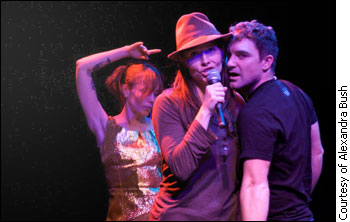
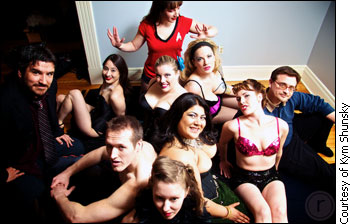
Geek chic. Ottawa’s Browncoats Burlesque troupe features Del Roba, top, and Foxie DeVille, second from left.

Browncoats Burlesque is one of several burlesque troupes across North America to showcase nerdlesque, but this quirky subgenre has grown in popularity only within the past two years.  One early notable troupe of this emergence was formed in 2008 under the name Nerdlesque to be a monthly burlesque series exploring nerd culture.  Since then, most major U.S. cities with a strong burlesque presence showcase nerdlesque acts, such as the Flaming Dames’ nerdlesque-themed show at Chicago’s New Millenium theatre company, or Skill Focus: Burlesque in Orlando, or Whedonesque Burlesque in Seattle.

For Roba, Browncoats Burlesque has been a labour of love.  The self-professed nerd says she had seen the Devil Dolls burlesque troupe in Ottawa and was inspired to create her own burlesque show, based on something she knew best.  And what what she knew best, she says, was nerd culture: video games, cult movies, science fiction series and other interests typically classified as “geeky.”

Conveniently, her first recruits for the show were friends from her live-action role-playing group, or LARP.  (LARP is an activity in which players create settings and characters and improvise scenes in a real-life setting, creating challenges for their characters not unlike storylines in video games.)

Dorks in short shorts

As risqué as burlesque is, the performance art attracts people with a variety of day jobs.  The performers with Browncoats Burlesque include workers for several branches of the government, a chef, and a neuroscience researcher.

A burlesque show can feature various sideshow performances, but the defining acts showcase performers — usually women — removing their clothes.  The main difference between burlesque dancers and other strippers is the tongue-in-cheek humour, which satirizes the sexualization of stripping.

Roba says that, friends and supporters aside, their audiences tend to span a variety of demographics.  She says that nerdlesque has a strong marketplace appeal.

“Nerdlesque is definitely something I think people can get behind. I find people are more able to relate to the performances than with some other styles of burlesque,” she says. “Most people can feel for the awkward nerd just trying to be cool.  Nerdlesque, in many ways, is a form of ‘fan fiction’ amongst the many that make up ‘fanculture’. That equals an army of nerds that could possibly get behind nerdlesque.”

‘My influences are ballet and video games.’ — Foxie DeVille

Aside from group numbers, the members of Browncoats Burlesque write and choreograph their own acts.  Under the wide umbrella of “nerdiness,” the range of ideas seems unlimited.

You’ll find, for example, a fervent Batman fan parading as the villains Poison Ivy and Harley Quinn, and an avid gamer pulled off a complicated ode to the computer game Tetris.  Performers say nerdlesque allows them to express and embrace the niche interests of their personal lives.

Foxie DeVille (who has asked to print her stage name to preserve her privacy) says she already had a background in burlesque before joining the Browncoats Burlesque.  The classically trained dancer lists-off a number of Hollywood influences that attracted her to more complicated choreography, such as a dance using large fans.  Despite her traditional training, she says she feels inspired by creative opportunities with the pop culture references.

“My influences are ballet and video games,” she says, noting the unusual marriage of the two hobbies.

At last Halloween’s show Freeks N Geeks, Roba performed a number based on the cult film Attack of the Killer Tomatoes, which she says she chose based on her passion for critically and commercially unsuccessful movies.  The emcees gave the audience red balls to throw at her during the performance, symbolizing a downpour of tomatoes from the film.  Though at first uncertain whether the audience would participate, she says that she was so impressed with the audience’s gusto in their throws that she cheerfully smiled and thanked the crowd when she was supposed to pretend she was dead.

“Audience interaction is pretty awesome,” says DeVille.  She says that although the audience doesn’t always understand the reference, they engage with the comedy and light-hearted nature of nerdlesque, more than with other burlesque shows.

Enthusiastic audience responses like these have encouraged the spread of nerdlesque troupes and individual acts, which in the United States now range from Seattle to New York City.  Montreal and Toronto feature individual nerdlesque acts, but Browncoats Burlesque is currently the only full-time, nerdlesque-only troupe in Canada.

Revenge of the nerds
NYC Nerdlesque
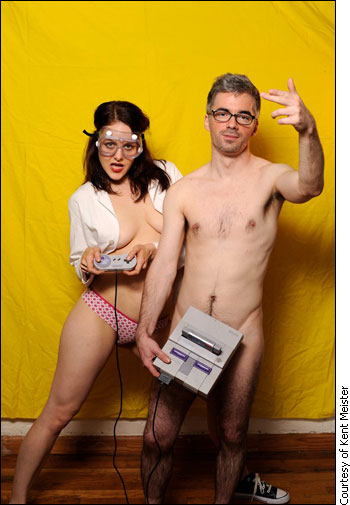
Software and hardware. New York City’s Nerdlesque boldly goes nude where no nerd has gone before.

Chris Chappell is a co-producer of the New York City–based troupe Nerdlesque, which is a joint venture between Sneaky Snake Productions and Captain Sharky’s Historical Gender Equality Reactualization.

Chappell says he suspects that the rise in nerdlesque groups across North America can be attributed partly to a general cultural shift.

“There’s this really complicated intersection of hipness and nerdiness,” says Chappell.  “There’s a mainstreaming of a lot of these [nerdy] things.”  In other words, “geek is chic”: It currently is trendy to celebrate the otherness of traditional nerd interests, and this new value is reflected onstage.

He says that in North America nerd pride is on the rise. “People have really incorporated that into their idea of culture.  And [nerd appeal in the arts] is happening organically as a result.”

Yet Chappell says there is a danger of not sufficiently honouring the original material from which nerdlesque troupes draw their references, indicating concern about taking away some of the substance of nerdy sources after they’ve hit the mainstream.  Still, he says nerdiness is a “vibrant trend and community,” and his troupe is proud to be a part of that.

For Browncoats Burlesque, whose acts have such personal significance to the performers, honouring the nerdy references is a priority.

Above all, though, the performers insist on one key component.

“Basically, we want everybody to have fun.  That’s all we’re really trying to do,” says Roba.

Even if it means smashing her prized Xbox for the show.
Quidditch for muggles

The seeker darts across the field on his broomstick when he spots the golden snitch—a university-team wrestler, dressed in gold—taunting him from the audience. The snitch is wedged among 20-something-year-old Harry Potter devotees torn between watching the coming confrontation and protecting their homemade magic wands

Devoted Harry Potter fans are turning their favourite fictional sport, Quidditch, into reality; trading lacrosse sticks for broomsticks and basketballs for quaffles. Though they can’t fly, their love for the boy hero is enough to fuel their imagination — and their broomsticks.
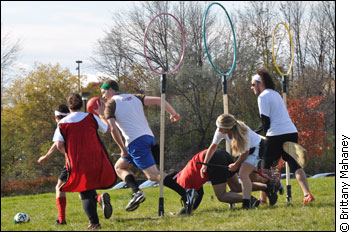
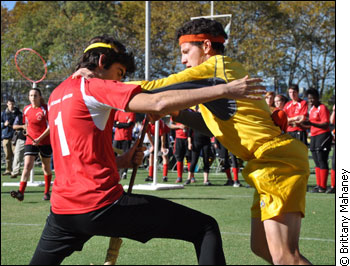
A seeker (left) braves a stalwart defence, trying to capture the flag attached to the golden snitch’s shorts.

“The snitch has been spotted!” the narrator yells, attempting a British accent.

Attention turns to Carleton University’s chaser, who is racing down the field with a quaffle (a volleyball to ordinary Muggles) under her arm. This isn’t an easy task, as she must sidestep the flying bludgers (dodgeballs) that the beaters are throwing at her. “Beat her! Bludge her!” chants a crowd of impassioned Ohio State fans in the audience. If it weren’t for the incessant cheering, it would be difficult to tell where each person’s allegiance lies, as both Carleton and Ohio sport red jerseys.

Amid this chaos, Carleton’s seeker focuses on his golden target and tackles the snitch to the ground, grabbing the flag around his waist. The Quidditch game is over and Carleton is victorious in its second game at the fourth annual World Cup in New York City’s DeWitt Clinton Park.

On a sunny day that seemed too hot to be November, with a backdrop of towering Manhattan buildings, Carleton took the field against 45 other teams at the World Cup. The Nov. 13–14 event, which is organized by the overarching International Quidditch Association, drew over 20,000 spectators and 757 players this year.

You needn’t believe in magic to see that Quidditch is now being taken seriously as a university sport. Carleton is one of 400 universities across the world to create a Quidditch team since 2006, inspired by J.K. Rowling’s Harry Potter series and the unforgettable scenes from the movies. The sport is a combination of football, dodgeball and tag, and is surprisingly demanding.

For the love of Harry

Andrea Hill, 20, captain of Carleton’s team, says children who grew up with Harry—literally, being about Harry’s own age as the books were released—are now adults and don’t want to let go of their favourite hero. Many of the players are of this age, about 20 or 21.  And Harry is easy to identify with: At core, he faces struggles that are universal.

“He may be able to fly on a broomstick and transfigure matchsticks to needles, but he is self-conscious, struggles with schoolwork and has a short temper that more often than not lands him in detention,” Hill says. “The books have taken a very fantastical element and grounded it in something normal people can relate to.”

Tabitha McDonald, 20, a keeper for Carleton University who recently wrote an English essay about the heroism of Severus Snape, starts giggling with the other girls at the mention of Daniel Radcliffe. She holds an icepack on her injured leg and mentions she is also nursing a broken rib. For McDonald, playing Quidditch is worth the pain. While she describes the team as a bunch of like-minded nerds, Quidditch also serves a deeper purpose: a way for her to connect with her favourite childhood series. It prompts memories of reading with her parents and the impatient wait each year for the next book to hit shelves.

“My whole year was centered around reading the next book,” McDonald says. “Quidditch was this sport that I had dreamed was a possibility, and then I heard about it and it was probably one of the happiest days of my life.”

At the World Cup, one could easily note that some players draped velvet Gryffindor cloaks over their shoulders or could recite Hogwarts-type incantations on command. Beyond obvious incentives to exercise and socialize, Harry Potter seems to have struck a deeper nerve with these Quidditch players, touching of their self image.  In fact, the cultish loyalty of players leads naysayers to deem Quidditch obsessive.

Why has Harry Potter remained so popular with young adults? “It crosses a lot of gaps and speaks to everyone,” McDonald explains.

‘Quidditch was this sport I dreamed was a possibility. Then I heard about it and it was probably one of the happiest days of my life.’
– Tabitha McDonald

Sherry Aske, a keeper for Carleton, remembers reading Harry Potter as a child and dreaming of running away to Hogwarts when she was upset. Aske, now 20, she says her love for the series will never waver.

“Reading works the same way for me now when I get stressed. I always liked it because you can escape from the everyday world. It’s like therapy,” she says. “I think it doesn’t matter how old you get but you don’t—I hope, anyway—you don’t lose your imagination.”

Paramedics were on hand at the World Cup, wheeling several overzealous players off the field on stretchers. Commentators occasionally narrated in Parselmouth (the language supposedly spoken by snakes), and there was that brunette dressed in navy blue who kept introducing herself as the head of Ravenclaw House.

The dark side

Whether this sense of whimsy is light-hearted or serious is arguable.  Turning fantasy into reality might do long-term damage to our collective imagination, says Susan-Anne Cooper, a professor of children’s literature at Carleton.

“People are quite happy to have it be literal, at which stage it’s not fantastic: There’s no room for make-believe or imagination,” Cooper says. “If people become completely literal-minded and lose the capacity to imagine, then we’re in big trouble.”

In this vein, Cooper points out, anyone can see Hogwarts Castle, visit Ollivander’s wand shop or sip butterbeer at Universal Studios’ new Harry Potter theme park in Florida. At least Quidditch players have to pretend they are flying (until hoover-boards become mainstream).

Beyond the physical incentives to play Quidditch, players feel closer to their favourite boy hero, Harry Potter.
A magic moment: Carleton throws the quaffle through the hoop, in a home-field game.

But Irvin Khaytman believes the sport shouldn’t be taken so seriously. Khaytman is a member of New York’s community team—the only team not tied to a university or high school. For him, Quidditch isn’t just a fantasy realized, it’s also a way to connect with likeminded people and to exercise.

“I’ve never been athletic, so to join a team full of nerds who just run around on brooms in capes and act goofy, it seems like an amazing time.”

Khaytman says he’s nostalgic for the series because he grew up with Harry and was the same age as his favorite characters when he read each book.

“It’s your past,” he says. “Everyone’s been at school; they’ve had the school bully; they’ve had the school teachers that you love and hate; they’ve had the evil assistant principal.”

Now, in the swirl of work and stress, Khaytman says playing Quidditch brings him back to a safe space.

Back in Ottawa, Carleton is competing against Saint Lawrence University on home ground. Nine-year-old Maliha Sarwar sits in the crowd with her mother and brother, munching on a licorice wand she bought in support of the team. Currently, the family is reading Harry Potter together and watching the movies after each book. Maliha represents a new generation that is growing up with Harry and his friends: she even dressed as Hermione last Halloween. Now, at the game, she watches team captain Hill, whose face is swathed in red war paint, tackle a male player two feet taller than she.

“I think it’s a very good game; I like Quidditch,” Maliha says. She repositions her glasses and waves her candy wand as she says, “I think I’d like to play one day.”

Related Links

Audio Visual Slideshow: Why Quidditch players love Harry Potter

Turning Japanese: Ottawa’s karaoke fever

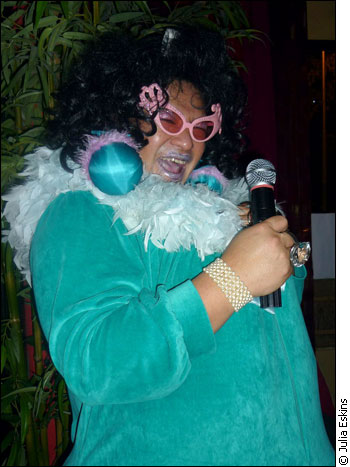
Draped in blue velvet, China Doll clutches the microphone with three fingers and the natural grace of a woman. Watching those hips gyrate to the beat, the audience almost forgets about his five o’clock shadow. His ring finger is appropriately sporting a fake diamond ring the size of a golf ball and, like a true diva, he flutters it through the air as he hits the high notes.

“Love, love will keep us together. Think of me baby whenever” — China Doll belts out as he prances around the room — “some sweet talking whore comes along, singing her song.” The audience giggles wildly as he ad-libs “whore” for “girl,” and erupts again when he assures the woman in the front row that he isn’t talking about her. It’s a version of the classic Captain and Tennille song that you’ll never hear on the radio, but one you might catch at Ottawa’s Shanghai restaurant on a Saturday night.


China Doll sparkles on Saturday nights at the Shanghai.

China Doll, known offstage as Edward Kwan, is the magnetic force that brings vocals-craving crowds to the little restaurant on Somerset Street. The family-owned business has been a community hot spot since the 1970s but has recently gained attention for wild karaoke nights hosted by Kwan’s alter ego. The image of his face is spray-painted on the side of the building, and inside you’ll either find him cooking egg rolls in the kitchen or singing in drag.

Newcomers leave vowing to return next week and regulars wonder why he doesn’t ad-lib “karaoke” for “love” instead. Love doesn’t always keep people together, nor does it keep restaurants in business, but karaoke might.

The Japanese tradition of karaoke has been popular in Western culture since the 1980s, but it’s no longer reserved for gloomy watering holes. In Canada and elsewhere, mainstream bars are now using karaoke to battle slow weeknights and economic slumps.

And apparently it’s working; according to the Performing Right Society, karoke revenues increased by 10 percent during the thick of the 2008-2009 recession.

In Ottawa, karaoke bars are packed from Monday to Sunday, with the Shanghai exceeding its 70 seat capacity almost every Saturday night. If you plan on showing up after 10 p.m., be prepared to stand in the doorway to catch a glimpse of the action. In typical karaoke fashion, little white pieces of paper are delivered to the DJ booth, and singers are called up to try their luck in front of a glowing screen. Some performances seem overly practised, while others require vocal assistance from the audience.

‘The truth is, karaoke is not about being good.’ – karaoke impresario Edward Kwan

As Kwan throws in commentary, he proves to be his own bizarre version of Simon Cowell. After a man in a suit performs a technically perfect performance of Boston’s “More Than a Feeling,” he rolls his eyes.

“The bad singers are more entertaining,” he says quietly as he covers his microphone. “We have Canadian Idol rejects that come in here and think they’re really good. The truth is, karaoke is not about being good.”

Kwan is wearing a curly black wig, white feather boa and pink framed glasses. He developed his feminine persona after volunteering to throw on a wig and sing at a private karaoke party. Ever since, the restaurant’s karaoke nights and China Doll’s outlandish outfits have been a celebrated attraction.

“It’s a total bonding experience,” says Kwan as he walks to the front of the restaurant. “Let me get that for you, honey,” he croons as he opens the door for a woman, who enters grinning uneasily. Kwan puckers his silver tinted lips and adjusts his wig. “Some people come in here looking so shocked. I just tell them to shut their jaw. When you step in here, you’re not in Ottawa anymore. You have to expect the unexpected.”


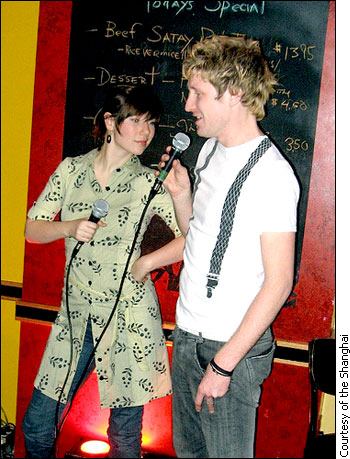
Performers at the Shanghai: free to do badly or well.

The Duet

At Carleton University, karaoke has turned a typically low-key graduate student bar and a slow Tuesday night into a midweek diversion.

“When we first started coming here, Mike’s Place was dead on a Tuesday. Through word of mouth, it went from five people to this,” says Carleton alumnus Justin Samlal as he gestures around the room. Tables are filled with people hunched over song binders and sipping beer, trying to gain some liquid courage to perform.

People can sing sometimes poorly, often ridiculously, with no social consequence.

Host Kristin Marand sits behind the equipment, watching the action. Asked about karaoke’s appeal, she replies with a shrug. “It’s the next level of singing in the shower. People jump at the chance to have an audience and let loose. It’s all about having an outlet. You can be awful and it doesn’t matter, it’s karaoke!”

In a world where cheers will follow just about any performance, people can sing sometimes poorly, often ridiculously, with no social consequence. This fun, supportive atmosphere is what keeps people coming back.

Samlal and friend Jacob Campbell have been coming to Mike’s Place karaoke every Tuesday for four years.

“I used to purposely avoid scheduling class on Wednesday mornings, and now I purposely avoid scheduling work meetings that day,” says Campbell.


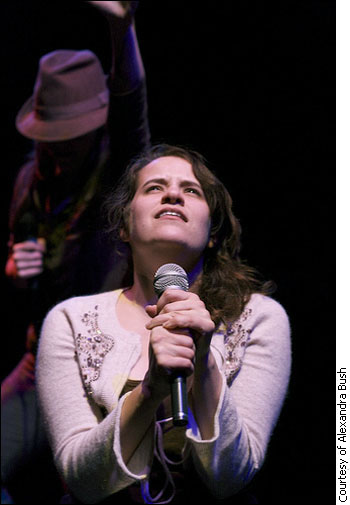
Sara Edwards embraces the moment in a heartfelt performance.

They perform as a duo, and will begin tonight with a choreographed repertoire of Bloodhound Gang’s “The Bad Touch”. As they get up for their turn, about ten people follow suit; everyone seems to know the hip-thrusting dance by heart. Their university days may be over, but karaoke keeps the bond strong.

The Soloist

For those seeking a romantic partner, the spotlight can be the perfect place to meet someone. Danni Plume has introduced karaoke to more than a dozen regular venues in Ottawa with her and her husband’s traveling karaoke show, Dog and Pony Sound. From the Royal Oak to the Lookout, Plume attributes busy karaoke nights to what she calls “the lonely hearts club” factor.

“Typically the people who come out here are looking for something. At gay bars, it’s very cute. The boys get up and basically market themselves to the room,” she says. “When they’re finished singing, there’s usually someone waiting to buy them a drink.”

Plume says she has combined her love of karaoke with a psychology degree to bring karaoke therapy to the capital. Karaoke can help people overcome fears of public speaking, especially in a relaxed bar environment with audience and host encouragement, she says.

“I was hooked after my first song. I enjoyed the exhilaration of stepping out of my shell. I enjoyed challenging myself. I enjoyed the camaraderie. Everyone supports each other.”

Karaoke’s popularity is a product of the people: both the performers and the audience, the fuel and the fire. Outside of lecture halls and cubical walls, karaoke offers a judgment-free atmosphere where anything goes. One man got so comfortable at the Shanghai one Saturday night, he took off all his clothes during his solo. We can only hope that that doesn’t mark the opening of a new Chippendales.  But racy nights like those are getting Ottawans to strip off their apprehensions and shine.


Amy O’Neal and friends at the Speak and Sing

Who wants 15 seconds of fame when you can have three and a half minutes? You may not know the words, you may have forgotten the tune, but if you can pretend, you can karaoke.


Related Links

Society of Composers, Authors and Music Publishers of Canada

Performing Right Society for Music


Urban gorillas and the parkour craze

James Bond attempted it. The Office mocked it. And now, a niche group of mostly teenagers is keeping fit by doing what these fictional characters can’t: vaulting over walls, cat-crawling up railings and leaping from 10-foot drops. This physical movement is called parkour, and its traceurs, or practitioners, combine athletic discipline with animal instinct to negotiate a path around everyday city structures.


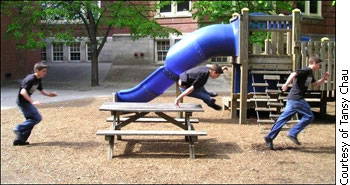
Vaulting a school picnic table in Toronto’s Beaches neighbourhood.

For them, the urban jungle becomes a playground littered with obstacles, and the goal is simple: to move forward as efficiently as possible. Running at a wall to leap it, a traceur jumps, bounds off the wall with one foot and, in keeping with the upward momentum, uses upper-body strength to make the final up-and-over push.

It’s harder than it looks. Casino Royale (2006) featured Daniel Craig’s Bond and his faltering parkour skills as he strove against an antagonist’s smooth manoeuvres; Bond finally resorted to blunt-force tactics such as powering through a still-wet plaster wall instead of swinging through a gap above it. And the well-received TV show The Office parodied the trend in last season’s premiere episode; Michael Scott, Andy, and Dwight amused audiences by somersaulting over couches, trampling across desks and falling into refrigerator boxes. YouTube, as well, has hundreds of thousands of streaming videos made by enthusiasts.

Parkour, then, is the latest craze in popular culture to hit the movies, televison and Internet. Its pioneers, widely credited to be David Belle and Sebastian Foucan, derived the name from parcours du combatant, a phrase that refers to the obstacle courses negotiated by the French military in war-torn Europe. Belle’s father was a soldier, and both founders were teenagers in the 1980s when they began experimenting in the outskirts of Paris.

Parkour has since exploded into the mainstream; MTV launched its “Ultimate Parkour Challenge” last fall where athletes battled for a $10, 000 cash prize. Ottawa has not been left off the map, and Patrick Bériault is here to help the pk scene grow.

Beginnings

Bériault initiated a parkour group that meets twice a week, on Wednesdays and Saturdays. As a health promoter for physical activity at the Somerset West Community Health Centre (SWCHC), he says he wanted to engage youth with a cutting-edge sport. To capture attention and attract participants, he bills the program as an extreme activity.

“My legs are aching the next day whenever I’m done, but it’s not extreme in the sense that we’re leaping across buildings and running among cars,” says Bériault.

The program, now in its second year, focuses on conditioning and teaching the essential body movements. With a background in kinesiology, Bériault leads sessions to strengthen muscles and quicken agility. Fast footwork and the ability to tumble can help prevent injury, he says, because the kids will be able to recover if a slip or a mishap occurs.


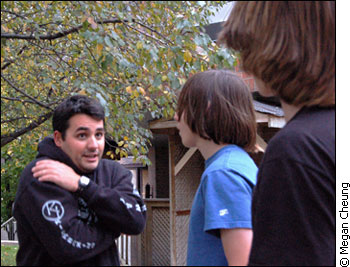
Patrick Bériault explains proper front-roll technique at a Gatineau training session.

“Parkour is as dangerous as you want it to be,” says Dan Iaboni, the whizz kid behind both the popular go-to website, pkTO.ca, and the unique indoor training centre known as the Monkey Vault in Toronto. “If you want to be perfectly safe, you can do parkour perfectly safe, because 99 per cent of the stuff is on the ground and the biggest problem you’re ever going to get is maybe a banged-up knee, bruises on your arm or a little cut or scratch.”

Sprained ankles are the most common injury in parkour (but even so are rare). Traceurs must understand their limits, Iaboni explains. Newcomers cannot simply go out, pretend they are Superman and copy a YouTube video.

Moving within the law

Perhaps due to the occasional reckless kid, parkour suffers ill repute among authorities. Security guards and law-enforcement officers are sometimes less than thrilled with the public activity.

‘We’re not doing anything wrong. It’s not illegal to jump down a set of stairs instead of walking them.’ – parkour organizer Dan Iaboni

“Especially in the financial district, security guards are always trying to kick us out left and right. People complain inside, and they don’t want us on the property,” says Iaboni. In that case, he explains, traceurs will leave and move to the next building.

Seventeen-year-old Juan Diego practised parkour in Ottawa for several months and sees disapproval as an overreaction. He says, in Canada especially, authorities should pause long enough to confirm the need for any interference.

“In Colombia, if they see you climbing something, they immediately think you stole something.  So they call the police,” says Diego.

The key is to ask permission before using the property, says Ottawa police spokesman Const. J.P. Vincelette. If traceurs fail to do so or choose to disregard the owner, they could be charged with trespassing. To date, Ottawa police do not have parkour flagged as a problem.

Says Iaboni, “We don’t have skateboards. We’re not marking stuff up. We don’t have spray paint in our hands. We’re not doing anything wrong. It’s not really illegal to jump down a set of stairs instead of walking them.”

Gaining momentum

The SWCHC group, comprised of 8 to 10 members during the summer peak season, often trains at Place du Portage in Gatineau and in downtown Ottawa — two hotspots for traceurs, because both locations provide creative possibilities. Intricate architecture, cement structures, benches and railings are all ideal to stimulate expression. These weekly meet-ups are as formal as parkour gets in Ottawa. The nation’s capital has yet to see the level of organization and enthusiasm that is visible in Toronto.

Toronto’s Monkey Vault, for instance, opened its doors in 2008 and continues to thrive as a community project. There are about 15 people who train every day and about 150 to 200 others who visit each month. It’s the only gym of its kind in Canada, designed with parkour specifically in mind.

Iaboni’s website, similarly, is a hub for enthusiasts to connect and to organize meets. More than 700 people visit the site at least three times a month, and Iaboni estimates 300 check it every day.

Iaboni says the city of Toronto sees about 60 different meet-ups in the summer. Popular places to train include the financial district, the University of Toronto, the city hall area and the downtown park Cloud Gardens.


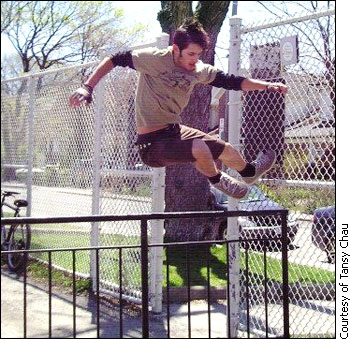
No obstacle is too big for traceur Max Lee Fox Stussi at Toronto’s Malvern Collegiate Institute.

At a training session, it’s not uncommon to drill a jump until the timing, body position and landing are perfected. If a structure becomes familiar to the point that its ins and outs are known by heart, the movement becomes instinctive.

Iaboni likens this second nature to someone who starts dancing when music is turned on. “They do whatever they feel like inside, and that’s what we do, too. We’re outside, we see a bunch of stuff and your body takes over.”

The leap to the future

In light of Canada’s good showing at Vancouver’s Olympics, could parkour have a future in international sport? Iaboni insists parkour is not about competition, despite the excitement over MTV’s Ultimate Parkour Challenge in the U.S. The culture in Canada is more oriented to building camaraderie and helping one another. Training in big groups, especially, provides the chance to exchange knowledge, ask questions and fine-tune skills.

“I’d like to see as many as possible doing it. Everyone used to do this stuff as a kid and everyone sort of grows out of it. I don’t believe people should grow out of it. Everyone should be moving and running around,” says Iaboni.

Related Links

The Monkey Vault

pkTO website

Canadian women’s roller derby revival

Ottawa resident Natalie Campbell is far from your typical female amateur athlete. Under her alias, Drunky Brewster — a combination of her childhood nickname and adult habits — she does it all, routinely hitting, blocking and falling, all while sporting a cleavage-baring top.

Campbell plays for the Ottawa-area Slaughter Daughters in one of Canada’s fastest-growing, full-contact women’s skating sports. And no, it’s not hockey. It’s roller derby.


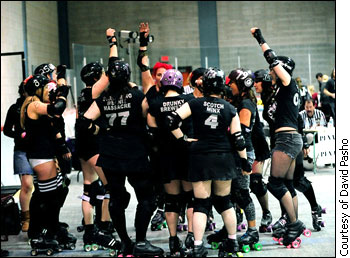
The Slaughter Daughters psych up for a bout at Montreal’s Beast of the East Tournament.

This rough lifestyle has come at a price to Campbell, who has sometimes suffered from track rash: a diamond-patterned irritation caused by falling onto the asphalt when wearing fishnets.

Due to other injuries, Campbell (who works as a graphic designer by day) hasn’t had feeling in her left buttocks for over a year. “My skates came out from under me and I ended up having a black bruise that took up my entire butt cheek for three months.” And compared to other girls in her league, the Rideau Valley Roller Girls, she’s one of the lucky ones.

Catching a wave

Once widely popular with TV audiences and amateur contestants of both genders, roller derby saw its appeal plummet in the late 1970s but has recently undergone a resurgence at an independent, grassroots level. Since 2003, roller derby has grown exponentially in North America. In five years, the Women’s Flat Track Derby Association (WFTDA) has gone from seven teams to 79 leagues across North America. Canada alone boasts about 23 leagues.

This new roller derby has garnered great attention; over 2000 fans attended the WFTDA’s regional and national championships. In the Ottawa region, the Rideau Valley Roller Girls’ bouts often sell out, sometimes with upwards of 800 fans.

For an amateur sport in Canada, roller derby has managed to attract huge crowds and increasing numbers of women wanting to try the sport. The question is why? Or at least why now?

Carolyn Storms, a sociologist at the State University of New York at Buffalo, thinks roller derby’s resurgence could be part of a larger trend toward violent sports, such for example the popular mixed martial arts competition Ultimate Fighting Championship.

Derby’s aggressive nature has certainly contributed to its rising popularity; however, many girls also say they have gotten involved with the skating sport because of its pro-female attitudes, its opportunities for roller skating and its novelty.

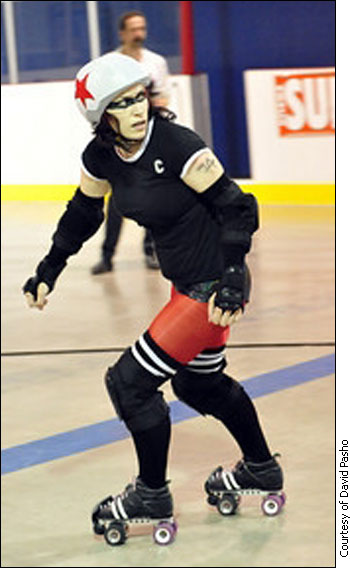
Modern roller derby is played on a flat track, which means teams can use any flat surface like a gym or parking lot. Each team sends out five players who skate in a pack during two-minute periods called “jams.” Points are scored when one player for each team, entitled “the jammer,” laps the pack while the other four players attempt to block the other team’s jammer from passing.


About to pounce: The Slaughter Daughters’ jammer prepares to lap the pack.

For women only

Montreal Roller Derby was one of the first leagues formed in Canada, in 2006. Montreal derby girl Cheryl Gladu (professional name: Ewan Wotarmy, or “You and what army?”) says that because the resurgent sport is predominantly female, it appeals to women who are tired of being undervalued in male-dominated institutions.

“Women are always the sideshow, just playing watered-down versions of male sports,” she says. “This is all about women playing a sport for women.”

Female bonding is a huge draw to the sport. Derby girls often are very close, on and off the track.

“The sense of the camaraderie in the league is unreal,” Gladu says. “I have a strong attachment to the women in a way I’ve never had in another sport.”

Derby girls aren’t in it only to socialize; they’re there also for love of roller skating and performance.

Kelly McAlear (Honey Bee), founder of the Ottawa Roller Derby league, sought to bring the sport to Ottawa after it had caught on in Montreal. She travelled every Tuesday to learn the ropes from the Montreal girls, and bought used skates to start her own league. She says she worked hard to revive the sport because she had loved roller skating as a kid and was always curious about derby.

Nancy Finley, a sociologist who has studied derby for over two years, agrees that roller skates are appealing to women.

“A lot of women feel really empowered skating. I see a lot of women who say, ‘I haven’t done this since I was a kid. I was always proud of myself when I was on skates,’” she observes.

‘A lot of women feel really empowered skating.’ — sociologist Nancy Finley

This is especially true for Canadian women, who have grown up with the ice traditions of hockey and recreational skating.

Gladu, a former hockey player, says although Canadian girls picked up derby later than Americans, they are catching up quickly because foundations in ice skating are transferable to roller skates.

She switched from hockey to derby after attending Montreal’s championship bout in 2008. “It was the biggest spectacle I’d ever seen for women’s amateur sport. You have hundreds of people cheering you on.”

A crowd-pleasing spectacle

The fans of roller derby in Canada are dedicated and growing. Montreal’s games are consistently sold out, and promoters have even began to sell Montreal derby merchandise like t-shirts, pins and beer cozies.

Finley says derby attracts more fans than your average amateur softball game because of the “talking dog syndrome”: people want to come see something unusual.

And with sassy derby names, skimpy costumes and bad-girl attitudes, derby really is like no other amateur sport.

Blackout Susan, Sister Disaster, Screaming Meanie Massacre and Scotch Minx: derby girl names can range from sexy to vicious but must be original. No two girls can have the same name.

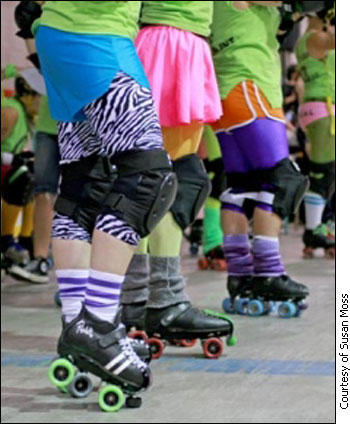
Outfit choices also range from a sexy spectacle to simple and athletic. However, whether a girl comes out in fishnets or work-out shorts, she must cover herself up with protective padding; wrist guards, elbow pads, knee pads and helmets are a must.


Neon duds worn by Montreal’s New Skids on the Block take sports gear to a new level.

Gabriell Garcia (Chica Loca), the marketing chair for the WFTDA, says adornments like the names and costumes have contributed to derby’s rapid growth.

“It’s a full-contact sport where women are being aggressive but being feminine and staying true to their femininity.  So it’s a really exciting show as well as sport,” she says.

Not for faint hearts

But roller derby encounters debate because of its aggressive nature.

Campbell admits the risk for injury is high. “Recently we played a game, and our biggest hitter broke her ankle, like it shattered,” she says. “Collar bone breaks are also common. Everybody’s always bruised up.”

However, Campbell says she risks injury because the physicality is what attracted her to roller derby. “It’s a sport where you’re encouraged to be more aggressive, and I feel like a lot of women aren’t often encouraged to be competitive and vicious.”

Some women feel the sport doesn’t need to be aggressive to be fun. McAlear has recently reformatted her league, Ottawa Roller Derby, to cut out hitting.

“Over the last three years I’ve seen a lot of bad stuff, and being at the hospital isn’t fun,” she says. “You need to respect those who don’t want to be hit. They should be able to have fun and be on skates too.”

It seems there is a market for the low-impact derby envisioned by McAlear. Her several open houses to pitch the idea have consistently brought crowded attendance and a waiting list.

Whether contact or non-contact, women’s roller derby has definitely roused a lot of interest in Canada. When asked what the future holds for the sport, Garcia of the WFTDA jokingly answers, “World domination.” But although she thinks it will keep growing, she also thinks modern derby should stay true to its grassroots.

At the team level, Campbell is just happy Ottawa has embraced the sport. Her Rideau Valley Roller Girls league is in the midst of introducing a new team, the Riot Squad; and with more girls in the league, the potential for travel to other cities will increase in the upcoming season.

However, even “if the sport doesn’t get any bigger, I don’t care, because I’m really happy with derby in Ottawa,” Campbell explains. “I’m excited to see what’s going to happen, and I know it’s going to be good.”

Related Links

Rideau Valley Roller Girls

Ottawa Roller Derby

Montreal Roller Derby

WFTDA