Turning Japanese: Ottawa’s karaoke fever

Draped in blue velvet, China Doll clutches the microphone with three fingers and the natural grace of a woman. Watching those hips gyrate to the beat, the audience almost forgets about his five o’clock shadow. His ring finger is appropriately sporting a fake diamond ring the size of a golf ball and, like a true diva, he flutters it through the air as he hits the high notes.

“Love, love will keep us together. Think of me baby whenever” — China Doll belts out as he prances around the room — “some sweet talking whore comes along, singing her song.” The audience giggles wildly as he ad-libs “whore” for “girl,” and erupts again when he assures the woman in the front row that he isn’t talking about her. It’s a version of the classic Captain and Tennille song that you’ll never hear on the radio, but one you might catch at Ottawa’s Shanghai restaurant on a Saturday night.
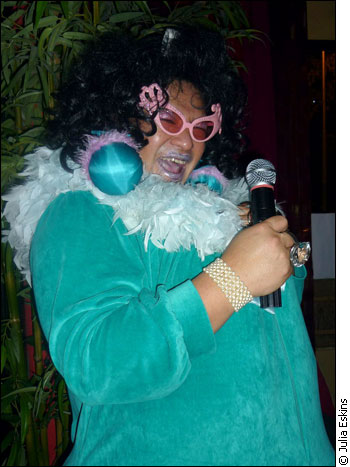

China Doll sparkles on Saturday nights at the Shanghai.

China Doll, known offstage as Edward Kwan, is the magnetic force that brings vocals-craving crowds to the little restaurant on Somerset Street. The family-owned business has been a community hot spot since the 1970s but has recently gained attention for wild karaoke nights hosted by Kwan’s alter ego. The image of his face is spray-painted on the side of the building, and inside you’ll either find him cooking egg rolls in the kitchen or singing in drag.

Newcomers leave vowing to return next week and regulars wonder why he doesn’t ad-lib “karaoke” for “love” instead. Love doesn’t always keep people together, nor does it keep restaurants in business, but karaoke might.

The Japanese tradition of karaoke has been popular in Western culture since the 1980s, but it’s no longer reserved for gloomy watering holes. In Canada and elsewhere, mainstream bars are now using karaoke to battle slow weeknights and economic slumps.

And apparently it’s working; according to the Performing Right Society, karoke revenues increased by 10 percent during the thick of the 2008-2009 recession.

In Ottawa, karaoke bars are packed from Monday to Sunday, with the Shanghai exceeding its 70 seat capacity almost every Saturday night. If you plan on showing up after 10 p.m., be prepared to stand in the doorway to catch a glimpse of the action. In typical karaoke fashion, little white pieces of paper are delivered to the DJ booth, and singers are called up to try their luck in front of a glowing screen. Some performances seem overly practised, while others require vocal assistance from the audience.

‘The truth is, karaoke is not about being good.’ – karaoke impresario Edward Kwan

As Kwan throws in commentary, he proves to be his own bizarre version of Simon Cowell. After a man in a suit performs a technically perfect performance of Boston’s “More Than a Feeling,” he rolls his eyes.

“The bad singers are more entertaining,” he says quietly as he covers his microphone. “We have Canadian Idol rejects that come in here and think they’re really good. The truth is, karaoke is not about being good.”

Kwan is wearing a curly black wig, white feather boa and pink framed glasses. He developed his feminine persona after volunteering to throw on a wig and sing at a private karaoke party. Ever since, the restaurant’s karaoke nights and China Doll’s outlandish outfits have been a celebrated attraction.

“It’s a total bonding experience,” says Kwan as he walks to the front of the restaurant. “Let me get that for you, honey,” he croons as he opens the door for a woman, who enters grinning uneasily. Kwan puckers his silver tinted lips and adjusts his wig. “Some people come in here looking so shocked. I just tell them to shut their jaw. When you step in here, you’re not in Ottawa anymore. You have to expect the unexpected.”
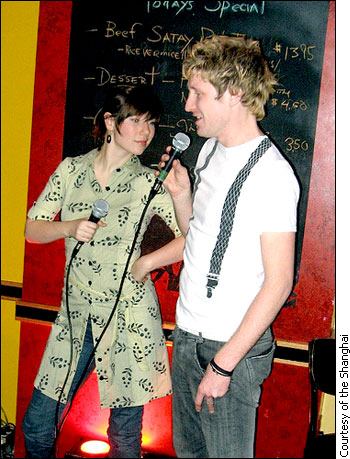

Performers at the Shanghai: free to do badly or well.

The Duet

At Carleton University, karaoke has turned a typically low-key graduate student bar and a slow Tuesday night into a midweek diversion.

“When we first started coming here, Mike’s Place was dead on a Tuesday. Through word of mouth, it went from five people to this,” says Carleton alumnus Justin Samlal as he gestures around the room. Tables are filled with people hunched over song binders and sipping beer, trying to gain some liquid courage to perform.

People can sing sometimes poorly, often ridiculously, with no social consequence.

Host Kristin Marand sits behind the equipment, watching the action. Asked about karaoke’s appeal, she replies with a shrug. “It’s the next level of singing in the shower. People jump at the chance to have an audience and let loose. It’s all about having an outlet. You can be awful and it doesn’t matter, it’s karaoke!”

In a world where cheers will follow just about any performance, people can sing sometimes poorly, often ridiculously, with no social consequence. This fun, supportive atmosphere is what keeps people coming back.

Samlal and friend Jacob Campbell have been coming to Mike’s Place karaoke every Tuesday for four years.

“I used to purposely avoid scheduling class on Wednesday mornings, and now I purposely avoid scheduling work meetings that day,” says Campbell.
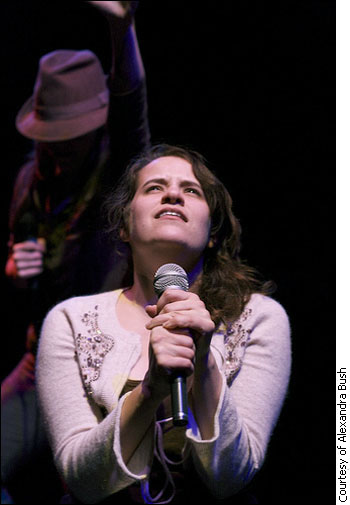

Sara Edwards embraces the moment in a heartfelt performance.

They perform as a duo, and will begin tonight with a choreographed repertoire of Bloodhound Gang’s “The Bad Touch”. As they get up for their turn, about ten people follow suit; everyone seems to know the hip-thrusting dance by heart. Their university days may be over, but karaoke keeps the bond strong.

The Soloist

For those seeking a romantic partner, the spotlight can be the perfect place to meet someone. Danni Plume has introduced karaoke to more than a dozen regular venues in Ottawa with her and her husband’s traveling karaoke show, Dog and Pony Sound. From the Royal Oak to the Lookout, Plume attributes busy karaoke nights to what she calls “the lonely hearts club” factor.

“Typically the people who come out here are looking for something. At gay bars, it’s very cute. The boys get up and basically market themselves to the room,” she says. “When they’re finished singing, there’s usually someone waiting to buy them a drink.”

Plume says she has combined her love of karaoke with a psychology degree to bring karaoke therapy to the capital. Karaoke can help people overcome fears of public speaking, especially in a relaxed bar environment with audience and host encouragement, she says.

“I was hooked after my first song. I enjoyed the exhilaration of stepping out of my shell. I enjoyed challenging myself. I enjoyed the camaraderie. Everyone supports each other.”

Karaoke’s popularity is a product of the people: both the performers and the audience, the fuel and the fire. Outside of lecture halls and cubical walls, karaoke offers a judgment-free atmosphere where anything goes. One man got so comfortable at the Shanghai one Saturday night, he took off all his clothes during his solo. We can only hope that that doesn’t mark the opening of a new Chippendales.  But racy nights like those are getting Ottawans to strip off their apprehensions and shine.
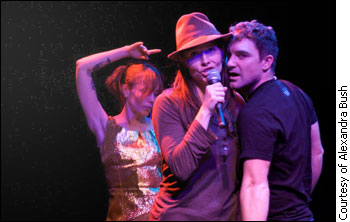

Amy O’Neal and friends at the Speak and Sing

Who wants 15 seconds of fame when you can have three and a half minutes? You may not know the words, you may have forgotten the tune, but if you can pretend, you can karaoke.


Related Links

Society of Composers, Authors and Music Publishers of Canada

Performing Right Society for Music

Urban gorillas and the parkour craze

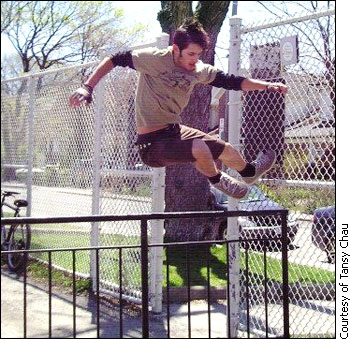
James Bond attempted it. The Office mocked it. And now, a niche group of mostly teenagers is keeping fit by doing what these fictional characters can’t: vaulting over walls, cat-crawling up railings and leaping from 10-foot drops. This physical movement is called parkour, and its traceurs, or practitioners, combine athletic discipline with animal instinct to negotiate a path around everyday city structures.


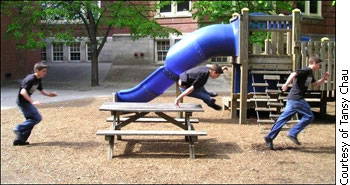
Vaulting a school picnic table in Toronto’s Beaches neighbourhood.

For them, the urban jungle becomes a playground littered with obstacles, and the goal is simple: to move forward as efficiently as possible. Running at a wall to leap it, a traceur jumps, bounds off the wall with one foot and, in keeping with the upward momentum, uses upper-body strength to make the final up-and-over push.

It’s harder than it looks. Casino Royale (2006) featured Daniel Craig’s Bond and his faltering parkour skills as he strove against an antagonist’s smooth manoeuvres; Bond finally resorted to blunt-force tactics such as powering through a still-wet plaster wall instead of swinging through a gap above it. And the well-received TV show The Office parodied the trend in last season’s premiere episode; Michael Scott, Andy, and Dwight amused audiences by somersaulting over couches, trampling across desks and falling into refrigerator boxes. YouTube, as well, has hundreds of thousands of streaming videos made by enthusiasts.

Parkour, then, is the latest craze in popular culture to hit the movies, televison and Internet. Its pioneers, widely credited to be David Belle and Sebastian Foucan, derived the name from parcours du combatant, a phrase that refers to the obstacle courses negotiated by the French military in war-torn Europe. Belle’s father was a soldier, and both founders were teenagers in the 1980s when they began experimenting in the outskirts of Paris.

Parkour has since exploded into the mainstream; MTV launched its “Ultimate Parkour Challenge” last fall where athletes battled for a $10, 000 cash prize. Ottawa has not been left off the map, and Patrick Bériault is here to help the pk scene grow.

Beginnings

Bériault initiated a parkour group that meets twice a week, on Wednesdays and Saturdays. As a health promoter for physical activity at the Somerset West Community Health Centre (SWCHC), he says he wanted to engage youth with a cutting-edge sport. To capture attention and attract participants, he bills the program as an extreme activity.

“My legs are aching the next day whenever I’m done, but it’s not extreme in the sense that we’re leaping across buildings and running among cars,” says Bériault.

The program, now in its second year, focuses on conditioning and teaching the essential body movements. With a background in kinesiology, Bériault leads sessions to strengthen muscles and quicken agility. Fast footwork and the ability to tumble can help prevent injury, he says, because the kids will be able to recover if a slip or a mishap occurs.


Patrick Bériault explains proper front-roll technique at a Gatineau training session.

“Parkour is as dangerous as you want it to be,” says Dan Iaboni, the whizz kid behind both the popular go-to website, pkTO.ca, and the unique indoor training centre known as the Monkey Vault in Toronto. “If you want to be perfectly safe, you can do parkour perfectly safe, because 99 per cent of the stuff is on the ground and the biggest problem you’re ever going to get is maybe a banged-up knee, bruises on your arm or a little cut or scratch.”

Sprained ankles are the most common injury in parkour (but even so are rare). Traceurs must understand their limits, Iaboni explains. Newcomers cannot simply go out, pretend they are Superman and copy a YouTube video.

Moving within the law

Perhaps due to the occasional reckless kid, parkour suffers ill repute among authorities. Security guards and law-enforcement officers are sometimes less than thrilled with the public activity.

‘We’re not doing anything wrong. It’s not illegal to jump down a set of stairs instead of walking them.’ – parkour organizer Dan Iaboni

“Especially in the financial district, security guards are always trying to kick us out left and right. People complain inside, and they don’t want us on the property,” says Iaboni. In that case, he explains, traceurs will leave and move to the next building.

Seventeen-year-old Juan Diego practised parkour in Ottawa for several months and sees disapproval as an overreaction. He says, in Canada especially, authorities should pause long enough to confirm the need for any interference.

“In Colombia, if they see you climbing something, they immediately think you stole something.  So they call the police,” says Diego.

The key is to ask permission before using the property, says Ottawa police spokesman Const. J.P. Vincelette. If traceurs fail to do so or choose to disregard the owner, they could be charged with trespassing. To date, Ottawa police do not have parkour flagged as a problem.

Says Iaboni, “We don’t have skateboards. We’re not marking stuff up. We don’t have spray paint in our hands. We’re not doing anything wrong. It’s not really illegal to jump down a set of stairs instead of walking them.”

Gaining momentum

The SWCHC group, comprised of 8 to 10 members during the summer peak season, often trains at Place du Portage in Gatineau and in downtown Ottawa — two hotspots for traceurs, because both locations provide creative possibilities. Intricate architecture, cement structures, benches and railings are all ideal to stimulate expression. These weekly meet-ups are as formal as parkour gets in Ottawa. The nation’s capital has yet to see the level of organization and enthusiasm that is visible in Toronto.

Toronto’s Monkey Vault, for instance, opened its doors in 2008 and continues to thrive as a community project. There are about 15 people who train every day and about 150 to 200 others who visit each month. It’s the only gym of its kind in Canada, designed with parkour specifically in mind.

Iaboni’s website, similarly, is a hub for enthusiasts to connect and to organize meets. More than 700 people visit the site at least three times a month, and Iaboni estimates 300 check it every day.

Iaboni says the city of Toronto sees about 60 different meet-ups in the summer. Popular places to train include the financial district, the University of Toronto, the city hall area and the downtown park Cloud Gardens.


No obstacle is too big for traceur Max Lee Fox Stussi at Toronto’s Malvern Collegiate Institute.

At a training session, it’s not uncommon to drill a jump until the timing, body position and landing are perfected. If a structure becomes familiar to the point that its ins and outs are known by heart, the movement becomes instinctive.

Iaboni likens this second nature to someone who starts dancing when music is turned on. “They do whatever they feel like inside, and that’s what we do, too. We’re outside, we see a bunch of stuff and your body takes over.”

The leap to the future

In light of Canada’s good showing at Vancouver’s Olympics, could parkour have a future in international sport? Iaboni insists parkour is not about competition, despite the excitement over MTV’s Ultimate Parkour Challenge in the U.S. The culture in Canada is more oriented to building camaraderie and helping one another. Training in big groups, especially, provides the chance to exchange knowledge, ask questions and fine-tune skills.

“I’d like to see as many as possible doing it. Everyone used to do this stuff as a kid and everyone sort of grows out of it. I don’t believe people should grow out of it. Everyone should be moving and running around,” says Iaboni.

Related Links

The Monkey Vault

pkTO website